Quick overview
A process audit is a structured evaluation of how work actually happens across workflows to identify bottlenecks, rework, and inefficiencies. It helps operations leaders understand where time is lost, why SLAs are missed, and how to improve performance and customer satisfaction using real data.
This guide explains how to audit operational workflows, what metrics to track, and how modern teams use digital work records to simplify audits, reduce manual effort, and maintain audit-ready processes.
Why does the same problem keep showing up even when everyone is busy?
Think of your operations like a busy highway during rush hour. Cars keep moving, but somewhere ahead, traffic keeps slowing everything down. You see missed SLAs, recurring delays, and uneven workloads, but where is the real blockage?
Without clear visibility, continuous improvement becomes difficult because the same inefficiencies keep repeating beneath the surface.
This is where a process audit becomes critical. It helps you step back and examine how work actually flows, so you can pinpoint where delays, bottlenecks, and inefficiencies are really coming from.
Table of Contents
- What do you mean by process audit?
- What does a process audit involve?
- What are the 7 steps in the audit process?
- What is a process audit checklist?
- How can process audits improve efficiency and benefit your organization?
- Why do process audits fail to uncover real inefficiencies?
- How do modern teams simplify process audits with real work data?
- How workforce analytics improves process audits
- Example: How a process audit reveals hidden bottlenecks
- How to prepare for a process audit with Time Doctor
- Final thoughts
- Frequently asked questions (FAQs)
What do you mean by process audit?
A process audit is defined as a structured review of how work actually happens across a workflow, often used as part of an internal audit to evaluate operational performance.
It focuses on how tasks are done, how time is spent, and where inefficiencies show up, not just what the process or work instructions say on paper.
In operations, a process audit looks at end-to-end workflows across teams, tools, and handoffs to uncover bottlenecks, rework, and idle time, often as part of a broader quality management system.
It helps you see whether your processes are truly meeting SLA targets, maintaining quality, controlling costs, and aligning with customer requirements.
As Harvard Business Review explains, “a process audit examines how work flows across organizational boundaries and where value is created or lost.”
This matters because most inefficiencies don’t come from bad procedures, they come from how work is actually executed.
A strong process audit gives you clear visibility into performance gaps, so you can move from assumptions to real, data-backed decisions and communicate findings clearly to key stakeholders.
What does a process audit involve?
A process audit involves reviewing how work flows across business processes, including tasks, teams, and systems, to identify inefficiencies, delays, and performance gaps.
It typically includes:
- Mapping the actual workflow
Document how work really happens using flowcharts, including task sequences, handoffs, and dependencies. Many teams use tools like Jira, Zendesk, or ERP systems such as SAP and Oracle to track workflows and support process audits. - Measuring time and performance
Track key metrics like cycle time, idle time, rework rate, throughput, and SLA adherence. - Comparing performance across teams or shifts
Spot variations in output, speed, and quality to uncover inconsistencies. - Identifying bottlenecks and inefficiencies
Find where work slows down, repeats, or gets stuck. - Recommending improvements and tracking results
Fix issues, standardize processes, and monitor performance over time.
To fully understand where inefficiencies come from, it also helps to look at how a process audit compares to a productivity audit.
| Focus | Process audit | Productivity audit |
| Main goal | Improve workflows | Improve time use |
| Focus area | Tasks, steps, handoffs | Time, activity, output |
| Key insight | Where work slows down | Where time is wasted |
| Outcome | Better processes | Better efficiency |
What are the 7 steps in the audit process?
The 7 steps in the audit process form a structured audit program that includes:
Step 1: Define the audit scope
Start your audit planning by selecting a specific operational workflow to review. For example, customer ticket resolution in a CX or contact center, claims processing in healthcare, or task delivery timelines in an agency or BPO. Set a clear goal such as reducing turnaround time or improving SLA compliance.
Step 2: Map the actual workflow
List each step in the process from start to finish and compare it with your process documentation.
- In a BPO or staff leasing setup, this could include ticket intake, assignment, resolution, and QA review. Identify who handles each step, what tools are used, and where handoffs occur.
Step 3: Identify key audit metrics
Choose the metrics that matter for your operations. In a contact center, this may include average handling time and SLA adherence.
- In technology companies or agencies, this could include cycle time, rework rate, and task completion speed.
Step 4: Collect process data
Gather real data on how work is performed.
- For example, track how long support tickets take in a CX team, how long tasks sit idle in a BPO, or how often revisions happen in an agency workflow.
Step 5: Analyze performance
Compare actual performance against targets and document key findings in an audit report.
- In healthcare operations, this could mean identifying delays in patient processing.
- In automotive operations, it could involve detecting inefficiencies in production or quality checks.
- In tech teams, it could involve spotting bottlenecks in development or support workflows.
Step 6: Identify bottlenecks and gaps
Pinpoint where work slows down or breaks.
- For example, approval delays in an agency, escalation backlogs in a contact center, or repeated errors in a KPO process.
Step 7: Implement improvements and monitor results
Apply targeted fixes and corrective actions such as redistributing workload, simplifying approvals, or standardizing workflows. Then monitor results across teams, whether in a BPO, healthcare system, or tech company, to ensure improvements are sustained.

What is a process audit checklist?
A process audit checklist is defined as a structured template of steps, metrics, and validation points used to evaluate how a workflow performs in real conditions.
It ensures audits are consistent, repeatable, and focused on identifying inefficiencies such as bottlenecks, rework, and idle time.
This checklist provides a clear way to review workflows across teams, shifts, or locations. It reduces subjectivity and ensures that every audit follows the same standards, making results easier to compare and act on.
What are the components of a process audit checklist?
A process audit checklist typically includes the following core components:
- Workflow steps
- Time benchmarks
- SLA targets
- Quality checks
- Compliance requirements
You can use this as a simple process audit template to guide your review:
| Area | Process audit checklist |
| Workflow and process flow | What are the exact steps in this workflow from start to finish?Where do handoffs occur between teams or systems?Are there steps that are skipped, repeated, or unclear? |
| Time and performance | How long does each step actually take compared to the expected time?Where does work typically slow down or wait?Are there tasks that consistently exceed SLA targets? |
| Bottlenecks and inefficiencies | Which steps create the most delays or backlogs?Where does rework happen most often?Are there approval stages or dependencies causing slowdowns? |
| Workload and resource allocation | Are some teams overloaded while others are underutilized?Is work evenly distributed across shifts or locations?Are resources aligned with process demand? |
| Quality and output | Are outputs meeting quality standards on the first attempt, or are there signs of nonconformity?How often does rework occur, and are there gaps in quality control causing it?Are errors linked to specific steps or teams? |
| Compliance and documentation | Are processes being followed as defined and aligned with regulatory requirements?Is there enough documentation to support audits, reviews, and compliance with ISO 9001 requirements?Are there gaps in reporting or data consistency? |
These questions help you uncover how work actually flows across your operations, not just how it is supposed to happen.
So what do you actually get from this?
How can process audits improve efficiency and benefit your organization?
Process audits improve operational efficiency by showing where time, effort, and resources are lost across workflows.
In structured environments, frameworks like Lean Six Sigma and ISO 9001 are often used alongside process audits to support continuous improvement.
They help teams uncover inefficiencies and optimize how work flows across operations.
This can help your organization:
- Uncover bottlenecks that slow down workflows and delay output
- Reduce rework by identifying errors, repeated tasks, and applying effective mitigations
- Highlight idle time and workload imbalance across teams or shifts
- Improve decision-making and strengthen risk management using real performance data instead of assumptions
- Boost SLA performance by addressing delays early
- Reduce operational costs by eliminating wasted effort
- Increase consistency and strengthen process control across teams, processes, and locations
- Strengthen external audits with structured, repeatable evaluations
However, even with a structured approach, many audits still fail to uncover the real source of inefficiencies.
Why do process audits fail to uncover real inefficiencies?
Process audits fail to uncover real inefficiencies when they rely on incomplete data, static reports, or assumptions about how work is performed. They show what happened, but not always why, making effective root cause analysis difficult.
1. Manual and incomplete data
Many audits depend on pulling data from multiple systems, spreadsheets, or reports. This often leads to gaps, inconsistencies, and outdated information, increasing potential risks. This makes it difficult to see how work actually flows across processes.
2. Focus on outcomes, not execution
Most audits highlight results such as missed SLAs or delays, but they don’t show where in the workflow the issue originated. Without visibility into tasks, handoffs, and activity, root causes remain unclear.
3. One-time audit approach
Audits are often treated as periodic exercises instead of continuous processes. This limits visibility into what happens between audit cycles, where inefficiencies usually build up.
4. Lack of real-time visibility
Without real-time data, bottlenecks, rework, and idle time stay hidden. Team members only see problems after they impact performance, not while they are happening.
5. Disconnected time and outcomes
Many audits fail to link how time is spent with actual results. This makes it harder to identify which activities add value and which ones create waste.
These gaps make it difficult for teams to move from reactive fixes to continuous improvement. Without a clear, real-time view of how work happens, inefficiencies remain hidden and repeat over time.
How do modern teams simplify process audits with real work data?
You can streamline process audits by using real work data that shows how work actually happens every day.
This gives you clear visibility into process performance, including how tasks move across teams, where delays occur, and how time is spent.
Instead of guessing, you can spot inefficiencies early, reduce rework, and make faster decisions that lead to better process improvements.
With this level of visibility, process audits become an ongoing, data-driven way to improve how work gets done across your organization’s processes.
From manual audits to continuous, audit-ready workflows
| Manual audit | Data-driven audit |
| Spreadsheet-based tracking | Real-time work records |
| Periodic reviews | Continuous visibility |
| Reactive fixes after issues occur | Proactive improvements as issues emerge |
| Hard to validate and inconsistent | Audit-ready, reliable data |
| Limited visibility into workflows | Clear view of process performance |
This shift from manual audits to continuous visibility changes how you manage process performance. Instead of relying on delayed reports, you gain a real-time view of how work flows across tasks, teams, and systems.
With workforce analytics, you can see where time is spent, how work moves through each step, and where inefficiencies begin to build. This makes it easier to identify bottlenecks early, reduce rework, and maintain audit-ready workflows without added effort.
How workforce analytics improves process audits
Workforce analytics improves process audits by giving you a clear, real-time view of how work is executed across tasks, workflows, and teams. It enhances layered process audits by providing clear visibility into how work is executed across tasks, workflows, and teams.
Instead of relying on assumptions or manual reports, it helps you understand process performance in real time, making it easier to identify inefficiencies and improve how tasks move across workflows.
It helps you:
- See how time is spent across tasks, teams, and workflows
- Identify bottlenecks early by tracking where delays occur
- Reduce rework by spotting repeated errors or inefficiencies
- Compare performance across remote, hybrid, and on-site teams
- Connect time, work, and results for better decision-making
- Maintain audit-ready data without manual preparation
A workforce analytics platform like Time Doctor supports this by creating a continuous, reliable data trail of work. This allows leaders to improve productivity analytics, strengthen compliance, and support data-driven coaching while maintaining transparency and trust across teams.
Example: How a process audit reveals hidden bottlenecks
Think of your workflow like a production line. Even if everyone stays busy, one slow step can hold everything back.
A support team handles around 1,000 tickets per week but starts missing SLA targets. At first glance, activity looks normal, so the issue is not obvious.
A closer look shows that one approval step adds an extra 4 hours to each ticket and affects about 30% of cases.
Simple impact:
- 1,000 tickets × 30% = 300 delayed tickets
- 300 tickets × 4 hours delay = 1,200 hours lost per week
That delay builds up quickly, even if the team is working at full capacity.
With workforce analytics, this type of bottleneck becomes visible through real work data such as time spent per task, workflow delays, and activity patterns across teams. Instead of relying on assumptions, leaders can see exactly where time is lost and take action earlier.
A platform like Time Doctor makes this possible by providing visibility across distributed teams. This will allow you to identify inefficiencies, rebalance workloads, and improve SLA performance without adding manual tracking or disrupting workflows.
After removing unnecessary approvals and redistributing the workload, turnaround time drops and SLA performance improves by 20%.
This example shows how better visibility into how work actually happens helps uncover hidden inefficiencies and turn process audits into a continuous, data-driven way to improve performance.
How to prepare for a process audit with Time Doctor
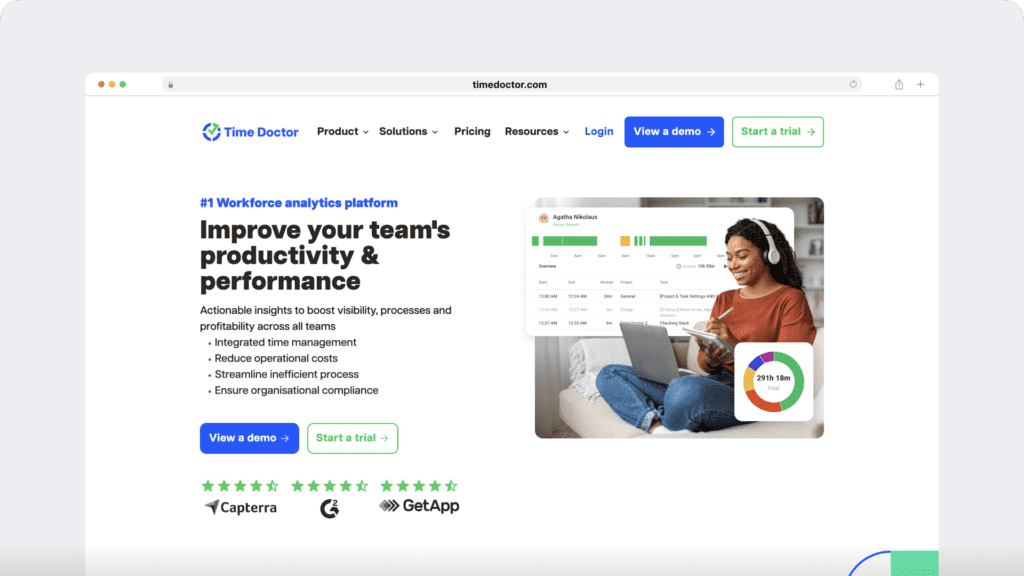
Time Doctor is a workforce analytics platform that helps you prepare for a process audit by turning everyday work activity into clear, actionable insights.
Instead of gathering data manually, you can rely on real-time visibility into how work flows, where delays build, and how time is spent across teams.
This allows you to identify inefficiencies early, improve process performance, and approach audits with accurate, audit-ready data while maintaining transparency and trust.
To prepare effectively, focus on these areas:
See process performance with workforce analytics
Start by reviewing how work flows across your processes. Workforce analytics shows where delays happen, which steps slow things down, and how performance varies across teams. This helps you identify bottlenecks before the audit begins.
Track time across workflows and tasks
Next, review how time is spent across each step. Time tracking helps you measure cycle time, validate SLA performance, and spot inefficiencies that may impact results.
Analyze productivity patterns across teams
Then, look at productivity patterns across teams or shifts. This helps you identify idle time, rework, or uneven workloads that affect consistency and performance.
Validate workflows with activity insights
Use activity data to confirm how work is actually done. This helps you verify workflows, identify gaps, and support audit findings with real evidence.
Compare performance and standardize best practices
Finally, compare performance across teams using Benchmarks AI. This helps you identify top performers, standardize best practices, and prepare a more consistent, data-backed audit.
To see how high-performing teams apply this in real scenarios, watch “What top teams get right: Benchmarking productivity with AI” from Time Doctor. It shows how benchmarking data helps leaders make smarter decisions and improve performance across teams.
Final thoughts
Whether you rely on spreadsheets or try to piece together productivity reports after the fact, the result is often the same, you see the problem, but not what’s causing it.
That’s where most process audits fall short.
When work stays invisible, operational inefficiencies keep repeating, delays build quietly, and teams stay busy without real progress. But when you can see how work actually happens, everything changes. Bottlenecks become clear, decisions become easier, and improvement becomes continuous.
That’s the shift, from guessing to knowing.
If you’re ready to simplify your process audits and gain real visibility into how work gets done, it may be time to take a closer look.
View a demo to simplify process audits and gain real-time visibility into how work gets done.
Frequently asked questions (FAQs)
A process audit focuses on how work is performed and is one of the key types of audits used to improve operational efficiency. This includes workflows, tasks, and execution steps. It evaluates how efficiently a process runs and where bottlenecks or inefficiencies occur.
A product audit, on the other hand, focuses on the final output. It checks whether the product or service meets quality standards and requirements.
In operations, process audits are more useful for improving efficiency because they reveal how work actually happens, not just the end result.
The 5 audit processes are:
• Planning
• Fieldwork
• Analysis
• Reporting
• Follow-up
These stages help structure how audits are conducted, from defining scope to implementing improvements and tracking results over time.
A process audit in healthcare evaluates how clinical or administrative workflows operate in real conditions. It helps identify delays in patient processing, inefficiencies in documentation, or gaps in compliance.
With workforce analytics, healthcare teams can maintain audit-ready records, improve workflow visibility, and support compliance without relying on manual reporting.
A manufacturing process audit evaluates how production workflows operate across machines, teams, and systems. It focuses on identifying inefficiencies, delays, and quality issues within the production process.
By using real-time data and workforce analytics, manufacturers can monitor process performance, reduce waste, and improve consistency across production lines.
You can prepare for a process audit by mapping workflows, defining key metrics, and gathering accurate data on how work is performed.
The most effective approach is to rely on real-time work data instead of manual reports. With a workforce analytics platform like Time Doctor, you can track time, monitor process performance, and maintain audit-ready records continuously, making audits faster, more accurate, and easier to manage.
Workforce analytics is the use of real-time data to understand how work is performed across tasks, teams, and workflows. It shows how time is spent, where inefficiencies occur, and how process performance changes over time.
Instead of relying on assumptions, workforce analytics gives you clear visibility into how work actually happens. This helps you identify bottlenecks, improve productivity, and make better decisions based on data.
Time Doctor is a workforce analytics tool to turn everyday work activity into actionable insights, helping you run more accurate process audits and maintain audit-ready operations.
Process audits are one of several types of audits, along with internal audits, product audits, and compliance audits. Process audits focus on how work is performed, while internal audits evaluate compliance and risk, and product audits assess output quality.
ISO 9001 is an international standard for a Quality Management System. It gives your organization a clear way to keep processes consistent, meet customer requirements, and improve performance over time.
It focuses on managing processes properly, reducing potential risks, and making continuous process improvements part of daily work.
To make this work in real life, you need visibility into how work is actually done. That’s where process audits help. They show whether teams follow defined processes and where improvements are needed.
With a workforce analytics platform like Time Doctor, you can use real work data to support audits, strengthen compliance, and keep your processes aligned with ISO 9001 without relying on manual tracking.


Carlo Borja is the Content Marketing Manager of Time Doctor, a workforce analytics software for distributed teams. He is a remote work advocate, a father and an avid coffee drinker.