Quick overview
An operational excellence strategy aligns process optimization, performance metrics, and leadership discipline to improve operational performance. However, driving continuous improvement requires structured, real-time visibility into daily execution.
Continuous improvement becomes sustainable when performance metrics connect directly to workflow behavior.
If you already track progress on cycle time, utilization, and SLA performance, what is still missing to sustain continuous improvement?
Lean initiatives, Six Sigma projects, and other improvement initiatives may have delivered measurable gains. Workflows may be standardized, and performance metrics clearly defined.
Yet operational excellence often fades over time.
Performance improves, then slowly drifts. Bottlenecks reappear. Workloads become uneven. Overtime rises even when output does not.
Monthly reports explain what happened, but they rarely reveal why execution shifted in the first place.
When performance data is not consistently linked to daily execution, improvement becomes reactive rather than sustainable.
Table of Contents
- What is an operational excellence strategy?
- How can an operational excellence strategy improve organizational performance?
- The 4 pillars of operational excellence strategy
- The foundational methodologies behind operational excellence
- 6 operational risks caused by limited workflow visibility
- A comparison between reactive and visibility-driven operational excellence
- How to implement an operational excellence strategy effectively
- Workforce analytics for operational excellence strategy
- Time Doctor for operational excellence and continuous improvement
- Final thoughts
- Frequently asked questions (FAQs)
What is an operational excellence strategy?
An operational excellence strategy, often referred to as Opex, is a structured approach that aligns business strategy with disciplined execution so performance remains consistent and measurable.
It relies on structured management systems to ensure that daily operations directly support organizational goals.
At its core, Opex builds a culture of continuous improvement. Instead of depending on isolated excellence initiatives, it embeds accountability, leadership alignment, and problem-solving into everyday work.
This strategy integrates proven methodologies such as Lean, Six Sigma, Kaizen, Business Process Management, and lean management principles to reduce waste, control process variation, and improve workflow efficiency.
Data-driven decision-making plays a central role. Clear performance metrics such as cycle time, SLA adherence, resource utilization, and margin per client support informed decisions and sustained improvement.
An effective operational excellence strategy includes:
- Leadership alignment that sets direction and accountability
- A culture that sustains continuous improvement
- Process optimization to eliminate inefficiencies
- Performance management driven by measurable metrics
- A focus on delivering value while meeting evolving customer expectations
When these elements work together, Opex strengthens efficiency, improves quality, and increases organizational agility.
Ultimately, it turns operational discipline into a system that drives consistent results, not just temporary gains from isolated projects.
How can an operational excellence strategy improve organizational performance?
A well-executed operational excellence strategy improves efficiency, reduces waste, and strengthens profitability. It connects daily execution to reliable service, better customer experience, and sustained customer-centric performance.
Here is how that impact appears in practice.
Predictable cycle time and lower cost per unit
Streamlined workflows reduce bottlenecks and eliminate non-value-added activities. Lean and Six Sigma principles minimize waste, stabilize cycle time, reduce operational cost per unit, and improve overall operational efficiency.
Greater efficiency directly strengthens margin control.
Reliable SLA performance and high-quality delivery
Standardized workflows and clear accountability improve service consistency. Fewer defects and less rework protect SLA adherence while maintaining output quality.
Improved quality reinforces customer focus, enhances customer satisfaction, and strengthens operational credibility.
Optimized resource utilization and higher productivity
Workload distribution aligns with real demand. Balanced resource utilization reduces idle time and prevents overextension. Productivity increases without increasing headcount.
Capacity planning is grounded in measurable patterns rather than assumptions.
Ownership-driven performance culture
Clear performance metrics and structured improvement cycles empower teams to identify inefficiencies and propose solutions. Continuous improvement becomes part of daily operations rather than a periodic initiative.
Accountability strengthens employee engagement and performance discipline.
Operational agility and resilience
Aligned processes and measurable workflows improve responsiveness to demand shifts, market changes, and supply chain disruptions. Faster adjustments strengthen service continuity and long-term sustainability.
Agility becomes a capability, not a reaction.
An operational excellence strategy creates a measurable system that turns performance into a lasting competitive advantage.
To sustain that advantage, organizations must apply the principles of operational excellence through clear, disciplined pillars that keep improvement consistent and scalable.
The 4 pillars of operational excellence strategy
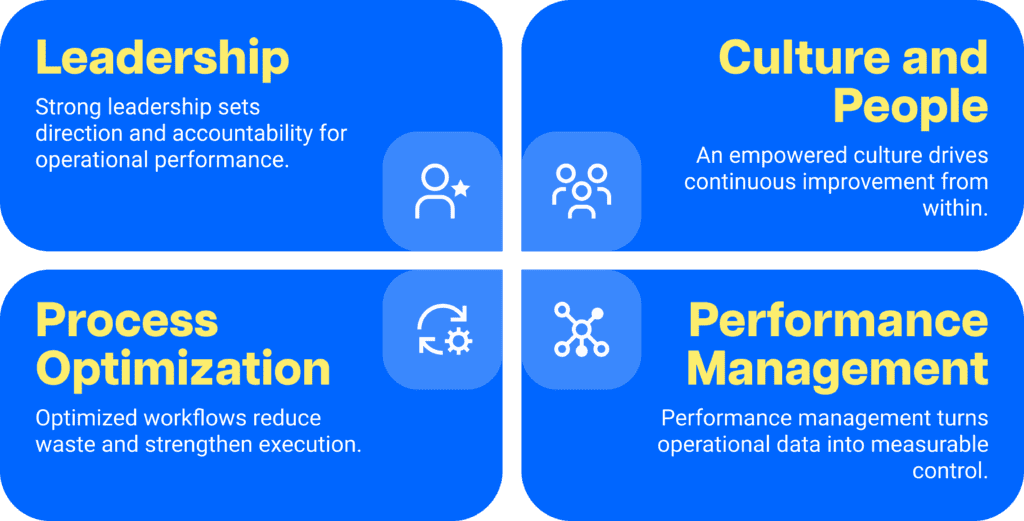
Pillar 1: Leadership
Strong leadership sets direction and accountability for operational performance.
- Defines measurable goals tied to cycle time and service levels
- Aligns teams around clear performance metrics
- Ensures decisions support long-term operational stability
- Reinforces ownership of results
Pillar 2: Culture and People
An empowered culture drives continuous improvement from within.
- Encourages frontline teams to identify inefficiencies
- Promotes accountability without blame
- Supports skill development and process ownership
- Aligns daily execution with customer value
Pillar 3: Process Optimization
Optimized workflows reduce waste and strengthen execution.
- Standardizes procedures to reduce process variation
- Maps workflows to remove bottlenecks
- Improves handoffs and queue management
- Strengthens workflow efficiency across teams
Pillar 4: Performance Management
Performance management turns operational data into measurable control.
- Tracks performance metrics such as cycle time and SLA adherence
- Monitors resource utilization and workload balance
- Uses technology and reporting to measure KPIs
- Supports data-driven continuous improvement
The foundational methodologies behind operational excellence
Operational excellence relies on proven improvement methodologies. These frameworks define how organizations reduce waste, improve workflow efficiency, minimize process variation, and strengthen performance metrics.
Each methodology contributes differently, but all support measurable operational performance.
Below are the most commonly used methodologies in operational excellence.
Core methodologies
| Methodology | Primary Focus | How It Improves Operations | Common Tools |
| Lean | Waste reduction and flow efficiency | Eliminates non-value-added activities and improves cycle time | Value stream mapping, 5S, Kanban |
| Six Sigma | Reducing process variation through data-driven analysis | Lowers defects, stabilizes quality, and strengthens SLA performance | DMAIC, statistical analysis |
| Lean Six Sigma | Efficiency and precision combined | Improves throughput while minimizing variation | Integrated Lean + DMAIC |
| Kaizen (Japanese continuous improvement) | Incremental, ongoing improvement | Encourages daily process optimization and employee involvement | Kaizen events, team-led improvements |
| Business Process Management (BPM) | Workflow modeling and governance | Standardizes and optimizes processes across teams | Process mapping, automation tools |
| Total Quality Management (TQM) | Organization-wide quality focus | Improves consistency and customer satisfaction | Quality audits, feedback systems |
| Theory of Constraints (TOC) | Bottleneck identification | Improves throughput by addressing system constraints | Constraint analysis |
| Agile and continuous improvement models | Iterative and flexible improvement | Increases adaptability and responsiveness | Sprint reviews, feedback loops |
Many of these methodologies originated in lean manufacturing and guide structured process improvements. An operational excellence strategy ensures they align with business goals and are applied consistently.
Workshops may help streamline processes, but without ongoing measurement and visibility into daily execution, improvements fade. Sustained performance requires disciplined insight into how work actually happens.
So what happens when improvement frameworks are in place, but real-time visibility into workflow behavior is missing?
6 operational risks caused by limited workflow visibility
When visibility into daily workflow behavior is limited, execution slowly moves away from defined standards. Without real-time insight into performance metrics and process variation, even well-designed operational excellence strategies lose momentum.
Here is where that breakdown begins.
1. Lagging KPIs hide root causes
Monthly or quarterly performance metrics reveal what happened. They rarely explain why it happened. By the time cycle time increases or SLA adherence drops, the operational shift has already occurred.
Without timely insight into workflow patterns, corrective action happens late.
2. Manual reporting slows response
Spreadsheets, static dashboards, and manual audits create reporting gaps. Data arrives after performance changes. Improvement cycles stretch longer than necessary.
When reporting lags behind execution, operational agility declines.
3. Inconsistent benchmarking across teams
Performance may vary across shifts, sites, or service lines. Without standardized, comparable data, benchmarking becomes subjective.
Variation persists because the execution differences remain unclear.
4. Overtime and burnout surface too late
Rising overtime, workload imbalance, and capacity strain often precede declines in performance metrics. However, without clear visibility into time distribution and resource utilization, those signals remain hidden.
By the time burnout becomes visible, productivity has already been affected.
5. Workflow friction remains invisible
Modern distributed operations rely on multiple systems, applications, and communication tools that shape daily user experiences. Without structured insight into tool usage and workflow handoffs, inefficiencies accumulate quietly.
Meetings expand, context switching increases, and digital overproduction absorbs productive time.
6. Process variation returns
Even after standardization efforts, execution drifts. Small deviations compound over time. Without measurable visibility into how work actually unfolds, process optimization loses momentum.
A comparison between reactive and visibility-driven operational excellence
Operational excellence can operate in two modes: reactive correction or visibility-driven control. The comparison below shows how structured visibility shifts performance from delayed response to proactive management.
| Area | Without Structured Visibility | With Structured Visibility |
| Bottleneck detection | Identified after KPIs decline | Identified in real time |
| Utilization tracking | Manual, inconsistent | Standardized and measurable |
| Continuous improvement | Episodic initiatives | Ongoing feedback loop |
| Meeting load visibility | Limited insight | Measurable time distribution |
| Tool usage patterns | Hidden inefficiencies | Clear app and workflow insight |
| Compliance monitoring | Periodic audits | Continuous monitoring |
| Capacity balance | Overtime-driven correction | Early workload alignment |
Structured visibility transforms operational excellence from reactive correction to proactive performance management.
How to implement an operational excellence strategy effectively
Operational excellence delivers results when execution becomes measurable and disciplined. A focused implementation approach includes five direct actions:
Step 1: Define measurable outcomes such as cycle time, SLA adherence, cost per unit, margin per client, and resource utilization. Clear targets anchor performance.
Step 2: Standardize workflows across teams and service lines to reduce process variation and support consistent benchmarking.
Step 3: Align performance metrics so throughput, quality, and utilization follow shared definitions that reinforce strategic alignment across the organization.
Step 4: Create structured end-to-end workflow visibility that connects daily execution to performance metrics, including time allocation, workload balance, and tool usage.
Step 5: Build a continuous cycle of measurement, improvement, and re-measurement to sustain gains and protect operational stability.
Modern operations require a dedicated execution layer that connects performance metrics to real workflow behavior. So, what provides that level of structured, real-time visibility?

Workforce analytics for operational excellence strategy
Workforce analytics serves as a critical enabler of execution within an operational excellence strategy. It converts defined performance metrics into measurable, day-to-day operational control.
By embedding structured, real-time visibility into workflow execution, performance management becomes continuous rather than periodic.
A modern workforce analytics platform strengthens operational excellence strategy in three critical ways.
1. It converts performance metrics into leadership insight
Performance metrics only create value when they guide decisions. Workforce analytics turns cycle time, SLA adherence, resource utilization, and margin per client into actionable operational insight.
Leaders gain real-time clarity into execution patterns and emerging risks, ensuring operational decisions stay aligned with customer needs. Performance becomes guided, not just reviewed.
2. It strengthens proactive operational control
Operational excellence depends on early detection. Workforce analytics surfaces workload imbalance, process variation, and capacity strain before service levels decline.
Capacity planning becomes data-driven. Continuous improvement shifts from reactive correction to structured adjustment.
3. It reinforces accountability through transparent visibility
Clear, role-based dashboards and standardized performance metrics create shared expectations across distributed teams. Execution becomes visible without invasive oversight.
Leaders guide with trusted data. Teams operate with clarity, alignment, and measurable discipline.
An operational excellence strategy deserves a workforce analytics platform designed for real-time visibility and accountable leadership. This is where Time Doctor comes in.
Time Doctor for operational excellence and continuous improvement
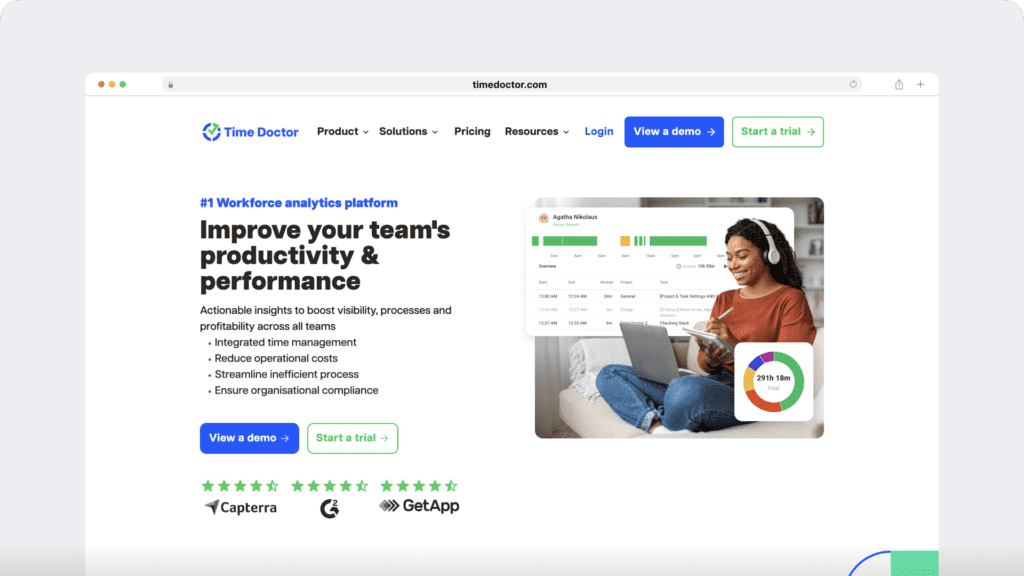
Operational excellence delivers lasting results when continuous improvement is visible and measurable.
Time Doctor is a workforce analytics platform that provides real-time, AI-powered insight into how work happens across remote, hybrid, and in-office teams. It turns daily activity into actionable data, helping leaders strengthen planning, accountability, and execution without micromanagement.
Here are the core features that power continuous improvement within your operational excellence strategy:
- Workforce Analytics that connects performance metrics to daily workflow behavior, strengthening execution discipline
- Benchmarks AI to compare performance patterns across teams and standardize operational best practices
- Employee Time Tracking, or monitoring that reveals how effort is allocated across projects, supporting utilization and margin control
- Productivity Analytics that surface inefficiencies, bottlenecks, and workflow variation before KPIs decline
- Meeting Insights to reduce collaboration overload and protect cycle time efficiency
- Software Cost Insights that identify underused tools and eliminate operational waste
- Time Management visibility to balance workload and improve capacity planning
- Screen Monitoring with privacy controls to support compliance and audit readiness in regulated environments
- Unusual Activity Reports that flag operational risk early, protecting quality and SLA performance
- Attendance and Payroll alignment to standardize reporting and reduce administrative friction
- Integrations that connect systems and prevent data silos from slowing continuous improvement
- Built for a Distributed Workforce, enabling consistent execution across remote, hybrid, and in-office teams
Operational excellence requires transparency grounded in clear policies and strong privacy safeguards that protect employees and other stakeholders. Visibility must strengthen accountability without eroding trust. Time Doctor supports structured insight with role-based controls and configurable settings, ensuring teams understand how data is used and why it matters.
The result is visibility without micromanagement, empowering leaders to guide performance through steady incremental improvements that support sustainable growth.
Final thoughts
An operational excellence strategy is not defined by how well it is designed, but by how consistently it is sustained.
Frameworks can be in place. Methodologies can be understood. Performance metrics can be tracked. Yet continuous improvement only becomes real when execution stays visible every day.
Operational excellence becomes sustainable when leadership, workflow visibility, and measurable discipline work together to protect long-term business success. Without that connection, even strong strategies lose momentum over time.
So whether an operational excellence strategy is already embedded in your organization or still evolving, the real question remains:
How will it be sustained and continuously improved in daily execution?
Continuous improvement is not maintained by intention alone. It is maintained by visibility.
As McKinsey puts it, “Operational excellence is not something leaders can whip up in time for the next quarterly report.” Sustained performance requires discipline, visibility, and long-term commitment.
View a demo of Time Doctor to see how real-time workforce analytics can power your operational excellence strategy and turn continuous improvement into daily execution.
Frequently asked questions (FAQs)
High-performing organizations consistently practice five habits:
• Clear performance standards
• Data-driven decision-making
• Early issue detection
• Cross-team accountability
• Continuous improvement
These habits require real-time visibility into how work actually happens.
Time Doctor supports this by delivering AI-enhanced workforce analytics that make productivity data transparent and accessible. Leaders gain the clarity to coach, rebalance workloads, and improve execution without relying on control-based management.
They focus on all three.
Reducing waste improves margins. Improving quality builds trust. Delivering consistent service strengthens customer satisfaction.
Operational excellence aligns these outcomes by improving how work flows through the organization. Time Doctor enables this alignment by providing real-time insight into workload, productivity, and process friction so leaders can make smarter decisions backed by data, not assumptions.
It improves performance by eliminating inefficiencies, standardizing execution, and enabling faster decision-making.
When leaders can see workflow bottlenecks, workload imbalance, and productivity trends early, they correct issues before KPIs decline.
Time Doctor provides actionable visibility into how work gets done across remote, hybrid, and in-office teams. This supports stronger planning, better accountability, and more effective management at scale.
An effective strategy starts with clear objectives, measurable KPIs, alignment with leadership, and consistent visibility into performance.
Many strategies fail because measurement systems lag behind execution.
Time Doctor helps close that gap by transforming daily activity into AI-powered insights. Leaders gain transparent, organization-wide visibility that supports trust-based leadership, proactive problem solving, and continuous improvement without adding operational complexity.
Workforce analytics uses real-time work data to show how time, effort, and workflows drive performance.
Instead of relying on delayed reports, it provides ongoing visibility into workload balance, bottlenecks, and productivity patterns. This allows leaders to correct issues early and sustain continuous improvement.
Time Doctor is a workforce analytics platform that delivers AI-enhanced, actionable insights into how work gets done. By making productivity data transparent and accessible, it empowers leaders to drive operational excellence with trust, clarity, and smarter decision-making.