Quick overview
A productivity audit shows you how work actually happens inside your team members by revealing how they spend time, how workflows move, and how tools support or slow down daily work, so you can make better decisions before small issues turn into bigger problems.
In this article, you’ll learn how productivity audits help leaders:
- Understand where time and effort really go
- Spot bottlenecks and workload imbalance early
- Boost productivity and improve accountability without micromanaging
- Support coaching and trust with workforce analytics
- Run productivity audits continuously, not as one-time reviews
How confident are you that you have a complete picture of what your team works on each day?
On the surface, work often looks under control. Tasks move forward. Meetings fill the calendar. Tools stay open throughout the day.
But leading like this often feels like driving while looking only in the rear-view mirror. You see activity, not direction.
Deadlines slip. Pressure builds. Burnout shows up only after something breaks.
As a leader, you’re expected to support your team, keep efficiency high, and act early when issues emerge. But without a consistent way to review how time and effort are actually used, small problems stay hidden.
When visibility depends on assumptions instead of evidence, it becomes harder to see the big picture. Teams stay busy, but confidence in your decisions weakens over time.
That’s when you start asking whether you’re seeing enough to lead well.
What is a productivity audit?
A productivity audit helps you understand how work actually happens inside your team.
You use it to see how time is spent, how workflows move, and how tools and apps support or slow down daily work.
Instead of relying on updates or one-off reviews, you look at real work patterns to understand where effort goes and whether work done within specific time blocks leads to meaningful outcomes.
This matters because productivity issues rarely show up as clear failures. They build quietly through small delays, uneven workloads, and constant busyness without real progress.
A productivity audit brings those patterns into view, so you can spot bottlenecks early, balance work more fairly, and make informed decisions based on evidence rather than instinct.
What are the benefits of a productivity audit?
When leaders review time spent, workflows, and tool usage together, activity becomes clear metrics they can trust to improve team productivity.
In practice, productivity audits deliver several outcomes that matter across roles:
1. Clearer use of time and resources
Workforce analytics and time-tracking apps reveal how the amount of time is used across the workday, supporting smarter resource allocation for high-priority work.
2. Fewer bottlenecks inside everyday workflows
Reviewing how task management moves between tools and project management workflows highlights delays, friction, and repeated handoffs. Addressing these gaps supports optimizing workflow without adding pressure.
3. Stronger accountability without micromanagement
When productivity audits focus on patterns rather than individuals, accountability feels fair and consistent. Teams understand expectations more clearly, and leaders spend less time chasing updates.
4. Higher morale through evidence-based recognition
Clear productivity analytics make strong performance easier to see and acknowledge. Recognition feels earned and objective, which reinforces trust and engagement across teams.
5. Earlier signals for coaching and development
Visibility into where focus breaks down or deep work stalls helps identify training needs sooner. Support turns into early action plans before frustration, burnout, or disengagement set in.
What happens when productivity audits are missing?
When you don’t have a consistent way to review how work actually happens, problems don’t disappear. They surface later, louder, and harder to fix.
Without a productivity audit, you typically see four issues emerge.
1. Burnout builds quietly
You miss early signals of overload because work hours spread unevenly across your team. High performers take on more, recovery time shrinks, and burnout shows up only when someone disengages or leaves.
2. Bottlenecks stay hidden
Work doesn’t usually fail all at once. It slows down in small ways. Tasks sit in queues and delays add up because leaders lack visibility into where time gets pulled into meetings, messaging, social media, and other time-wasters.
3. Decisions turn reactive
You step in after deadlines slip or pressure spikes. Without a consistent time audit, decisions rely on instinct and urgency instead of evidence and timing.
4. Trust starts to erode
When clarity is missing, accountability feels subjective. Teams feel scrutinised instead of supported, and leaders feel forced to check in more often just to stay informed.
These issues don’t come from a lack of effort. They come from a lack of visibility into how work really flows day to day.
Global engagement sits at 21%, while 77% of workers report stress, clear signals that risk builds long before burnout shows up.
When leaders act earlier, the payoff is real, with wellbeing investments delivering a fourfold return on mental health spend.
How to use workforce analytics data to conduct a productivity audit
Workforce analytics data automates key parts of a productivity audit, turning it into a leadership tool rather than a monitoring exercise.
The goal stays simple, understand how work actually happens so leaders can prioritize decisions before problems escalate.
When you use workforce analytics responsibly, productivity audits follow a few clear principles:
- Focus on patterns, not individuals
Reviewing time spent from a time tracking tool, alongside workflows and tool usage, highlights friction and imbalance without singling people out. Audits stay objective and evidence-based. - Use insights for coaching, not control
Productivity analytics help leaders understand how personal productivity supports team outcomes and priority tasks. Feedback reflects real work patterns instead of assumptions or one-off updates. - Build trust through transparency
Visibility exists to improve workflows and protect wellbeing, not to monitor behavior. Teams understand why data matters and how it supports sustainable performance. - Rely on continuous insight instead of one-off reviews
Workforce analytics surface recurring patterns early, with timely notifications that highlight bottlenecks and workload imbalance before burnout takes hold. - Connect effort and outcomes across modern work setups
Analytics provide a consistent view of execution across remote, hybrid, and in-office teams. Trends and benchmarks reveal how productivity changes over time, enabling proactive decisions instead of reactive fixes.
This kind of visibility supports better leadership decisions. Instead of reacting to pressure, you will act on patterns that repeat over time.
Time Doctor provides this foundation by turning everyday work data into actionable workforce analytics.
A step-by-step template for running a productivity audit
| Step | What leaders review | A productivity audit case study in practice |
| Set the audit focus | Clarify where visibility is missing | For example, a hybrid organisation notices delivery timelines slipping even though teams look busy and headcount has not changed. Then, you decide to run a productivity audit to understand where work slows down day to day. |
| Review time spent | Analyse how time is distributed across tasks and roles | Then, time data shows senior contributors spend a large share of their week in meetings and coordination work, leaving limited time for focused execution |
| Examine workflows | Track how work moves between people and stages | Next, workflow patterns reveal tasks often stall during handoffs and approvals, adding quiet delays that compound across projects |
| Compare patterns over time | Look at trends rather than single days | Over several weeks, overtime steadily increases even though the project scope stays the same, signalling mounting pressure rather than growth |
| Review tool usage | See how tools support or slow down work | At the same time, teams jump between multiple tools to complete a single task, increasing context switching and rework |
| Watch early risk signals | Identify unusual or changing work patterns | Soon after, attendance and activity trends show longer workdays paired with rising idle time, pointing to overload before burnout becomes visible |
| Act and monitor impact | Adjust workflows and track results | Finally, you will rebalance workloads, reduce recurring meetings, simplify approvals, and continue monitoring patterns to confirm that focus time improves and delays decline |
How can Time Doctor help leaders run productivity audits at scale?
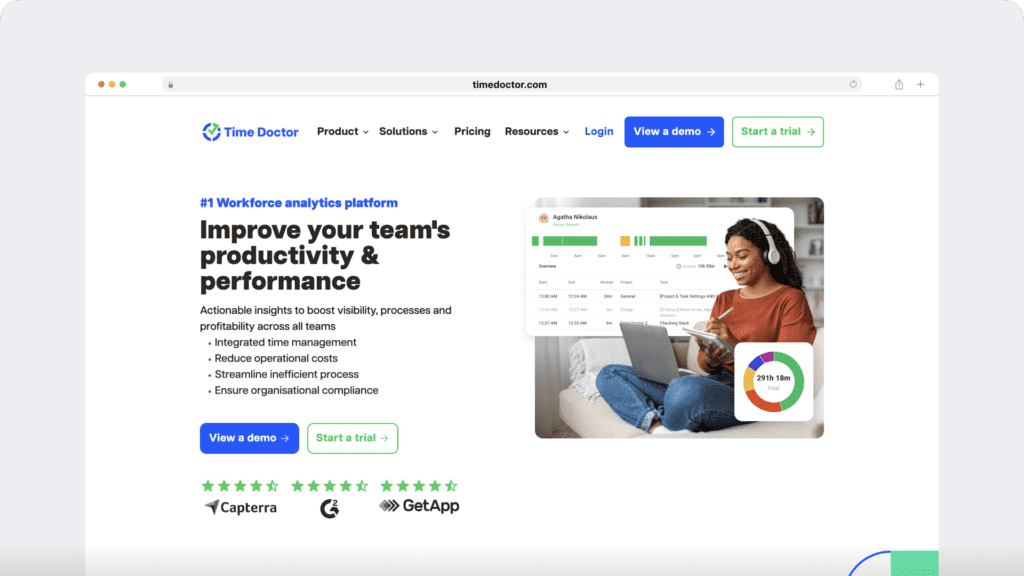
Time Doctor is a workforce analytics platform designed to support ongoing productivity audits at scale. It brings time spent, workflows, and tools together in one view, so leaders can understand patterns, address issues early, and support teams consistently across modern work setups.
Empowered leadership
- A shared view of how time is spent across roles, projects, and teams helps leaders align productivity audits with outcome-based KPIs rather than surface-level activity.
- Productivity analytics surface workload patterns early, helping HR leaders identify burnout risk, uneven effort, and disengagement before retention issues escalate.
- Meeting insight and workflow signals provide evidence for coaching conversations, clearer expectations, and fair recognition of performance.
- High-level execution trends remain visible to founders and executives without pulling them into daily noise, supporting strategic planning, accountability, and confident decision-making.
Actionable visibility
- Workforce analytics show how work flows through everyday tasks, making it easier to streamline processes across modern work environments.
- Screen monitoring and activity context add clarity when investigating inefficiencies, while keeping productivity audits focused on work patterns rather than surveillance.
- Attendance trends and unusual activity signals highlight early signs of overload, disengagement, or workflow breakdowns, enabling proactive intervention.
- Software cost insight reveals which tools support productive work and which quietly drain time and budget, helping IT leaders manage shadow IT effectively.
Seamless partnership
- Productivity audits operate continuously when insights integrate naturally with existing tools and workflows through flexible integrations.
- Low-lift setup and clear productivity analytics support adoption across healthcare, technology companies, and agencies without disrupting daily operations.
- Payroll and attendance data align with time management insights, reducing manual reconciliation and improving operational accuracy.
- Transparent pricing and scalable features allow productivity audits to grow with distributed teams instead of remaining one-off initiatives.
Final thoughts
Productivity audits matter because they help you see problems early, before pressure builds and decisions slow business growth and profitability. No matter the team or industry, you need that clarity to lead well.
But be honest for a moment. How often does visibility arrive only after deadlines slip, workloads feel uneven, or burnout starts to surface?
Trying to piece together time spent, workflows, and tools through spreadsheets or excel and status updates makes that clarity hard to sustain.
You invest more effort, yet confidence in what you’re seeing stays limited.
Workforce analytics change that experience. They give you a clear, consistent view of how work actually flows, so productivity audits stay continuous and leadership feels more deliberate instead of rushed.
If you’re ready to see what that clarity looks like inside your own organisation, view a demo of Time Doctor.
Frequently asked questions (FAQs)
A time audit shows how work actually fills the workday, not how it’s planned. In a productivity audit, this comes from Time Doctor’s automatic time tracking, which records time spent across tasks, apps, and websites as work happens.
You can see where high-priority work gets interrupted, how focus shifts across time blocks, and where effort quietly leaks away, without relying on estimates or self-reported updates.
A productivity audit improves team efficiency by showing where work slows down, overlaps, or gets stuck.
With Time Doctor, workforce analytics bring time spent, app usage, and workflow signals into one view. That clarity helps you streamline processes and rebalance workloads without asking people to work longer hours.
Most teams discover that only part of the workday goes toward focused, meaningful work. Meetings, context switching, and reactive tasks often take more time than expected.
Time Doctor helps you understand how the workday actually breaks down by showing when focused work happens, when interruptions spike, and how time spreads across tools.
A productivity audit helps you see when deep work happens and what disrupts it. By reviewing time blocks, task patterns, and interruptions, you can identify which parts of the day support focus and which ones break it.
Time Doctor makes this visible through:
• Automatic time tracking, which shows how long focused work lasts before interruptions occur
• App and website usage reports, which reveal when tools, messaging apps, or meetings pull attention away from deep work
• Idle time and activity context, which highlight breaks in focus without guessing why work paused
• Meeting Insights, which show how meetings fragment the workday and reduce uninterrupted focus time
Together, these features help you adjust schedules, meeting load, and expectations so teams can protect deep work instead of constantly switching tasks.
Time-tracking apps provide the foundation for a productivity audit. Time Doctor goes beyond basic time tracking by combining time data with workforce analytics. It shows how time connects to tasks, tools, meetings, and workload patterns, helping leaders act on evidence while keeping audits focused on patterns, not people.
A productivity audit improves efficiency when you review patterns in time use, workflows, and tools to improve systems, not to monitor behavior.
Time Doctor supports this approach by keeping visibility centered on outcomes and recurring patterns. Leaders gain the insight they need to coach, plan, and prioritize without hovering or eroding trust.


Carlo Borja is the Content Marketing Manager of Time Doctor, a workforce analytics software for distributed teams. He is a remote work advocate, a father and an avid coffee drinker.