Quick overview
Time study for employees matters because every decision about efficiency, capacity, and performance depends on how well you understand where time actually goes. When you can clearly see how work flows across specific tasks, tools, and processes, you stop relying on assumptions and start improving with confidence.
Modern time studies are no longer about isolated measurements. They’re about understanding real work patterns so you can plan better, reduce friction, and support teams without adding pressure.
In this article, you’ll learn what a time study for employees is, why it still matters in modern teams, how to apply it step by step, and how workforce analytics help turn time studies into an ongoing capability for improving worker performance and operational outcomes.
If you don’t know exactly where time goes across your workflows, how confident are you that your capacity and delivery decisions are actually working?
You’re expected to improve efficiency, identify bottlenecks, and optimize workflows, yet visibility into how time is actually spent is often limited. Work keeps moving, hours add up, and teams stay busy, but inefficiencies quietly form inside processes, handoffs, and tools.
By the time they become visible, delivery timelines, costs, or planning decisions have already been affected.
This challenge isn’t new. Over a century ago, Frederick Winslow Taylor introduced scientific management and industrial engineering principles, including early time and motion study methods, to understand how work was performed and how time was used on the production floor.
The intent was simple: replace guesswork with evidence. What’s changed is the nature of work itself.
Today, work no longer happens on a single floor or in a linear process. It spans systems, software, and teams. Relying on assumptions or spreadsheets makes it harder to see how effort truly flows.
This isn’t about micromanagement. You’re looking for objective visibility that helps you understand how work moves, plan capacity with confidence, and focus improvement efforts where they matter most.
Table of Contents
- What is a time study for employees?
- Why conduct a time study analysis?
- Key requirements for a successful time study analysis
- How to apply time study analysis in modern teams
- How to calculate standard time?
- A modern example of time study analysis in practice
- How does Time Doctor support modern time studies?
- Final thoughts
- Frequently asked questions (FAQs)
What is a time study for employees?
A time study for employees is a method used to understand how time is spent on tasks, workflows, and processes through structured time measurement. It focuses on analyzing how work moves from start to finish, how long activities take, and how cycle times form as time accumulates or slows down within the flow of work.
This approach uses work measurement to focus on how work is structured and executed. You examine patterns, tasks, and processes through workflow analysis and employee time insights to understand how effort is distributed and how work operates in practice.
Therefore, this helps you understand how time is used without relying on manual estimates.
Why conduct a time study analysis?
You conduct time-study analysis to support confident operational planning and improvement initiatives. This insight helps you:
- Identify bottlenecks and inefficiencies by spotting where time consistently builds up, particularly during handoffs, repeated steps, or rework that quietly slows delivery.
- Improve capacity planning and resource allocation by understanding process time and how long work really takes, making it easier to balance workloads and avoid overloading teams.
- Align effort with business priorities by gaining clarity on how actual time is used, so high-impact work gets protected and low-value activities no longer absorb attention.
- Reduce reactive firefighting by surfacing issues earlier, allowing you to address constraints before they turn into missed deadlines, rushed reallocations, or cost overruns.
This kind of employee time insight helps you improve processes, optimize workflows, and make decisions based on real work patterns in your organization.

Key requirements for a successful time study analysis
When the foundation of time study analysis is right, the insights are easier to trust and more useful for improving how work gets done. Here are the key requirements:
1. Setting clear objectives
Start by defining what you want to improve before you measure time. Whether the goal is identifying bottlenecks, improving capacity planning, or optimizing workflows, clarity helps you focus your data collection on the right activities and ensure it leads to meaningful action.
2. Shared visibility and trust
Time study analysis works best when it’s built on transparency. When team members understand that the goal is to improve processes, not monitor individuals, the data reflects real work patterns. Clear communication and shared visibility build trust, leading to more accurate employee time insights.
3. Choosing the right data sources
Relying on stopwatches, Excel, time study templates, or one-off observations limits what you can see in a time study analysis. Manual methods can also influence behavior, introducing bias such as the Hawthorne effect.
With automation, you capture real work flow between tasks and processes without disruption. Modern time studies use this approach to produce consistent, reliable insights at scale.
4. Selecting a representative time frame
The timing of your analysis matters. Tracking trends over time with a sufficient sample size gives you a more accurate picture than relying on isolated snapshots.
Choosing periods that reflect normal working conditions helps you avoid skewed data caused by peak demand, unusual events, or temporary disruptions.
When these elements come together, time study analysis becomes a dependable way to understand how work flows, surface meaningful patterns, and support better operational decisions.
How to apply time study analysis in modern teams
Applying time study analysis in modern teams starts by viewing work as a system rather than a set of isolated tasks.
Step 1: Understand how time moves through tasks, tools, and processes
Start by examining how work moves from start to finish in everyday activities. With data analysis and employee time insights, you see how time flows through tasks, tools, and processes in real work.
Step 2: Compare effort across teams and processes
Next, compare how similar work is performed by different team members or processes. When the same work takes different amounts of time, AI-powered benchmarks help you see those differences clearly, revealing gaps in workflow efficiency, highlighting process constraints, and showing where improvements will have the greatest impact.
Step 3: Look for delays, rework, and handoff friction
As patterns become clearer, you can see where work naturally slows and where improvements will have the greatest impact. Delays often appear during handoffs, approvals, rework, or transitions between workstations, rather than within a single task. By recognizing where time consistently accumulates, you can identify bottlenecks, improve process efficiency, and focus your efforts on the areas that matter most.
Step 4: Use patterns over time to guide decisions
Finally, you focus on trends over time to see how work flows and where improvements stick. This clarity supports better capacity planning, stronger operational efficiency, and more confident workflow decisions.

How to calculate standard time?
Standard time gives you a consistent reference for how long a task or process typically takes under normal working conditions, whether you record it in a spreadsheet or a standard time template. You use it to support capacity planning, workflow analysis, and operational efficiency, helping you plan work more accurately and improve processes with confidence.
To calculate standard time, you move through four practical steps.
1. Calculate the average time
You start by calculating the average time, which represents how long a task usually takes based on multiple observations.
Formula
Average Time = Sum of Observed Times ÷ Number of Observations
When you use multiple observations, you account for normal variation and establish a reliable baseline based on the pace of an average worker. This gives you a clearer view of how work typically flows through tasks and processes, supporting more accurate workflow analysis and better operational decisions.
Example: Calculating average time in a real workflow
Imagine you’re reviewing how long it takes to complete a recurring operational task, such as processing a customer request or completing a routine internal review.
You observe the task over four completed cycles:
- Observation 1: 22 minutes
- Observation 2: 26 minutes
- Observation 3: 24 minutes
- Observation 4: 28 minutes
To calculate the average time, you add the observed times and divide by the number of observations.
Average Time = (22 + 26 + 24 + 28) ÷ 4
Average Time = 25 minutes
This average gives you a reliable baseline for employee time analysis, reflecting how the task typically fits into the flow of work. From here, you can compare similar processes, support workflow analysis, and make more informed decisions about capacity and process improvement.
2. Calculate normal time
Next, you calculate normal time by adjusting the average time to reflect a typical working pace using a performance rating. This step accounts for performance differences that naturally occur between people or situations.
Formula
Normal Time = Average Time × (Rating Factor ÷ 100)
The rating factor represents how the observed pace compares to a standard pace. Normal time gives you a consistent reference point for comparing similar tasks and processes among teams.
Example: Calculating normal time using a rating factor
Using the previous example, assume the average time for a recurring operational task is 25 minutes.
While reviewing the work pattern, you determine that the task was completed at a pace slightly above the typical standard. To reflect this, you apply a rating factor of 120.
Normal time is calculated using the following formula.
Normal Time = 25 × (120 ÷ 100)
Normal Time = 30 minutes
This normal time represents how long the task would take at a steady, expected working pace for a qualified worker. It provides a more consistent reference for employee time and workflow analysis, making it easier to compare similar tasks or processes between teams and identify improvement opportunities.
3. Account for allowances
Work does not happen without interruption. To reflect real working conditions, you include allowances for things like breaks, personal needs, transitions between tasks, and unavoidable delays.
Allowances are usually expressed as a percentage and help ensure your calculations reflect how work actually flows day to day, not ideal conditions.
Example: Applying allowances to reflect real working conditions
At this point, you’ve defined a 30-minute normal time for the recurring operational task using the data gathered earlier.
Next, you account for allowances that reflect how work naturally flows during the day. These allowances might include short breaks, task transitions, brief context switching, or routine interruptions that are part of normal operations.
After reviewing the work pattern, you apply a total allowance of 20%.
This allowance reflects realistic working conditions and ensures the time study reflects how work actually happens within processes, rather than an idealized scenario.
4. Calculate standard time
Once you have normal time and allowances, you calculate standard time, which represents the expected time required to complete a task under typical conditions.
Formula
Standard Time = Normal Time ÷ (1 − Allowances)
Standard time becomes a practical benchmark you can use for:
- Comparing similar processes
- Supporting workflow analysis
- Improving capacity planning
- Identifying opportunities to improve process efficiency
Rather than relying on one-off calculations, modern teams apply this concept to understand time patterns within work systems and make more informed operational decisions.
Example: Calculating standard time for a recurring operational task
Continuing from the previous steps, you’ve calculated a normal time of 30 minutes for a task and applied an allowance of 20% to reflect real working conditions.
You now calculate standard time using the formula:
Standard Time = 30 ÷ (1 − 0.20)
Standard Time = 30 ÷ 0.80
Standard Time = 37.5 minutes
This standard time represents the expected time the task typically takes under normal conditions, accounting for routine breaks, transitions, and interruptions that occur during the workday.
You can now use this standard time as a consistent reference for employee time analysis and workflow analysis. It helps you compare similar processes, support more accurate capacity planning, and identify where process improvements will have the greatest impact.
Instead of treating standard time as a fixed target, you use it to identify work patterns and make more confident, data-informed operational decisions.
A modern example of time study analysis in practice
Once you apply time study analysis, the impact shows up in how you make decisions and where you focus improvement efforts. Instead of debating assumptions, you work from clear, shared visibility into how time and effort shape outcomes.
With this clarity, you can:
- See which steps have the greatest impact on turnaround time, helping you focus on improvements where they matter most.
- Plan capacity with more confidence by understanding how work actually flows within tasks and processes.
- Standardize effective practices across teams by comparing similar processes and replicating what works well.
- Improve operational efficiency without increasing pressure, since changes target workflows and handoffs rather than individual effort.
- Support continuous process improvement, a core idea behind lean manufacturing, by using consistent time patterns to guide decisions over time.
This is where time study analysis moves beyond calculation and becomes a practical tool for improving how work gets done, giving you clear visibility into work patterns and the confidence to scale operations more effectively.
How does Time Doctor support modern time studies?
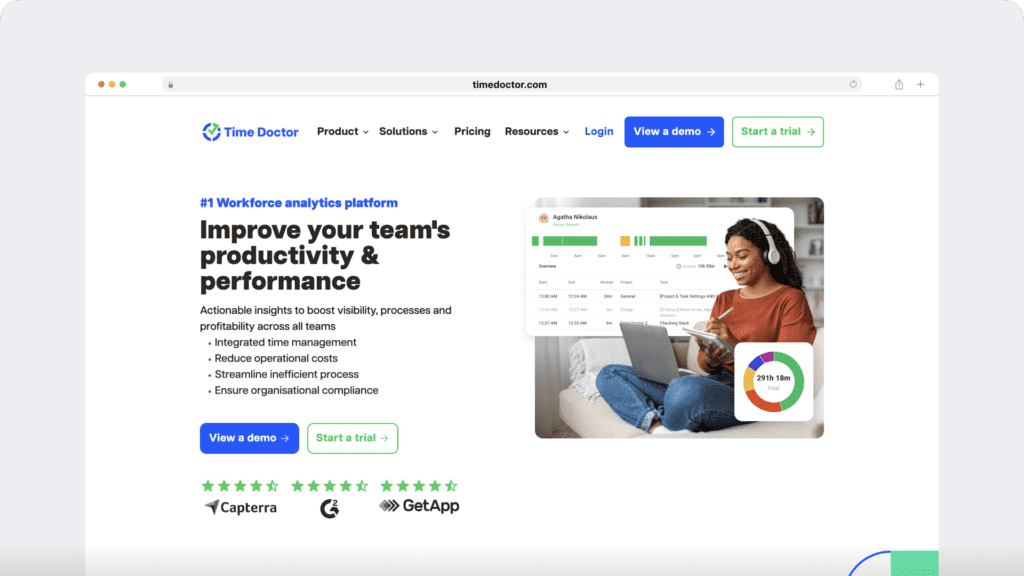
Modern time studies work best when visibility is continuous, shared, and built on trust.
Time Doctor turns modern time studies into a continuous capability by giving managers real-time, AI-enhanced insights into how work actually gets done. With clear, accessible data across people, tools, and workflows, leaders can make faster, smarter decisions, support their teams, and improve operations with trust, not control.
With this approach, you can:
- Understand how time is spent across roles and locations through employee time tracking, productivity analytics, and time management insights that reflect real work patterns.
- Compare performance across teams and workflows using Benchmarks AI, helping you see how similar processes perform in technology companies, agencies, or healthcare environments and where improvements will have the greatest impact.
- Gain visibility into collaboration and focus time by understanding meeting activity, software usage, and broader productivity patterns, giving context to how workdays are structured without constant oversight.
- Spot early signals that affect efficiency or risk by identifying unusual work patterns and seeing where software is underused or overlapping across teams. These insights help you address issues early, control software costs, and maintain operational efficiency.
- Support accurate operations and planning with attendance, payroll alignment, and flexible integrations that fit into existing systems without adding reporting overhead.
This combination supports empowered leadership, allowing you to improve processes using data rather than control. It delivers actionable visibility into how work happens within people, tools, and workflows, and it functions as a seamless partnership that’s easy to adopt and scale.
By bringing continuous visibility to time studies, Time Doctor helps you move from isolated measurement to ongoing improvement, giving you the clarity to optimize workflows and support consistent performance as operations grow.
Final thoughts
Time study for employees still matters because every operational decision you make is shaped by how well you understand where time actually goes. When that understanding is clear, improvements feel deliberate, planning feels grounded, and decisions around capacity, delivery, and pricing become easier to sustain.
What has changed is not the need for time studies, but the way work happens. Processes now span tools, teams, and environments, and they change faster than manual methods can keep up. When visibility lags behind reality, even strong teams end up reacting rather than improving.
When you can clearly see how work flows, trust grows, decisions feel lighter, and performance improves without adding pressure. You stop guessing, start prioritizing with confidence, and build operations that scale with intention.
And if the choices guiding your workflows still come from snapshots or rough estimates, how much potential improvement is quietly being left on the table right now?
Get a demo to see how Time Doctor helps you turn time studies into continuous, trust-first workforce analytics.
Frequently asked questions (FAQs)
Time study analysis applies to many types of work beyond manufacturing. You can use it to understand how long customer requests take from start to finish, how approvals move through teams, or how recurring operational tasks flow across a production process. In modern teams, time studies focus on task duration, handoffs, and tool usage to reveal how work progresses across workflows.
Effective time studies focus on understanding how work flows across tasks and processes. The most useful metrics reveal meaningful patterns that support better planning and improvement:
• Task and process duration to understand how long it takes from start to finish
• Time between steps and handoffs to see where work naturally pauses or queues
• Workload distribution to understand how effort spreads across teams and roles
• App and software usage to identify which tools support work and where time is concentrated
• Capacity utilization to support more accurate planning and balanced workloads
Tracking these metrics over time strengthens workflow analysis, supports productivity analytics, and helps you plan operations with greater confidence.
High-quality time study analysis comes from consistent data, clear context, and transparent use. Studies are most useful when they reflect normal working conditions, include realistic allowances for transitions and breaks, and rely on continuous employee time data rather than isolated observations.
As teams work across remote, hybrid, and in-office environments, modern time studies work best when they fit naturally into daily workflows. Time Doctor supports this with automated workforce analytics that show how time flows across tasks, tools, and processes, without adding extra reporting. This makes it easier to maintain accurate insights as teams grow and work evolves.
Time study analysis improves efficiency by showing how time flows across tasks and workflows. It helps you streamline handoffs, reduce rework, balance workloads, and plan capacity with confidence. When supported by workforce analytics like Time Doctor, time studies become a continuous way to improve operations as work evolves.


Liam Martin is a serial entrepreneur, co-founder of Time Doctor, Staff.com, and the Running Remote Conference, and author of the Wall Street Journal bestseller, “Running Remote.” He advocates for remote work and helps businesses optimize their remote teams.