Quick overview
To lead performance reviews for remote employees with trust and data, you focus on outcomes, work patterns, and shared context instead of visibility or assumptions.
This approach helps you run fair, consistent reviews that support growth, reduce bias, and protect work-life balance.
In this article, you’ll learn what performance reviews for remote employees are, why they matter now, how leaders run them responsibly, and how data-driven visibility turns reviews into clear, trust-building conversations.

When your team works remotely, performance reviews become one of the few moments where you’re expected to make sense of everything that usually happens out of sight.
Who’s performing well? Who’s overloaded? Where are things starting to slip?
High performers get overlooked, burnout goes unnoticed, and feedback feels subjective instead of fair.
As per the 2023 State of Performance Enablement report, “More than half (55%) of employees rank fairness as the most important aspect of employee experience.”
Without clear visibility, these questions are surprisingly hard to answer during the review process.
For leaders, that creates discomfort. And for employees, it creates distrust.
Performance reviews for remote workers aren’t harder because people work less. They’re harder because many teams shifted how they work during and after the pandemic, without changing how performance is evaluated.
But before you can improve how reviews are run, it helps to get clear on what a performance review for remote employees actually is, and how it differs from the in-person reviews most leaders are used to.
What is a performance review for remote employees?
Employee performance reviews for remote teams are focused conversations, often held through video conferencing, where you assess outcomes, work patterns, context, and employee needs rather than physical presence.
When your team works remotely, you no longer have the everyday signals that once came naturally in face-to-face environments. You cannot see who is staying late, who looks busy, or who is struggling quietly.
As a result, performance reviews for remote employees exist to replace those missing signals with clarity.
Instead of relying on visibility or recent interactions, you look at how work actually gets done. You consider progress toward goals, quality of output, collaboration habits, teamwork, and how time is distributed across tasks and priorities.
This helps you understand performance in a way that feels fair, not reactive.
Most importantly, remote performance reviews create trust by combining outcomes, context, and self-assessments.
They give employees confidence that they are being evaluated on what matters, and they give you the context you need to coach, support, and recognise effort without guessing.
When done well, these reviews turn uncertainty into alignment and help remote teams move forward together.
Why do performance reviews for remote employees matter now?
Because when your team works remotely, you no longer get performance signals for free.
As an HR leader, operations leader, or people manager, you’re expected to make fair decisions about employee performance, growth, and support across your remote workforce.
Yet in remote settings and hybrid environments, the cues you once relied on simply are not there anymore. That makes performance reviews one of the most important moments to regain clarity and streamline how performance decisions are made.
Performance review process matters now because they help you answer questions you cannot afford to guess on, such as:
- Are you evaluating employee performance fairly across remote and hybrid teams?
When work happens out of sight, proximity bias can creep in. A clear review structure helps you focus on outcomes and contribution, not visibility.
- Do you have enough visibility into how work gets done without micromanaging?
You need visibility into progress and workload without constant check-ins. Performance reviews give you shared clarity on goals and priorities without turning daily work into oversight.
- Can you spot burnout and work-life balance risks early?
Remote employees often work longer hours, especially across time zones. Regular performance reviews help surface workload issues early and create space to talk about boundaries and sustainability.
- Are remote employees getting recognition and feedback that feels real?
Feedback is easy to miss when work happens through virtual meetings. Performance reviews create a clear moment to recognise effort and support employee engagement.
- Are you aligned as remote and hybrid work becomes the default?
Remote work is no longer temporary. Performance reviews now act as a core alignment tool, helping you maintain consistency, clarity, and trust across distributed teams.
Ultimately, performance reviews for remote employees matter now because distance removes visibility. These reviews help you replace assumptions with understanding, bias with fairness, and uncertainty with confident leadership.
What happens when remote performance reviews fall short?
When performance reviews lack structure and clarity in remote teams, the impact shows up quickly and quietly:
- Reviews become subjective, and decisions rely on memory, recent conversations, or who feels most visible.
- Burnout and disengagement go unnoticed until productivity drops or top talent leaves unexpectedly.
- Coaching becomes inconsistent because managers lack a clear context to guide meaningful conversations.
- Bias creeps in, favouring louder voices or in-office employees over actual outcomes.
- Trust erodes as employees struggle to understand how their performance is evaluated.
- Leadership loses visibility, making it harder to plan, support teams, or scale with confidence.
These gaps rarely cause immediate failure, but over time, they turn performance reviews into a source of frustration rather than clarity.

How do leaders run performance reviews for remote employees responsibly?
Before you think about processes, templates, or tools, conducting performance reviews effectively in remote teams starts with how you approach them as a leader.
In remote teams, responsibility means using performance reviews to create clarity and support, not to watch or police work. When employees cannot see how decisions are made, trust erodes quickly. When reviews feel transparent and consistent, trust compounds.
Running performance reviews responsibly means you:
- Lead with transparency, so employees understand what is being evaluated and why, starting from onboarding onward
- Focus on patterns and outcomes, not isolated moments or constant availability
- Use visibility to coach, not to control or micromanage
- Respect privacy boundaries, so data supports people instead of creating anxiety
When you get this mindset right, performance reviews become a shared conversation about progress and improvement, not a one-sided judgement.
How to run a remote performance review: Before, during, and after
Once the foundation is clear, execution becomes much easier. Strong remote performance reviews follow a simple flow that keeps conversations focused and fair.
Before the review: Prepare with clarity
A productive performance review starts long before the meeting.
Before you sit down with a remote employee, make sure you:
- Clarify goals, expectations, and success criteria
- Review performance trends and workload patterns over time
- Gather context around priorities, constraints, and dependencies
- Ask the employee to reflect on their work and share their perspective
Preparation helps you separate performance issues from process issues, misaligned expectations, or overload. It also ensures the review feels thoughtful rather than reactive.
During the review: Lead the conversation
The review itself should feel like a collaborative discussion, not an interrogation.
During the conversation, focus on:
- Sharing the same information you are using, so there are no surprises
- Discussing trends and outcomes rather than individual moments
- Asking open questions to understand what is behind the numbers
- Balancing constructive feedback with recognition and encouragement
When you frame feedback around clarity and improvement, remote employees are far more likely to engage openly and honestly.
After the review: Create alignment and follow-through
A performance review only matters if it leads to action.
After the conversation, take time to:
- Document key decisions, feedback, and agreed next steps
- Adjust goals, priorities, or workload if needed
- Clarify support, resources, or development opportunities
- Set expectations for follow-up and ongoing check-ins
This follow-through turns performance reviews into an ongoing leadership practice rather than a one-off event.
A clear before, during, and after structure removes ambiguity and gives everyone the same reference point.
Instead of reacting to isolated moments, you evaluate performance using shared expectations, clear context, and agreed-upon next steps. That consistency is what allows reviews to scale without losing trust.
A simple framework for remote reviews: the 5 C’s of performance management
Different teams use different models. What matters is having a repeatable structure that keeps reviews consistent, fair, and focused when work happens remotely.
For remote teams, an effective performance review framework often comes down to five core elements:
1. Context
You understand the conditions behind the work, including workload, priorities, and constraints, not just the outcome.
2. Clarity
You align on expectations, clear goals, and what good performance looks like, so reviews feel predictable instead of subjective.
3. Conversation
You treat the review as a two-way discussion, not a one-sided evaluation, leaving space for questions, feedback, and reflection.
4. Coaching
You focus on improvement and support, using insights to guide development rather than assign blame.
5. Commitments
You end with clear next steps, shared ownership, and follow-through, so the review leads to action rather than ambiguity.
This kind of framework matters because remote performance reviews break down when they rely on instinct or memory.
A simple structure helps you consistently evaluate performance, reduce bias, and build trust across remote and hybrid teams, even as your organisation scales.

How do modern teams apply performance reviews across remote and hybrid work?
Modern teams no longer treat formal reviews as a once-a-year obligation. They rely on regular feedback to understand how work is really going.
Instead of waiting for annual reviews, you pay attention to patterns over time. This helps you notice when workloads shift, focus drops, or pressure builds, before problems escalate.
Your conversations focus on trends over time, which helps feedback feel balanced, clear, and grounded, even when work happens out of sight.
Most importantly, you use performance reviews to act early. You rebalance workloads, clarify priorities, and support people before burnout or disengagement sets in.
This approach turns performance reviews into a tool for clarity, care, and retention, not just evaluation.
In a remote working environment, continuous performance reviews depend on clear visibility into how work unfolds, without micromanaging.
Time Doctor supports trust-based performance reviews by giving leaders clear, actionable workforce insights that turn everyday work patterns into fair, data-informed conversations.
How does Time Doctor support trust-based performance reviews?
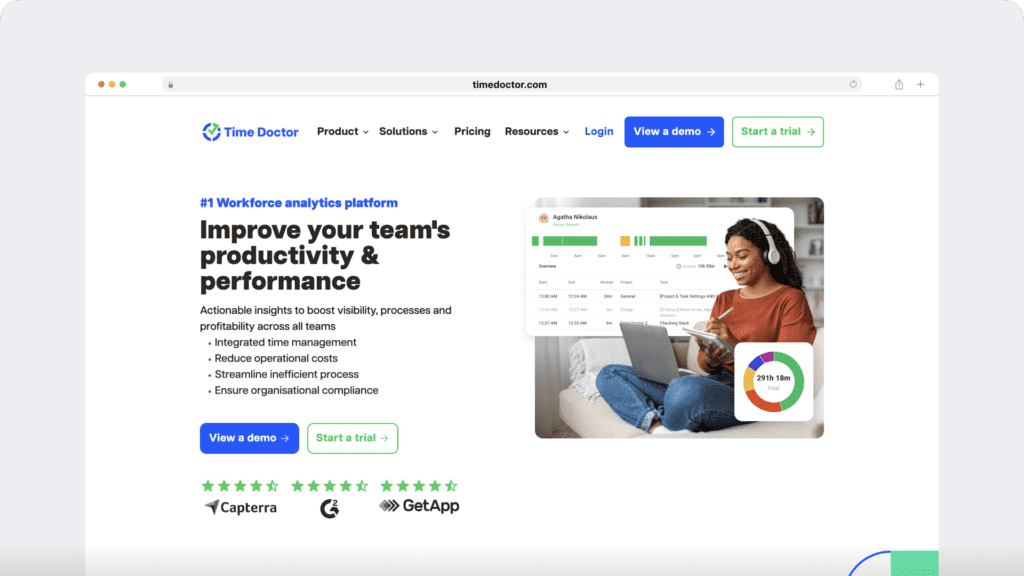
Time Doctor is a workforce analytics platform that helps you lead with trust, not control.
Empowered leadership: Lead with trust, not control
Time Doctor helps you lead performance reviews with confidence by giving you insight that supports coaching and clarity:
- See clear patterns in effort, focus, and workload over time
- Understand how priorities and capacity align across teams
- Recognise strong performance through outcomes and contribution
- Coach employees with shared context that supports growth
- Support teams across healthcare, technology companies, and agencies with consistent, reliable signals
Performance reviews naturally centre on development, alignment, and sustained performance, grounded in real work patterns.
Actionable visibility: clarity without micromanagement
Time Doctor gives you the visibility needed to run fair reviews, without turning them into surveillance:
- Work hours, attendance, and task distribution help you understand workload and priorities during reviews.
- Work-focused employee monitoring provides shared context for discussing focus and execution.
- Productivity analytics and time management trends show patterns over time, not one-off days.
- Meeting insight and software cost insight reveal where time goes in meetings and tools, supporting conversations about efficiency, collaboration, and process improvement.
- The Unusual Activity Report surfaces changes in work patterns, helping you address issues early.
Together, these insights help performance reviews feel clear, balanced, and supportive, even when work happens remotely.
Seamless partnership: Built to support real teams
Time Doctor fits naturally into how modern organisations operate, without adding friction:
- Integrate performance reviews with payroll, attendance, and existing integrations
- Support compliance and workforce planning needs for HR (Human Resources) and operations teams
- Use privacy controls and optional screen monitoring to maintain transparency and trust
- Scale easily across a distributed workforce without heavy IT overhead
- Keep performance reviews focused on people and progress, not the tool itself
With Time Doctor, performance reviews for remote employees become easier to run, easier to trust, and easier to scale.
Final thoughts
If your performance reviews feel rushed, subjective, or disconnected from how work actually happens, the issue often isn’t effort or intent. It’s the lack of shared clarity.
Thriving in remote and hybrid teams is not just about hiring the right people. It’s about giving leaders the visibility and confidence to coach fairly, support early, and make decisions that feel consistent and human.
Time Doctor is the right fit when you want performance reviews to build trust, protect work-life balance, and scale leadership confidence across remote, hybrid, or even in-the-office teams. It gives you the insight to lead with fairness and clarity.
So, do your performance reviews help people grow, or do they leave too much to guesswork?
View a demo to make your next performance review cycle fair, consistent, and data-driven.
Frequently asked questions (FAQs)
Performance reviews work best when they include regular check-ins, not just annual feedback. Time Doctor supports this with real-time workforce analytics, so reviews reflect clear patterns over time.
The most useful metrics focus on outcomes and trends. These KPIs include progress toward goals, workload balance, and how time is used across tasks. Time Doctor brings these signals together through productivity analytics and employee time tracking, helping performance reviews stay clear and fair.
Fairness comes from consistency and shared context. Using the same benchmarks to set goals across remote, hybrid, and in-the-office teams reduces proximity bias. Time Doctor provides a shared view of work patterns, so performance conversations stay clear and consistent.
You avoid micromanagement by setting clear expectations and focusing on trends and outcomes. Time Doctor supports this by turning everyday work data into high-level insights that guide coaching.
Time Doctor improves remote performance management by giving you real-time visibility into how work happens, so performance evaluations are based on clear patterns, shared context, and outcomes. This helps you run fair, consistent reviews that support coaching and growth, not guesswork.
Yes. Team members across healthcare, technology companies, agencies, and other distributed teams use Time Doctor to align performance reviews with company goals and support sustainable productivity across remote and hybrid work.
On-site reviews rely on face-to-face visibility and informal signals. Remote reviews require a clearer view of outcomes and work patterns. Time Doctor provides that shared visibility, helping you run fair performance reviews across remote, hybrid, and on-site teams without relying on presence.


Carlo Borja is the Content Marketing Manager of Time Doctor, a workforce analytics software for distributed teams. He is a remote work advocate, a father and an avid coffee drinker.