Quick overview
Employee monitoring and employee surveillance are often used interchangeably, but they lead to very different outcomes. Monitoring focuses on visibility into work patterns so teams can improve productivity, stay aligned, and work with clarity.
While surveillance crosses the line when tracking becomes excessive, hidden, or invasive, it creates stress and distrust rather than improving performance.
This article breaks down the difference and shows how ethical workforce analytics help leaders improve results without making employees feel watched.
Does monitoring employees mean spying on them?
Imagine implementing workplace monitoring that tracks every keystroke, reviews social media use, records phone calls, captures screenshots, and shows real-time activity through monitoring software.
On paper, it promises visibility into work hours, especially for remote employees, often summarized through performance dashboards.
But in reality, it creates tension.
When monitoring systems collect this much data, employees may wonder whether they’re being supported or watched.
What begins as performance tracking can quickly feel like employee surveillance, in which every action is scrutinized and trust erodes.
This pressure is even stronger with remote workers, especially after the rapid shift to remote work during the pandemic.
Without clear boundaries, tracking software can blur work hours, replace conversations with screenshots, and turn monitoring systems into a source of stress rather than clarity.
The truth is, the real risk isn’t using workplace monitoring. It’s using it in a way that makes people feel controlled instead of trusted.
Table of Contents
- What is employee surveillance?
- What are the three types of surveillance?
- Why do employees dislike employee surveillance?
- How does employee monitoring differ from employee surveillance?
- Comparison table: employee surveillance vs. employee monitoring
- How can businesses track employee activity without surveillance?
- What is employee monitoring?
- What is the best employee monitoring tool?
- Time Doctor: The best employee monitoring solution
- Time Doctor vs. traditional employee monitoring tools
- Final thoughts: The right way to monitor productivity without surveillance
- Frequently asked questions (FAQs)
What is employee surveillance?
Employee surveillance is the practice of tracking and collecting data on employees’ activities, behavior, and digital interactions in the workplace, often justified by cybersecurity or compliance concerns, to effectively monitor workers.
Companies use various technologies to monitor computer usage, location, communication, and work habits, especially for employees in remote and hybrid work environments.
What are the three types of surveillance?
Employee surveillance generally falls into three categories. Understanding these helps clarify how different monitoring systems operate in the workplace and where they can create risk when applied without clear boundaries.
1. Digital surveillance
This includes keystroke logging, screen monitoring, screenshots, app and website tracking, email monitoring, and AI-driven behaviour analysis that evaluates work patterns in real time.
2. Physical surveillance
This involves tools such as CCTV cameras and GPS tracking to monitor employees’ locations and movements during work hours, often used in call center settings.
3. Biometric surveillance
This uses biometric data, such as fingerprint scans, facial recognition, or other identity-verification technologies.
While monitoring is often used to track work hours and performance, surveillance goes further, collecting detailed data that may include real-time activity tracking, personal movements, and even biometric information.
But where is the line between necessary monitoring and constant surveillance? And how much workplace data is too much?
Why do employees dislike employee surveillance?
For many employees, the problem is not just being subject to electronic monitoring but how and why they are being tracked.
According to Business News Daily, employers must be careful when using tracking software, as some forms of surveillance may violate privacy laws, including the Electronic Communications Privacy Act (ECPA) and state laws in Connecticut and New York.
Additionally, Time Doctor’s guide to employee monitoring laws explains that different states and countries have varying rules on consent and tracking, making compliance even more complex.
In fact, a Harvard Business Review study found that employees who feel closely monitored are 50% more likely to disengage from their work.
Here are some of the biggest reasons employees push back against workplace surveillance and how it impacts employee satisfaction:
1. Lack of transparency
Many employees do not know how much they are being watched or why specific data is being collected. When monitoring policies are unclear, employees may feel their privacy is being violated.
2. Micromanagement
Knowing that their employer is tracking keystrokes, taking screenshots, or using GPS can make employees feel micromanaged rather than trusted to do their jobs.
3. Increased stress
Studies show that constant monitoring increases anxiety, leading employees to focus more on appearing productive rather than doing meaningful work.
4. Privacy concerns
Many employees worry about how their personal data is stored and who can access it. Some monitoring software collects more data than necessary, including electronic communications, biometric information, and internet activity.
5. Blurred boundaries between work and personal life
Some companies track employees outside work hours, monitoring their activity on company-owned laptops or installing surveillance cameras in locker rooms, raising significant privacy concerns. This raises serious concerns about workplace privacy and compliance with federal and state laws.
How does employee monitoring differ from employee surveillance?
Employee surveillance and employee monitoring both involve tracking employee activity, but the key difference is how they are used.
All surveillance is monitoring, but not all monitoring is surveillance.
Monitoring becomes surveillance when it becomes excessive, invasive, or secretive. If businesses use keystroke logging, hidden GPS tracking, or AI-driven behavior analysis without clear policies or employee consent, they create a culture of fear rather than productivity.
The difference comes down to intent and execution. Ethical monitoring builds trust and accountability, while unethical surveillance leads to stress, disengagement, and privacy concerns.

Comparison table: employee surveillance vs. employee monitoring
| Feature | Employee Surveillance | Employee Monitoring |
| Purpose | Control and micromanage | Improve employee performance and productivity |
| Transparency | Often hidden or unclear | Fully disclosed monitoring policies |
| Methods | Keystroke logging, video surveillance, GPS tracking | Workplace monitoring with tracking software |
| Employee autonomy | Limited | Respected |
| Privacy impact | High | Minimal and ethical |
| Legal risks | Can violate federal law and state laws in places like Connecticut and New York | Compliant with privacy laws and monitoring systems |
| Example tool | Surveillance technologies and wearable trackers | Ethical employee monitoring software |
How can businesses track employee activity without surveillance?
The best approach is to balance workplace monitoring with clear boundaries, comply with applicable laws, and ensure there’s a legitimate business reason for tracking work hours and performance metrics, without creating privacy violations.
The key is to use ethical monitoring technology focusing on efficiency, not control.
7 best practices for ethical employee monitoring
1. Follow privacy laws to stay compliant
Businesses must follow federal and state employment law, including the Electronic Communications Privacy Act (ECPA) and state laws in places like Connecticut and New York, to ensure workplace monitoring is legal and ethical.
2. Be open about what is being monitored
Employees should know what employee data is being collected, how it’s used, and why. Clear communication builds trust and prevents confusion around workplace monitoring.
3. Only track work-related activities
Instead of monitoring keystrokes, reading emails, or tracking phone calls, businesses should focus on work hours, productivity metrics, and project completion. Tracking too much can feel intrusive.
4. Respect employee privacy and work-life balance
Monitoring should happen only during the workday and on company-owned devices. Tracking employees after hours or on personal devices crosses privacy boundaries.
5. Use productivity tools instead of surveillance systems
Ethical monitoring software tracks performance trends without GPS tracking, security cameras, or keylogging, which can create stress and disengagement.
6. Let employees see their own data
Employees should have access to their productivity reports to track their progress and improve without feeling micromanaged.
7. Make monitoring about support, not control
The goal should be to help employees succeed, not to watch their every move. Ethical tracking ensures businesses can measure performance fairly without creating a culture of fear.
But how can businesses successfully implement monitoring without crossing into invasive surveillance?
That’s where employee monitoring software comes in. It helps businesses balance performance tracking with employee autonomy.
What is employee monitoring?
Employee monitoring involves tracking work hours, performance, and productivity to ensure employees stay on task and meet company goals. Unlike employee surveillance, which can include excessive tracking and hidden data collection. Ethical monitoring software is designed to:
- Fair productivity measurement
- Compliance with workplace policies
- Support for remote and hybrid teams
- Improved time management without invading privacy
What is the best employee monitoring tool?
Many employee monitoring tools exist, but not all support modern workforce needs. Some focus too heavily on control, while others lack the insight required to manage performance across remote, hybrid, and in-office teams.
The right tool does more than track activity. It provides workforce analytics that explain how work actually happens, so decisions are based on evidence rather than assumptions.

Key features to look for in employee monitoring software
Before selecting an employee monitoring tool, businesses should look for the following essential features:
- Time tracking – Accurately monitor work hours and task duration.
- Productivity insights – Provide performance data without invasive tracking.
- Workforce analytics – Help managers make informed decisions.
- Screen monitoring – Capture proof of work without excessive surveillance.
- Automated reports – Generate detailed performance summaries.
- Compliance with privacy laws – Ensure legal and ethical monitoring.
Many employee monitoring tools claim these features, but few providers strike a balanced approach to transparency, privacy, and productivity tracking.
Time Doctor: The best employee monitoring solution
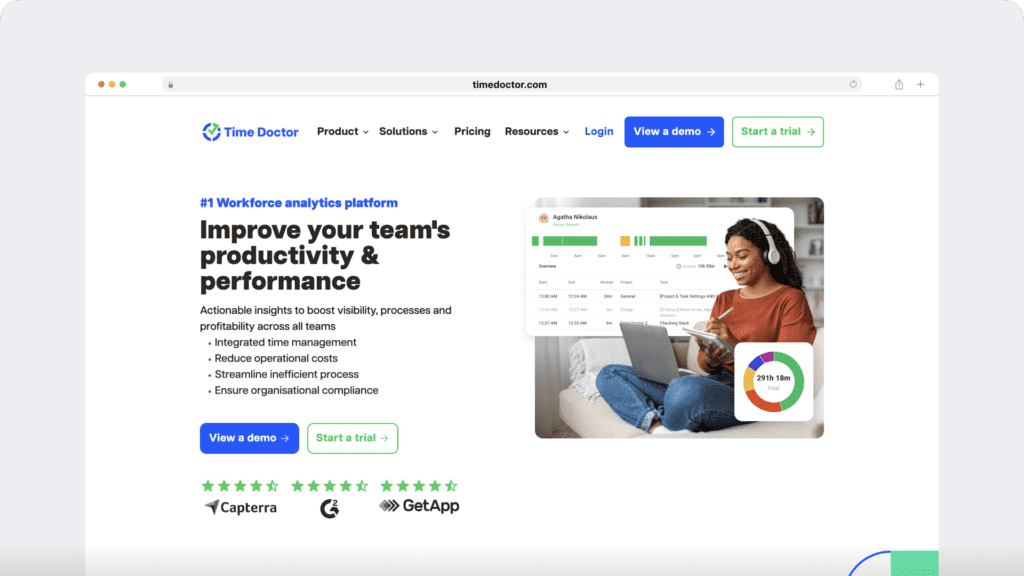
Understanding how work gets done matters, especially across distributed, flexible, and on-site teams. Many employee monitoring tools promise visibility but rely on heavy oversight that creates tension and resistance.
Time Doctor is a workforce analytics platform that shows how work actually happens. It turns everyday activity into clear, usable insight, so decisions are based on facts, not assumptions.
Visibility without micromanagement
Work hours, focus, and workload trends are easy to understand, giving managers better context for check-ins without having to monitor every move. This supports fair management, clearer expectations, and better performance conversations.
Insight you can act on
Instead of raw activity data, patterns across time, tasks, and tools become visible. This makes it easier to spot bottlenecks, uneven workloads, and early signs of burnout before they turn into bigger problems.
Easy to roll out and manage
Setup stays simple, with clear controls and privacy safeguards. Teams understand what’s tracked and why, which helps adoption and reduces friction from day one.
Time Doctor helps organizations understand work at scale, better support teams, and improve performance without crossing into employee surveillance.
Time Doctor vs. traditional employee monitoring tools
| Feature | Time Doctor | Other Tools (Varies by Software) |
| Time tracking | Provides accurate work hour visibility with flexible tracking and clear summaries. | Most tools track time, but some lack manual entry options or detailed breakdowns. |
| Productivity insights | Surfaces productivity patterns across focus time, tools, and work rhythms to support better decisions. | Some tools offer basic activity tracking but lack deep productivity analytics. |
| Workforce analytics | Turns day-to-day work data into real-time workforce analytics that support planning, coaching, and accountability. | Often available only in enterprise-level plans or as separate add-ons. |
| Automated screenshots (optional) | Offers optional visual context, with controls to blur or disable capture to respect boundaries. | Many tools force screenshot tracking by default without privacy controls. |
| Compliance with privacy laws | Supports compliance with employment and data protection laws, with controls designed to reduce privacy risk. | Some tools comply, but others store excessive data without transparency. |
| Customizable tracking settings | Allows visibility settings to be tailored by role and team, supporting fairness and consistency. | Some tools offer fixed tracking settings, making it harder to customize monitoring per employee. |
| Payroll and invoicing integration | Integrates work hour data with payroll and invoicing systems to reduce manual effort. | Some have limited payroll integrations or require third-party plugins. |
| Supports remote and hybrid teams | Designed for distributed and on-site teams, with consistent visibility across different work environments. | Some tools focus only on in-office tracking, making them less effective for remote teams. |
| Employee-friendly monitoring | Built around transparency and ethical visibility, supporting performance without micromanagement. | Some tools lean toward strict surveillance, offering keystroke logging and forced tracking. |
| Transparent data access for employees | Employees can access their own work insights, supporting shared understanding and accountability. | Some tools restrict access, meaning employees cannot see their own data. |
Final thoughts: The right way to monitor productivity without surveillance
Workplaces are changing, and so are the ways businesses track productivity. But there’s a big difference between monitoring and surveillance.
The key? Intent and execution.
Monitoring is about efficiency, accountability, and transparency, but not spying. And it works best when it helps performance and preserves trust.
Time Doctor helps businesses track work hours, measure productivity, and support employees without invading their privacy.
So, is your company monitoring productivity correctly? Or is it crossing into surveillance without realizing it?
If you want a fair, ethical, and transparent way to monitor productivity, it might be time to find a solution that prioritizes trust.
Frequently asked questions (FAQs)
In many cases, yes, but only when the goal is clarity rather than control. When monitoring helps explain work patterns and workload, teams stay aligned and decisions improve. By contrast, tools built around constant oversight often create resistance. Time Doctor supports consistency and trust by showing how work gets done across distributed and on-site teams, without turning monitoring into surveillance.
Generally, this increases risk. Even on company-owned devices, monitoring outside defined work hours can raise legal and trust concerns. Time Doctor helps reduce this risk by allowing tracking to be limited to defined work hours and paused outside the workday, so monitoring stays focused on business activity only. This protects both the organisation and employees while maintaining clear, compliant boundaries.
At the federal level, the Electronic Communications Privacy Act (ECPA) sets basic rules for workplace monitoring, and some states apply stricter employment laws. Time Doctor is designed to support these requirements by offering compliant, transparent monitoring practices, making it easier to track work without overstepping legal or privacy boundaries.
Yes, but with conditions. New York law requires employers to notify employees about certain types of electronic monitoring. As a result, organisations benefit from tools that make monitoring visible, configurable, and easy to explain from day one.
In some cases, yes, especially when monitoring is tied to legitimate business needs. However, problems arise when tracking is excessive, undisclosed, or unrelated to work. Therefore, focusing on work patterns instead of individual behaviour helps maintain appropriate boundaries.
When employees feel watched, they focus more on appearing busy than doing meaningful work. Time Doctor helps prevent this by using transparent monitoring that focuses on shared insight, so performance conversations stay grounded in real work patterns and trust remains intact.
Define clear work-hour boundaries and give employees access to their own data. Time Doctor supports this approach by keeping monitoring focused, transparent, and configurable, making it easier to maintain visibility while respecting employee privacy.


Liam Martin is a serial entrepreneur, co-founder of Time Doctor, Staff.com, and the Running Remote Conference, and author of the Wall Street Journal bestseller, “Running Remote.” He advocates for remote work and helps businesses optimize their remote teams.