Quick overview
Data accuracy is important because it ensures the information in reports, dashboards, and analytics reflects what is actually happening across your operations.
With reliable data, you can make better business decisions about capacity planning, resource utilization, and process improvement while reducing reporting errors and improving efficiency.
In this article, you’ll learn what data accuracy means, why it matters for operational performance, the risks of inaccurate data, and how workforce analytics helps leaders make better operational decisions.
Have you ever made an operational decision that later felt… off?
On paper, the numbers look fine. Productivity appears stable, utilization seems healthy, and dashboards show everything running smoothly. Yet the results on the ground tell a different story.
It can feel like navigating with a slightly misaligned compass. The direction looks right, but every step quietly drifts farther from the truth.
As a leader, you are responsible for capacity modeling, workflows, and performance. Because even small amounts of bad data can distort the signals behind critical decisions. And when the data is inaccurate, the path forward becomes harder to trust.
Table of Contents
- What is data accuracy and why is it important?
- Key factors that affect data quality beyond accuracy
- Understanding data accuracy, data integrity, data consistency, and data profiling
- Real-world examples of how operations leaders use data accuracy across industries
- What causes data inaccuracy in organizations?
- What are the operational consequences of inaccurate data?
- How to improve data accuracy in your operations
- How workforce analytics helps close data accuracy gaps
- How Time Doctor ensures data quality
- Final thoughts
- Frequently asked questions (FAQs)
What is data accuracy and why is it important?
Data accuracy describes how closely your information reflects real-world activity across the entire data lifecycle, from collection to reporting.
When data is accurate, your reports, operations dashboards, and analytics match what is actually happening across your operations. When it is based on poor quality data, decisions about capacity, resources, and processes can rely on misleading signals.
Think of it like a navigation app. If the map is wrong, you still move forward, but in the wrong direction.
In reality, the impact can be significant. Gartner reports that “poor data quality costs organizations at least $12.9 million per year on average”.
Many of these financial losses come from operational inefficiencies, incorrect reporting, compliance risks, and the time teams spend correcting flawed records instead of improving performance.
Why is it important to ensure that data is accurate?
Accurate data supports several important outcomes across modern organizations.
Better decision-making
Accurate data helps you make informed, data-driven decisions. Reliable performance metrics reduce risk and support stronger operational results.
Operational efficiency and cost control
Fewer reporting errors reduce operational bottlenecks and help streamline data audits. Your teams spend less time fixing mistakes and more time improving workflows and productivity.
Customer trust and service quality
Reliable customer information helps you deliver consistent, personalized service, which improves customer satisfaction and reduces the risk of reputational damage.
Regulatory compliance and reporting reliability
Accurate records help you meet legal and industry standards. This will give your stakeholders confidence in your reporting while reducing the risk of errors, penalties, or compliance issues.
Reliable analytics and AI insights
Analytics platforms and artificial intelligence rely on high quality data. When your data is accurate, you can trust the insights they provide to guide decisions.
Ultimately, accurate data makes it easier for you to evaluate workflows, monitor productivity patterns, and drive continuous improvement with confidence.
Key factors that affect data quality beyond accuracy
Accuracy is only one dimension of data quality. Enterprise data governance frameworks also emphasize other factors that determine whether operational data can be trusted for analytics and decision-making.
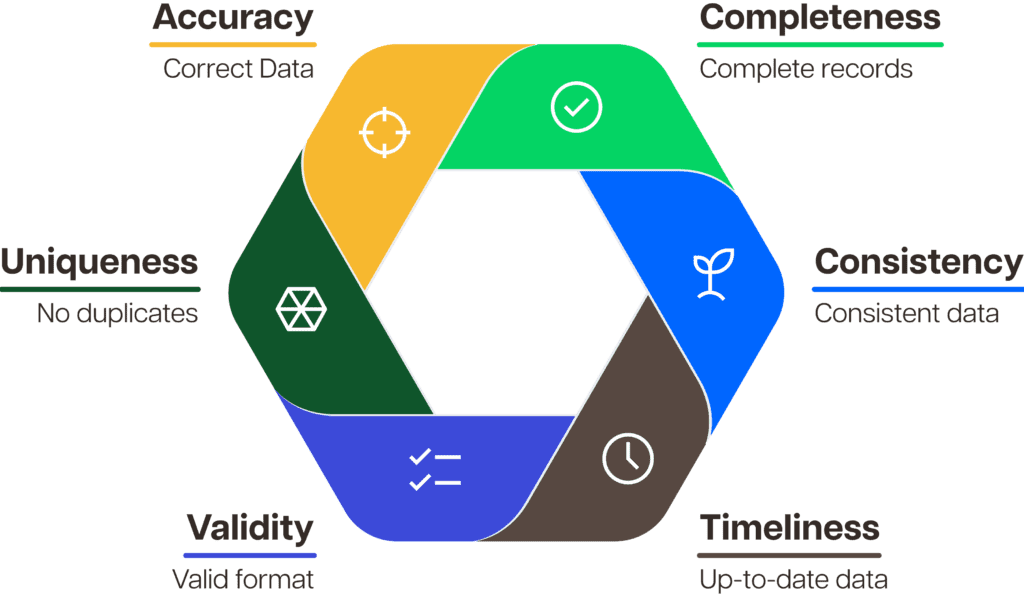
Completeness
Your datasets should include all required information. When records or fields are missing, blind spots appear, making it harder to evaluate performance and workflows accurately.
Consistency
Data should produce the same results across systems, reports, and dashboards. When numbers don’t match, it becomes harder to identify which version reflects the true operational picture.
Timeliness
Timeliness means your data is current and up to date. When you rely on outdated data, you may respond to issues that have already changed.
Validity
Data validation ensures information follows the right formats, rules, and standards. When entries are incorrect or inconsistent, analytics become distorted and insights become less reliable.
Uniqueness
Uniqueness ensures that each record appears only once in a dataset. Duplicate entries can inflate metrics, distort analytics, and create misleading signals in performance dashboards.
Data quality factors overview
| Factor | Diagram Label |
| Accuracy | Correct data |
| Completeness | Complete records |
| Consistency | Consistent data |
| Timeliness | Up-to-date data |
| Validity | Valid format |
| Uniqueness | No duplicates |
These dimensions serve as core data quality metrics in frameworks such as DAMA Data Management Body of Knowledge (DMBOK) and data quality guidance from organizations such as IBM.
Understanding data accuracy, data integrity, data consistency, and data profiling
At this point, the key factors affecting data quality are clear. However, terms like data accuracy, data integrity, data consistency and data profiling are often used interchangeably, even though they mean different things.
Here’s a simple comparison to clarify each concept.
| Concept | Definition | Example |
| What is data accuracy? | Refers to how closely data reflects real-world activity and whether it is free from errors. | Logged work hours match the actual time spent on tasks. |
| What is data integrity? | Ensures data remains complete, consistent, and unchanged as it moves across systems and over time. | Employee data stays intact and consistent when transferred between HR, payroll, and reporting systems. |
| What is data consistency? | Ensures the same data produces the same results across systems, reports, and dashboards. | Productivity metrics show the same values across dashboards, reports, and analytics tools. |
| What is data profiling? | The process of analyzing datasets to assess quality, structure, and potential issues before use. | Reviewing datasets to identify missing values, duplicates, or unusual patterns before generating reports. |
In practice, data accuracy shapes how operations run day to day. It works together with data integrity, consistency, and profiling to ensure your data stays complete, aligned, and reliable across systems.
When these are in place, performance metrics reflect real conditions and support better decisions. When they are not, even well-intentioned actions can lead to delays, inefficiencies, or missed targets.

Real-world examples of how operations leaders use data accuracy across industries
Data accuracy directly shapes how operations leaders plan, execute, and improve performance. Across industries, reliable data will help you make decisions based on actual conditions, not assumptions.
Here’s how it plays out in real operational environments.
Healthcare operations
Operations leaders rely on accurate data to manage staffing, patient flow, and service delivery in healthcare industry. When patient volumes, treatment times, or staff availability are tracked correctly, it becomes easier to allocate resources, reduce wait times, and maintain care quality.
Finance and banking operations
In finance, accurate data supports transaction monitoring, compliance reporting, and protects against non-compliance risks. Operations leaders use reliable data to ensure reporting aligns with regulatory standards, detect anomalies early, and maintain operational control across systems.
Retail operations
Retail leaders depend on accurate sales and inventory data to plan demand, manage stock levels, and optimize store performance. When the data reflects real buying patterns, teams can make better inventory and pricing decisions while improving customer experience.
Manufacturing operations
In manufacturing, data accuracy supports production planning, quality control, and supply chain coordination. It helps leaders identify bottlenecks, balance workloads, and meet production targets without delays.
Service and operations teams
For service-based organizations, accurate data helps track workloads, monitor SLAs, and manage team performance. Operations leaders rely on this data to balance capacity, improve response times, and ensure service levels are consistently met.
So if you notice, across all these industries, the role is the same. Decisions depend on whether the data reflects reality.
When the data is accurate, you can plan with confidence, respond faster to issues, and improve performance consistently. And when it is not, even well-informed decisions can lead to inefficiencies, missed targets, or operational risk.
What causes data inaccuracy in organizations?
Data inaccuracies rarely come from a single issue. In most organizations, they build up over time due to gaps in processes, systems, and data management practices.
These issues often remain hidden until performance metrics stop reflecting what is actually happening on the ground.
Here are the most common causes of data inaccuracy.
Manual data entry
Manual processes increase the risk of human error, especially when tasks that could be automated rely on manual input. Small mistakes such as incorrect entries, missed inputs, or duplicate records can quickly affect reports, dashboards, and performance metrics.
Siloed systems
When company’s data is spread across disconnected tools like CRM, HR systems, and analytics platforms, it creates data silos that make it harder to maintain a single source of truth. As a result, updates don’t always match, which leads to conflicting reports and unreliable insights.
Inconsistent formats
Different teams may follow different data standards, formats, or naming conventions. This makes it difficult to combine datasets, analyze trends, or generate consistent reports across the organization.
Outdated records
Data that is not updated regularly loses relevance. Decisions based on outdated information may reflect past conditions rather than current operational realities.
Lack of data governance
Without clear data ownership, standards, and validation processes, data quality becomes difficult to control. Errors go unnoticed, and inconsistencies can spread across systems.
Fragmented reporting tools
Using multiple reporting tools without proper alignment can create different versions of the same data. When dashboards and reports show conflicting numbers, it becomes harder to trust any single source.
This is why importance of data accuracy matters. These issues do not just affect data quality. They directly impact how operations are managed.
When data is inaccurate, performance metrics become unreliable, decision-making slows down, and improvement efforts may focus on the wrong problems.
What are the operational consequences of inaccurate data?
Inaccurate data does not just affect reporting. When performance metrics no longer reflect reality, even well-planned strategies can lead to the wrong outcomes.
In practice, the consequences often show up in key operational areas:
- Incorrect root cause analysis – Issues may be misidentified because the data points to misleading signals instead of actual problems.
- Wasted process improvement efforts – Teams may invest time and resources into changes that do not address the real bottlenecks.
- Misallocated resources – Inaccurate data can lead to overstaffing, understaffing, or uneven workload distribution.
- Missed SLAs – Service levels may appear on track in reports while actual delivery falls behind expectations.
- Flawed forecasting – Decisions around capacity, timelines, and demand may rely on incorrect assumptions.
Ultimately, when data is inaccurate, process improvements become guesses instead of decisions.
How to improve data accuracy in your operations
Improving data accuracy requires more than fixing errors after they appear. It depends on structured processes and regular productivity audits to ensure long-term reliability. It starts with building systems and processes that prevent inaccuracies from happening in the first place.
- Standardized data collection – Use consistent formats, fields, and definitions across teams to reduce confusion and errors.
- Automated data tracking – Replace manual inputs with automated systems where possible to reduce human error and improve consistency.
- Validation rules and controls – Set rules that flag incorrect or incomplete data before it enters reports and dashboards as part of your quality assurance process.
- Centralized reporting systems – Maintain a single source of truth to avoid conflicting data across tools and departments.
- Regular data quality checks – Review datasets consistently to identify data quality issues early and maintain accuracy over time.
However, even with these practices in place, maintaining data accuracy becomes more challenging as operations scale. Manual checks, delayed reporting, and disconnected systems can still create gaps between what is recorded and what is actually happening across workflows.
To close that gap, organizations need more than structured processes. They need continuous visibility into how work is performed. This is where workforce analytics plays a critical role, helping validate data against real activity and detect inconsistencies early.
How workforce analytics helps close data accuracy gaps
Workforce analytics changes that by giving you visibility into real work patterns. Instead of relying only on manual inputs or disconnected reports, you can see how time is spent, how workflows move, and where inconsistencies start to appear.
This shift matters because data accuracy is not just about clean inputs. It is about whether your data reflects reality.
With workforce analytics, you can:
- Validate reported data against real activity – Compare timesheets, task updates, or reports with actual work patterns to spot gaps early.
- Detect inconsistencies across workflows – Identify where delays, idle time, or unexpected patterns through analytics and machine learning.
- Turn raw activity into actionable insights – Transform day-to-day work signals into clear data you can use for planning, coaching, and decision-making.
- Remove blind spots in operations – Gain visibility across remote, hybrid, and in-office teams so nothing gets lost between systems or handoffs.
Instead of guessing which data to trust, workforce analytics helps you see the full picture so your decisions reflect how work actually gets done, not just how it is reported.
But how do you apply workforce analytics in a way that consistently validates your data and supports day-to-day operations?
This is where Time Doctor comes in. As a workforce analytics platform, it helps you validate data against real work activity, so your reports and dashboards stay aligned with what is actually happening across your operations.
How Time Doctor ensures data quality
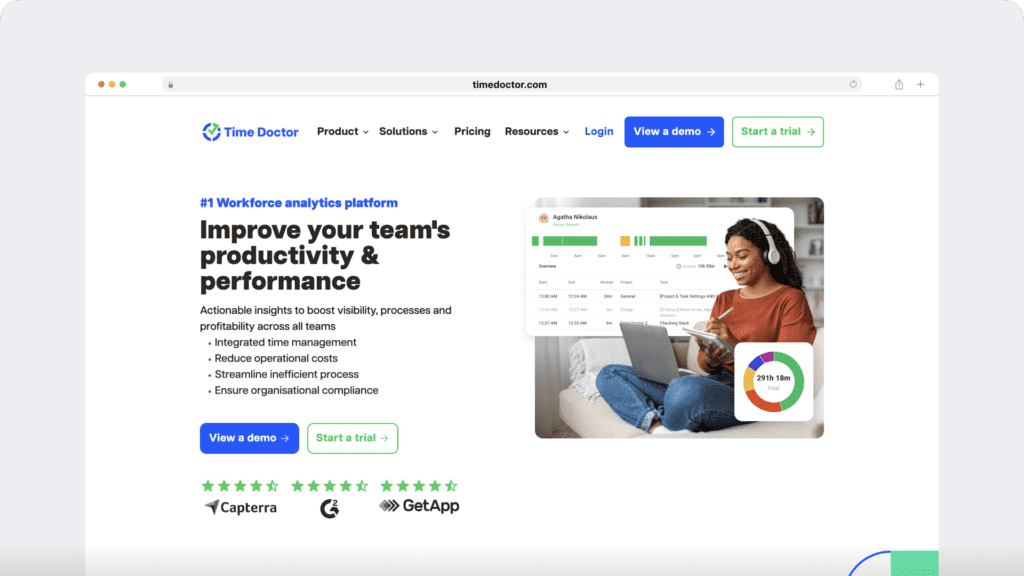
Time Doctor is a workforce analytics platform that gives leaders real-time visibility into how work actually gets done. Instead of relying on assumptions or incomplete reports, it turns day-to-day activity into accurate, actionable data you can trust.
The challenge is that continuous optimization often breaks down when the data behind your decisions is unreliable.
When reports are delayed, inconsistent data, or based on manual inputs, improvements start to drift. As a result, bottlenecks go unnoticed, resources get misallocated, and teams end up optimizing based on signals that do not reflect actual work.
But Time Doctor connects your data directly to real work activity, so your optimization efforts stay aligned with what is actually happening across your operations.
Time Doctor features that improve data accuracy:
- Workforce analytics and real-time dashboards show how work actually happens across teams. This helps you validate reported data against real activity, so inaccurate assumptions are easier to spot.
- Time tracking and activity monitoring capture actual work hours, app usage, and task-level effort. This reduces reliance on manual inputs, which are often a major source of data errors.
- Productivity analytics and Benchmarks AI analyze patterns across teams, roles, and workflows using advanced algorithms to identify trends and outliers. This helps you benchmark performance, compare outputs consistently, and identify outliers or inconsistencies before they impact reporting and decisions.
- Unusual activity reports and attendance tracking highlight gaps, irregularities, and mismatches in recorded data. This makes it easier to catch inaccuracies before they impact performance metrics.
- Project, task, and meeting insights connect time spent to actual outputs. This helps ensure that performance data reflects real work outcomes, not just reported activity.
- Integrations and centralized reporting keep data aligned across tools and systems. This prevents conflicting data sources and maintains consistency in your reports and dashboards.
- Payroll and time management alignment ensure that recorded hours match actual work activity. This improves accuracy in both operational reporting and compensation data.
With accurate, real-time data in place, optimization becomes consistent and reliable. Instead of guessing, decisions are based on how work actually happens.
Final thoughts
At some point, every leader hits that moment of doubt.
If your data looks right, but your results don’t, what are you really basing your decisions on?
You want to trust your dashboards. You want to believe the numbers. But when something feels off, it usually is. And even small gaps in your data can quietly lead your decisions in the wrong direction.
The real difference is not more data. It is data you can trust.
When your data reflects how work actually happens, everything changes. Decisions feel clearer. Priorities fall into place. You stop second-guessing and start leading with confidence.
So, whether you keep relying on what is reported, or start making decisions based on what is actually happening across your operations.
View a demo to see how Time Doctor helps you turn real work activity into data you can trust.
Frequently asked questions (FAQs)
Data accuracy refers to how closely your data reflects real-world activity. When data is accurate, the information in your reports, dashboards, and analytics matches what is actually happening across your operations.
Time Doctor improves data accuracy by using built-in time tracking and activity monitoring to capture work data directly, instead of relying on manual inputs.
Time Doctor uses workforce analytics as the foundation, supported by productivity analytics and real-time dashboards, to give you a clear view of how work actually happens across roles and teams.
Data accuracy directly affects the quality of your decisions. When your data reflects reality, you can plan capacity, allocate resources, and improve workflows with confidence.
Accurate inputs from Time Doctor that track work hours, app usage, and task-level activity make it easier to trust the insights behind your decisions.
Accurate data helps improve decision-making, reduce operational errors, and increase efficiency. It also supports better forecasting, stronger compliance, and more reliable performance tracking across teams.
In most cases, 80% accuracy is not enough for operational decisions. Even small inaccuracies can create misleading trends, especially when data is used for forecasting or performance evaluation.
Using tools that provide real-time tracking and anomaly detection, such as Benchmarks AI and unusual activity reports, helps improve accuracy over time.
Data consistency means that the same data produces the same results across systems, reports, and dashboards. Consistent data ensures that teams are working from a single, reliable version of the truth.
Systems with integrations and centralized reporting, like Time Doctor, help maintain consistency across tools and teams.
Data stays consistent when organizations use standardized formats, centralized reporting, and integrated tools.
Solutions like Time Doctor support this through integrations, unified dashboards, and cross-team reporting, which reduce discrepancies and keep data aligned across systems.


Carlo Borja is the Content Marketing Manager of Time Doctor, a workforce analytics software for distributed teams. He is a remote work advocate, a father and an avid coffee drinker.