How Time Doctor uses AI models to turn activity data into actionable benchmarks
Quick overview
Benchmarks AI helps you understand how your team is really performing.
It compares your activity data against similar teams using AI models, so you can identify gaps, set better goals, and improve with confidence.
In this article, you’ll learn how Time Doctor enables you to validate performance, uncover inefficiencies, and turn activity data into clear, actionable benchmarks.
You have the data, but you lack the context to evaluate its quality.
Your team tracks hours, activity, and productivity every day. Yet the same questions remain:
Are we actually performing well?
What does “good” look like?
Are we ahead or falling behind?
The challenge isn’t a lack of data. It’s the absence of meaningful comparison.
Most teams rely on internal metrics, but this often limits how accurately your team’s performance is evaluated.
A support team, a sales team, and an operations team all follow different patterns, so comparing them the same way leads to the wrong conclusions.
This is exactly where Benchmarks AI comes in.
Instead of guessing, you compare your team to others doing similar work, using similar tools, and following similar workflows. You gain more than raw metrics. You understand your relative performance, identify high-performing behaviors, and determine where improvement is needed.
Benchmarks AI makes this possible at scale, giving you a reliable way to evaluate performance without relying on assumptions or inconsistent internal baselines.
This is especially critical if you’re responsible for operations, workforce performance, or scaling team efficiency.
Table of Contents
- What are AI productivity benchmarks in workforce analytics?
- Why internal data can be misleading
- How do AI-powered benchmarks actually work?
- How teams use benchmarking to improve performance at scale
- What high-performing teams do differently with benchmarking
- Why Time Doctor makes benchmarking work
- Final thoughts
- Frequently asked questions (FAQs)
What are AI productivity benchmarks in workforce analytics?
AI productivity benchmarks in workforce analytics compare your team’s performance against AI-matched peer groups based on real work behavior.
Instead of relying on isolated metrics or generic averages, benchmarks provide contextual insight into how work actually happens, helping you understand what good performance looks like for your specific workflows and roles.
Why internal data can be misleading
Tracking productivity internally is no longer the challenge. Most teams have dashboards full of time logs, app usage breakdowns, employee monitoring data, and engagement charts.
But here’s the truth: internal metrics only tell you how your team is performing compared to itself. Without context, they don’t show how you measure up against similar teams doing similar work.
And without external benchmarks, that data can be misleading without the right context.
Here’s why:
- You might overestimate performance by comparing only to past internal averages
- You risk misplaced coaching or tool investments based on skewed metrics
- You may end up rewarding busyness over effectiveness, simply because the team looks active
Let’s say your design team averages 42 hours per week. Productivity reports show minimal idle time and consistent app usage.
On paper, they appear to be doing well. However, when benchmarked against a matched peer group using the same creative tools and workflows, they fall in the bottom 25% for productivity.
Another team in customer operations might also appear busy. They spend more than 10 hours each week in collaboration tools like Slack and Zoom, but struggle to stay consistent with task tools like Jira or Salesforce.
When benchmarked against similar teams, the data tells a different story. Overcommunication and frequent context switching are pulling them away from their core work.
These performance shifts are difficult to detect solely from internal data. Without an external baseline, there’s no way to know if teams are working in line with expectations, or slowly veering off course.
How do AI-powered benchmarks actually work?
AI-powered benchmarks use large language models (LLMs) to analyze patterns in how work actually gets done, including time spent, tools used, and workflow behavior.
The system then clusters users into peer groups based on these patterns and assigns performance percentiles across key metrics such as productive time, tool usage, and activity levels.
Because benchmarks are continuously updated and based on aggregated, real-world data, they reflect how teams actually operate today—not static assumptions or outdated averages.
What internal metrics miss and how benchmarking provides context
Benchmarking gives your data the context you need to evaluate performance accurately.
Most teams already track activity, but without external comparison, it’s hard to know what “good” actually looks like.
By comparing your team against similar peers, benchmarking turns raw data into clear, actionable performance standards.
1. Uncover gaps that internal reports miss
Internal data shows trends, but not how you compare. A team may look stable on paper, yet benchmarking can reveal that they fall in the bottom 25% for key metrics, signaling hidden inefficiencies.
2. Identify high-performing patterns worth scaling
Top-performing teams reflect repeatable behaviors. Benchmarking highlights what drives results so you can replicate success across teams.
3. Detect early signs of burnout or inefficiency
More hours do not always mean better performance. Benchmarking exposes mismatches between effort and output, helping you catch risks before they escalate.
4. Set fair, data-backed goals
Instead of guessing what “good” looks like, you can anchor targets to real benchmarks. Percentile-based goals align expectations and make performance conversations more objective.

Benchmarking works as a continuous layer on top of your existing data. It helps you focus on what matters without adding business complexity.
Most importantly, it is designed to guide, not grade. It gives leaders the clarity to ask better questions, act earlier, and lead with confidence.
How teams use benchmarking to improve performance at scale
Across organizations, benchmarking is used as a practical layer for planning, coaching, and decision-making.
With Benchmarks AI in Time Doctor, these use cases become measurable, repeatable, and easy to apply across teams.
This helps operations, HR, and leadership teams align on performance expectations using the same data.
1. Coaching with confidence
With benchmarking, managers in your organization can determine whether a team needs support or whether expectations need realignment. It replaces guesswork with context, especially when performance shifts are difficult to explain using internal data alone.
2. Setting goals that teams can actually reach
Benchmarking provides percentile-based targets that are both realistic and motivating. Instead of relying on arbitrary numbers, leaders can align goals with what similar teams are actually achieving.
3. Measuring impact with data, not opinions
Whether introducing a new tool, workflow, or training, benchmarking reveals whether changes are driving real improvement. Tracking percentile movement over time makes it easier to evaluate effectiveness.
4. Adjusting for real work patterns
Work habits vary across teams. Some rely heavily on collaboration, while others depend on deep focus. Benchmarking surfaces these patterns, helping leaders adjust expectations and processes accordingly.
5. Testing ideas before scaling them
Operations teams use benchmarking to validate pilots or experiments. When a new approach improves performance against a peer baseline, it becomes easier to justify rolling it out across the organization.
What high-performing teams do differently with benchmarking
Most teams use benchmarking. High-performing teams apply benchmarking strategically, and this is where your team can gain an advantage
Instead of treating it as a reporting tool, it becomes a way to guide decisions, support coaching, and continuously improve how work gets done.
Here’s what sets your team apart:
1. Guidance over pressure
Benchmarking is used as a support system, not a scoreboard. This approach helps focus on priorities, encourages clarity in leadership, and supports continuous improvement.
2. Like-for-like comparison
Comparisons are based on similar tools, workflows, and responsibilities, ensuring benchmarks remain accurate, relevant, and actionable.
3. Data-driven conversations
Insights from benchmarking guide discussions on processes, priorities, and team dynamics, leading to more meaningful action.
4. Trend-based analysis
Performance is evaluated over time rather than through isolated data points. Consistent trends inform better planning, decision-making, and team support.
To make this work in practice, you need a system that turns your activity data into clear, comparable benchmarks.
One that captures accurate productivity data, highlights meaningful patterns, and gives you real benchmarks to work with. That’s exactly where Time Doctor comes in.
Why Time Doctor makes benchmarking work
Benchmarking is only as valuable as the data and context behind it.
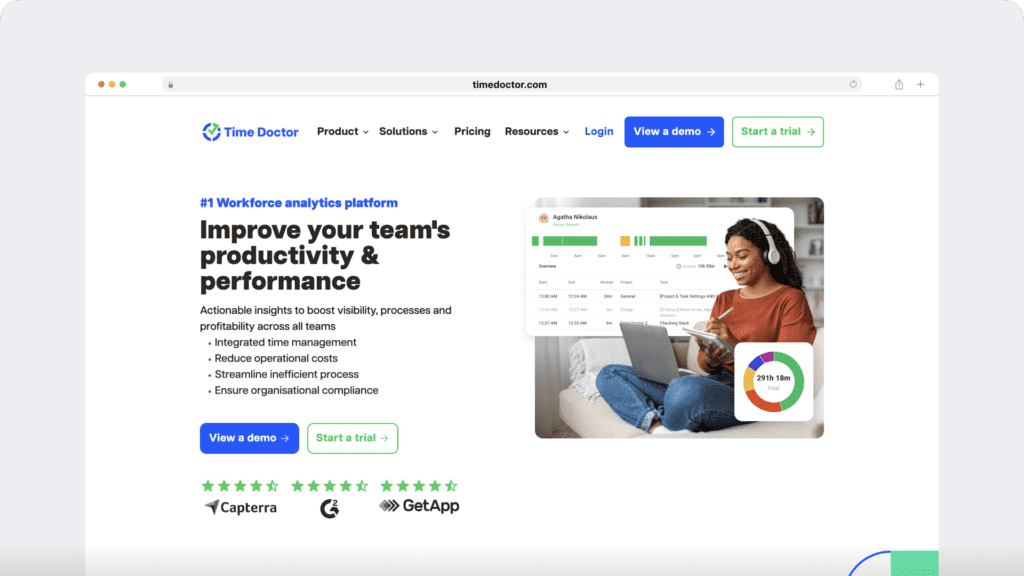
Time Doctor is a workforce analytics platform that gives managers clear visibility into how work gets done, so they can lead with trust, not control.
With Benchmarks AI, that visibility extends beyond your own team. You can compare performance against relevant peer groups and turn internal data into clear, defensible benchmarks. This provides a transparent and defensible way to evaluate performance across teams.
This gives leaders across operations, HR, and executive teams a shared, reliable view of performance.
Benchmarks AI removes the guesswork from performance comparisons by analyzing anonymized data from over 250,000 users across 12,000 companies. Instead of relying on broad categories like job titles or industries, it builds peer clusters based on actual work behaviors.
This ensures each benchmark reflects real work patterns, not assumptions. As a result, the insights you receive are more accurate, more relevant, and easier to act on.
With Benchmarks AI, you can:
- Access weekly percentile updates across key productivity metrics
- Make apples-to-apples comparisons across individuals, teams, or roles
- Use contextual data to set fair goals, detect performance drift, and lead with confidence
These insights are powered by a foundation of workforce analytics features that make benchmarking accurate, transparent, and actionable:
a. Real-time employee time tracking
See total hours worked, productive time, and time spent on tasks, broken down by app and website.
b. Productivity analytics across tools and workflows
Measure how time is spent across collaboration tools, AI platforms, and custom workflows, so you understand not just how long teams work, but how effectively.
c. Screen monitoring and idle time tracking
Surface passive vs active work patterns, detect distractions, and generate an Unusual Activity Report to highlight anomalies in focus time.
d. Attendance and schedule compliance
Know when people are working, how consistently, and whether patterns are drifting, which is critical for high-burnout or fast-scaling teams.
With these capabilities in place, Benchmarks AI becomes more than a comparison tool. It becomes a strategic layer that turns activity data into context you can lead with.
Final thoughts
When your team is spread across tools, locations, and schedules, it becomes harder to see what’s actually working.
Many tools offer benchmarks. But most rely on broad averages or static comparisons that don’t reflect how your team actually works.
Time Doctor’s Benchmarks AI is different.
It uses AI models to analyze real work patterns, then matches your team with others who use similar tools, follow similar workflows, and operate in similar conditions.
That means you’re not comparing against generic industry data. You’re comparing against teams that actually work like yours.
The result is benchmarking that is not only more accurate but also more actionable.
Instead of guessing what “good” looks like, you get clear, defensible benchmarks you can use to coach teams, set realistic goals, and make confident decisions.
No leaderboards. No vanity metrics. Just real context you can act on.
If your current tools show you activity, Time Doctor shows you how that activity compares and what to improve next.
See how Benchmarks AI works in your team.
View a demo and discover how Time Doctor helps you turn activity data into clear, actionable performance benchmarks.
Frequently asked questions (FAQs)
Benchmarks AI uses AI-trained models to group teams by how they actually work, not just job title or industry. It considers time tracked, tool usage, workflows, and behaviors to create contextual peer clusters. This ensures comparisons are meaningful and relevant to your real-world operations.
Yes. Time Doctor updates benchmark comparisons weekly, so you can see whether your teams are improving, falling behind, or holding steady. It’s a powerful way to evaluate progress after introducing new processes, tools, or training.
Not at all. Time Doctor and Benchmarks AI are used by companies of all sizes, from fast-scaling startups to global teams. The peer comparisons are based on real behavioral data, so even smaller teams can benefit from the same level of context and insight.
All benchmark data is anonymized and aggregated. No individual or company identifiers are ever shared. Benchmarks AI was built with a privacy-first approach, ensuring full compliance while still delivering accurate peer-based insights.
That’s where Benchmarks AI excels. Because peer groups are formed using actual work behavior. And that includes collaboration tools, task workflows, and work patterns. Your team is compared to others who truly work as they do, no matter how specialized their role is.
Yes.Time Doctor integrates with dozens of tools, including Jira, Salesforce, Microsoft Teams, and Google Workspace. You can layer benchmark insights on top of your existing productivity and workforce analytics for a complete, directional view.
Time Doctor doesn’t just show you data; it helps you make decisions. With detailed productivity analytics, idle time tracking, attendance insights, and screen activity monitoring, you can dig into the “why” behind each benchmark and plan the next steps confidently.
No. Benchmarks AI is not designed as a leaderboard or ranking system. Instead, it provides contextual benchmarks that help you understand performance relative to similar teams. The goal is to guide decisions and support improvement, not to create competition or pressure.