Quick overview
The benchmarking process helps you understand how your team or organization performs compared with industry standards, peer groups, or competitors. By comparing key metrics and workflows, you can identify gaps, validate strengths, and make better decisions for improvement.
In this guide, you’ll learn:
- The key steps in the benchmarking process
- The different types of benchmarking organizations use
- The main benefits benchmarking provides for performance improvement
- How benchmarking supports better performance measurement and decision-making
What if your “productive” 40-hour workweek is really worth only 25?
For operations leaders responsible for workflow efficiency, capacity planning, and team performance, this question is more than provocative. It reflects the daily reality inside many organizations.
Hidden inefficiencies, unclear business processes, and poor workload balance often go unnoticed since the metrics on the surface appear stable.
Yet when you look closer, the cracks begin to show as deadlines slip, top performers carry more than their share, and the risk of turnover quietly increases.
This is why the benchmarking process is so important.
When you compare your company’s performance against industry benchmarks and competitors using external benchmarking with data from similar peer groups, you can clearly see where the gaps are.
Without benchmarking, you often make decisions without reliable context, which can quietly reduce productivity, customer satisfaction, and profit margins.
As mentioned in STRATECHI, ‘Benchmarking provides an inventory of creative changes that other companies have enacted.’
The uncomfortable truth is that without clear benchmarking data, you cannot be confident about your organization’s performance.
Table of Contents
- What is benchmarking?
- Why is benchmarking important?
- What are the five main types of benchmarking?
- What metrics and data should you collect in a benchmarking process?
- What are the 5 steps of benchmarking?
- 7 essential steps in the benchmarking process with Time Doctor
- What are the 4 stages of benchmarking?
- What is an example of a benchmarking process?
- How Time Doctor supports the benchmarking process without micromanagement
- Common mistakes to avoid in benchmarking
- Final thoughts
- Frequently asked questions (FAQs)
What is benchmarking?
Benchmarking is the process of comparing your organization’s operational performance, productivity metrics, or business processes against industry benchmarks, peer groups, or competitors to identify performance gaps and opportunities for improvement.
When you look at a number like “30 hours of productive time” on its own, it does not tell you much.
However, when you compare it to similar teams or roles, you can quickly see whether your overall performance is ahead, behind, or right in the middle.
It is also important to understand the difference between benchmarks and key performance indicators (KPIs):
- KPIs track your progress against your own internal goals.
- Benchmarks provide an external reference point that shows how your results compare to others.
Together, KPIs and performance benchmarking support effective performance measurement by showing not only if you are meeting targets but also if those targets reflect real-world standards and proven methodologies.
Today, benchmarking is smarter than ever, as it leverages AI to group teams with peers who share similar work patterns and utilize the same tools.
This ensures fair and accurate comparisons, rather than relying on generic averages. As a result, you can trust the insight and act with confidence.
Why is benchmarking important?
The benchmarking process is important because it provides the context you need to make informed decisions and achieve lasting results.
Without it, you risk running your team on instinct, outdated metrics, or misleading averages. But with it, you can:
- Spot performance gaps by seeing exactly where your results fall behind peer groups.
- Validate your strengths and back up your KPIs or targets with solid proof points.
- Replace guesswork with reliable comparisons that reflect how work actually happens, not just generic industry averages.
- Support continuous improvement and drive measurable performance improvement by turning raw numbers into insights that guide better planning.
- Improve business performance by deciding where to focus effort and how to allocate resources.
- Use performance benchmarking to set smarter goals, catch risks earlier, and make faster data-based decisions.
- Build long-term growth by aligning your team around real-world standards and avoiding wasted effort.

What are the five main types of benchmarking?
Not all benchmarking looks the same. The benchmarking process can take different forms depending on what you want to measure, who you compare against, and what kind of insight you need for continuous improvement and better business performance.
Understanding the different types of benchmarking helps you choose the right approach for your goals.
The four most common types of benchmarking are internal, competitive, functional, and process benchmarking. Strategic benchmarking is often added as an advanced category.
1. Internal benchmarking
Compare teams or departments inside your own organization. For example, one branch may consistently outperform another. By studying their business processes, you can transfer best practices across the company.
2. Competitive benchmarking
Look at how your direct competitors perform in areas like customer satisfaction, turnaround times, or costs. This type of performance benchmarking highlights where you might be falling behind and where you can gain a competitive advantage.
3. Functional benchmarking
Focus on specific functions such as supply chain, IT, or customer support. Comparing performance in these areas helps you refine KPIs and adopt proven methods that drive efficiency.
4. Process benchmarking
Zoom in on specific workflows, such as project management or onboarding. By analyzing each step, you can spot delays, reduce waste, and apply process improvement where it matters most.
5. Strategic benchmarking
Study industry leaders or companies outside your own field to discover world-class practices that you can adapt.
For example, a hospital may learn from supply chain benchmarks in manufacturing to streamline its own workflows.
Together, these approaches give you flexibility. Whether you are focused on internal consistency, competitive benchmarking, or learning from industry standards, the right type of benchmarking makes your results meaningful and actionable.
What metrics and data should you collect in a benchmarking process?
A benchmarking process only works if your data is strong. You need reliable numbers, not gut feelings, to see how your team is really doing.
That’s why it’s key for you to gather data often, ensure it comes from the right places, and confirm it reflects everyday work
At the highest level, you’ll want to benchmark key performance metrics such as:
Productive time
This shows how much of each day your team spends on focused, high-value work. When you track productive time, you can see whether your employees are focusing their energy on the right tasks or getting sidetracked by distractions.
It’s one of the clearest ways for you to measure efficiency, support your benchmarking efforts, and ensure work translates into results.
Project turnaround
This measures the time it takes to complete a project or task from start to finish. When you track it, you can identify delays in workflows and determine if deadlines are reasonable.
A faster turnaround usually means your team is working well together and using resources wisely
Customer satisfaction
This indicates how effectively you’re meeting client needs, typically through surveys, questionnaires, NPS scores, or retention rates. High customer satisfaction confirms that your team’s work is creating real value.
Low scores, on the other hand, can warn you that processes, service quality, or workloads need urgent attention.
Cost per unit
This shows how much it takes to deliver a product or service. When you track it, you can control spending and keep profits healthy. Comparing it with other benchmarks also indicates whether your operations are as cost-effective as those of your peers.
Meanwhile, you can take benchmarking further by looking at how work actually happens every day. This means using both time and behavior metrics and tool usage metrics to give you actionable visibility into performance.
In Time Doctor, benchmarking goes further by breaking performance down into time and behavior metrics as well as tool usage metrics:
Time and behavior metrics
- Total hours – the total tracked time a user is actively working on their computer.
- Share of time (productive, unproductive, neutral, unrated) – a breakdown of activity categories based on how apps and websites are classified.
- Productive time – time spent in apps and websites categorized as productive for the user’s role or team.
- Share of productive time – the percentage of total tracked time spent productively versus unproductively or neutrally.
- Share of active time – the percentage of time with active keyboard or mouse input, used as a proxy for engagement.
- Share of unusual activity time – time flagged as irregular, such as very low input or sudden behavior shifts, to detect workflow disruptions.
Tool usage metrics
- Apps usage breakdown – categorizes time across collaboration tools (Slack, Zoom, Gmail), task tools (Jira, Salesforce), AI tools (ChatGPT, Jasper), and other tools.
- Share of time on AI tools – the percentage of total tracked time spent on standalone AI tools like ChatGPT or Claude.
- Share of time on collaboration tools – the percentage of time spent in communication platforms like Slack, Teams, or Gmail.
- Share of time on task completion tools – the percentage of time spent on core work software, such as project management, design, or support platforms.
Each of these metrics includes performance bands (top 25%, middle 50%, bottom 25%), so you can see not only the raw data but also exactly where your team sits compared to their peers.
When you combine these insights with traditional KPIs, you optimize decisions by replacing assumptions with real benchmarking data.
This provides a stronger foundation for benchmarking studies, helps confirm strengths, and supports continuous improvement in overall business performance.

What are the 5 steps of benchmarking?
- Identify the process or performance metric to benchmark
- Select benchmarking partners or peer groups
- Collect internal and external performance data
- Analyze performance gaps and root causes
- Implement improvements and monitor results
These five stages describe the general benchmarking framework. But when implemented using workforce analytics platforms such as Time Doctor, organizations often follow a more detailed operational process.
7 essential steps in the benchmarking process with Time Doctor
The benchmarking process provides a clear path to identify gaps, validate strengths, and improve performance with confidence.
Here’s how you can put it into action with Time Doctor’s benchmarks:
1. Select a subject to benchmark
Start with the areas that have the biggest impact on your results. You might consider factors such as productive time, project turnaround, or customer satisfaction.
With employee time tracking and task-level reports, you can pinpoint where your team spends the most energy and decide which processes need attention first.
2. Choose benchmarking partners
Comparing your team to broad averages can be misleading. Time Doctor uses AI-powered matching to compare your team with peers who work in similar roles and follow similar patterns.
You can choose matched peers for the most accurate view or look at all profiles for a wider perspective
3. Document your current performance
You need a starting point before you can measure progress. Time Doctor dashboards and reports give you a clear baseline of your own performance, including tracked hours, workload balance, and activity breakdowns.
4. Collect and analyze benchmarking data
Time Doctor helps you collect data from anonymized activity across more than 250,000 users and thousands of companies.
This ensures that your benchmarks are not only accurate but also relevant to your specific needs.
You can use the date picker to explore performance trends across custom ranges and spot shifts over time.
5. Measure your performance against benchmarks
Time Doctor charts indicate whether your team falls within the top 25% (best-in-class), the middle 50%, or the bottom 25% (with room for improvement).
You can compare up to five users or teams at once, and even click into data points for exact percentile ranks.
6. Create an action plan
When Time Doctor highlights performance gaps using relevant data, you can design initiatives to close them. This could mean redistributing workloads, coaching employees, or using automation to handle repetitive tasks.
For example, if 20% of your staff is carrying 80% of the workload, Time Doctor will flag the imbalance before burnout sets in.
7. Implement changes and monitor results
An action plan only works if you track the outcome. With Time Doctor, you can spot trends more quickly using full-width charts and combine benchmarks with other reports for a comprehensive picture.
Over time, you’ll see percentile shifts that demonstrate whether your initiatives are effective and translating insights into measurable process improvements.
What are the 4 stages of benchmarking?
The benchmarking process typically follows four core stages that help organizations move from measurement to improvement. Each stage builds on the previous one to turn performance data into actionable insights.
| Stage | Description |
| Planning | Define metrics and benchmarking partners |
| Data collection | Gather internal and external performance data |
| Analysis | Compare results and identify gaps |
| Action | Implement improvements and track results |

What is an example of a benchmarking process?
In our recent Time Doctor Benchmarks webinar, we shared a real-life story that demonstrates how benchmarking can help protect teams from burnout.
A global logistics company thought performance was fine because projects were being delivered.
However, during an exit interview, a long-term employee stated that they were handling most of the team’s work.
When the company reviewed its benchmarking results, it saw the problem clearly.
About 15–20% of staff were handling 70–80% of the workload. This meant a few people were overwhelmed, while others had capacity left unused.
Once you saw the data, they spread the work more evenly and coached managers to keep the balance. This simple change improved morale, reduced the risk of turnover, and helped the team move closer to superior performance across the company.
This example demonstrates how role-based benchmarking provides the visibility you need to identify issues before they lead to burnout.
If you want to see how this works, you can watch the full Benchmarks webinar where we walk through AI-powered peer matching, percentile rankings, and role-based comparisons that uncover hidden performance gaps and guide smarter action.
How Time Doctor supports the benchmarking process without micromanagement
Many leaders avoid performance tools because they fear it will turn into surveillance.
Time Doctor features were built to solve that problem.
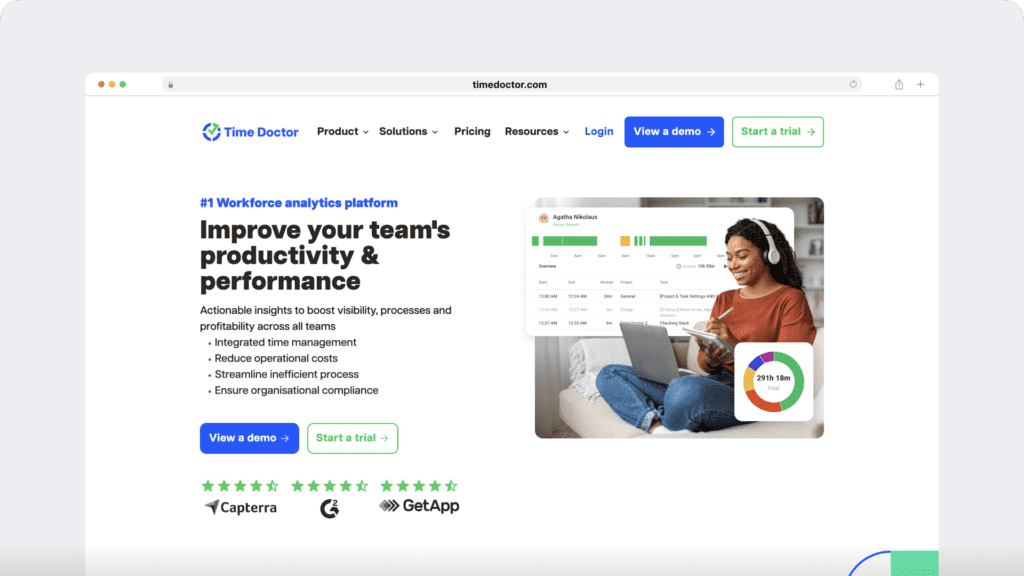
Its benchmarking capabilities are built on a workforce analytics platform that gives you clear visibility into how work actually happens, without micromanaging your teams.
Instead of monitoring individuals for control, you gain AI-enhanced insights that reveal patterns, fair comparisons, and opportunities for improvement. This visibility helps managers lead with trust, not control, while making smarter operational decisions.
Time Doctor transforms raw activity data into AI-enhanced workforce analytics that help you make smarter operational decisions.
1. Establish your baseline with time tracking
You set a clear starting point using Employee Time Tracking and Productivity Analytics. These features measure productive time, task completion, and project turnaround so you can ground your performance benchmarking in real work, not assumptions.
2. Compare fairly with Benchmarks AI
Instead of using generic industry averages, Benchmarks AI and Workforce Analytics compare your team with peers who share similar roles and work styles.
This ensures your benchmarking results are accurate and relevant, whether you run technology companies, agencies, or healthcare teams.
3. Spot risks early with activity insights
You don’t need to micromanage when the data shows you the risks. Tools like Unusual Activity Reports, privacy-friendly Screen Monitoring, and distraction alerts help you spot performance gaps early.
This way, you can step in before burnout or missed deadlines while still giving your team the freedom to work
4. Connect insights to outcomes
Time Doctor links visibility to impact. Features like Attendance,Payroll, and Integrations show how your benchmarks affect costs, schedules, and retention across remote, hybrid, and in-office teams.
With transparent pricing, you scale continuous improvement without creating extra complexity.
Common mistakes to avoid in benchmarking
A benchmarking process can backfire when you approach it the wrong way. These are the most common mistakes and why they matter:
- You treat benchmarks like a scoreboard, which creates pressure and frustration instead of improving your own processes.
- You rely only on direct competitors, which limits your view and blocks insights you could gain from other benchmarking partners, weakening your competitive edge.
- You skip the action plan, which leaves your benchmarking results sitting in a report with no real change because you fail to implement changes.
- You use benchmarking as surveillance, which damages trust and makes teams feel controlled instead of empowered.
But Time Doctor prevents these mistakes by giving you:
- Anonymized peer groups through Benchmarks AI, so benchmarking never turns into a scoreboard.
- AI-powered matching that goes beyond direct competitors, giving you insights that expand your view and strengthen your competitive edge.
- Automated reports that guide you to create an action plan, so your benchmarking results never sit idle.
- Privacy-first features like Unusual Activity Reports and optional Screen Monitoring, which give you visibility without micromanagement.
Final thoughts
The real risk in skipping a structured benchmarking process is not just missing numbers. It is missing the hidden story behind those numbers, where wasted hours pile up, where customer satisfaction slips, and where your top performers edge closer to burnout.
Time Doctor gives you the workforce analytics to see what others cannot. From Benchmarks AI to Productivity Analytics, you gain insight that helps you act with confidence across remote, hybrid, and in-office teams.
So what if the “strong performance” you see today is only an illusion, and without proper benchmarks, your business is already falling behind peers who measure smarter?
View a demo to see how Time Doctor turns benchmarking into a competitive advantage.
Frequently asked questions (FAQs)
Time Doctor tracks activity in real time, so the data you use in your benchmarking process is accurate and consistent. This eliminates errors that frequently occur when teams rely on manual timesheets or scattered reports.
Yes. Even if you manage a small team, Time Doctor benchmarks compare you to relevant peers matched by role and work style. This helps you see if your team is performing like larger or more established groups in your field.
Time Doctor updates benchmarks weekly, allowing you to spot changes quickly instead of waiting for quarterly or annual reviews. Regular updates keep your action plans relevant and responsive to real conditions.
Time Doctor integrates with project management, CRM, and communication platforms. This lets you see benchmarks across all tools in one place, so you understand how technology impacts performance.
Yes. By showing fair comparisons and trends, Time Doctor makes it easier to coach teams and celebrate wins. When employees see how their work compares to peers, they feel recognized and supported instead of monitored.
Time Doctor highlights where workloads are balanced or uneven. This helps you assign tasks more effectively, prevent bottlenecks, and ensure resources are being used where they create the most impact.
Absolutely. Time Doctor provides documented activity logs, attendance data, and productivity insights. These records can serve as reliable evidence for audits or compliance checks, adding another layer of value to your benchmarking process.
Companies conduct benchmarking analysis by selecting relevant performance metrics, gathering internal and external data, comparing results against peer benchmarks, and implementing improvements based on the insights. Workforce analytics platforms help automate this process by collecting activity data and highlighting performance gaps.
Workforce analytics works in the benchmarking process by collecting and analyzing data on how work actually happens across teams. Metrics such as productive time, workload distribution, and tool usage reveal patterns that help you compare performance with peer groups or industry benchmarks.
Platforms like Time Doctor transform this data into actionable insights through AI-powered benchmarking, allowing operations leaders to identify inefficiencies, balance workloads, and improve workflow efficiency.


Liam Martin is a serial entrepreneur, co-founder of Time Doctor, Staff.com, and the Running Remote Conference, and author of the Wall Street Journal bestseller, “Running Remote.” He advocates for remote work and helps businesses optimize their remote teams.