Quick overview
Employee work-life balance improves when leaders have clear visibility into how work is actually happening, not just what gets delivered. When workload, time allocation, and after-hours activity go unseen, imbalance builds quietly until burnout, disengagement, or turnover become unavoidable.
This article explains how workforce visibility gives you clarity across the workday, helping you measure work-life balance and protect sustainable performance before strain impacts your results.
How confident are you that your team’s employee work-life balance is truly healthy and not quietly drifting toward burnout or micromanagement?
Maybe performance still looks stable and deadlines continue to get met. However, work hours stretch, breaks disappear, and unused PTO signals a growing workload imbalance. Energy fades even while output appears steady.
Without clear operational visibility into time allocation and workload patterns, stress builds beneath the surface. In remote work and hybrid environments, blurred boundaries make the strain harder to detect, which puts long-term performance and retention at risk.
According to Gallup, “76% of employees experience burnout at least sometimes”. As more organizations adopt hybrid and flexible work arrangements following the pandemic, the structure of the workday continues to evolve.
In this environment, employee work-life balance becomes essential to performance, retention, and overall well-being.
But the real question is not whether work-life balance exists, but whether leadership has enough visibility inside the work environment to protect productivity, trust, and long-term performance.
Table of Contents
- What is employee work-life balance?
- The 4 pillars of work-life balance
- What are the consequences of poor work-life balance?
- Why does work-life balance break down despite strong performance?
- The measurable signals of unhealthy work-life balance
- How can Time Doctor support better work-life balance?
- Executive check: Is employee work-life balance truly sustainable?
- Final thoughts
- Frequently asked questions (FAQs)
What is employee work-life balance?
Employee work-life balance refers to how sustainably work responsibilities fit within employees’ personal time, health, and long-term capacity to perform.
As a leader, your responsibility is to ensure expectations, workload, and time boundaries support consistent productivity without eroding well-being.
Work-life balance does not mean reducing working hours. Instead, it means structuring work so employees can meet performance goals while maintaining space for rest, family, childcare, and personal commitments.
But did you know that one of the earliest attempts to define balance dates back to the 1800s?
The phrase“Eight hours labor, eight hours recreation, eight hours rest” was first popularized by Welsh social reformer Robert Owen. His 8-8-8 rule for work-life balance aimed to divide the day evenly between work hours, personal life, and recovery.
That framework created a simple structure for protecting time. However, modern workplaces rarely follow neat time blocks. Remote access, global collaboration, and flexible schedules blur the line between work hours and personal life.
The 8-8-8 rule focuses on dividing time evenly. But healthy work-life balance involves more than how hours are split. It also depends on mental, physical, social, and purpose-driven wellbeing.
Together, these dimensions form the four (4) pillars that sustain work-life balance and drive stronger employee engagement over time.
The 4 pillars of work-life balance
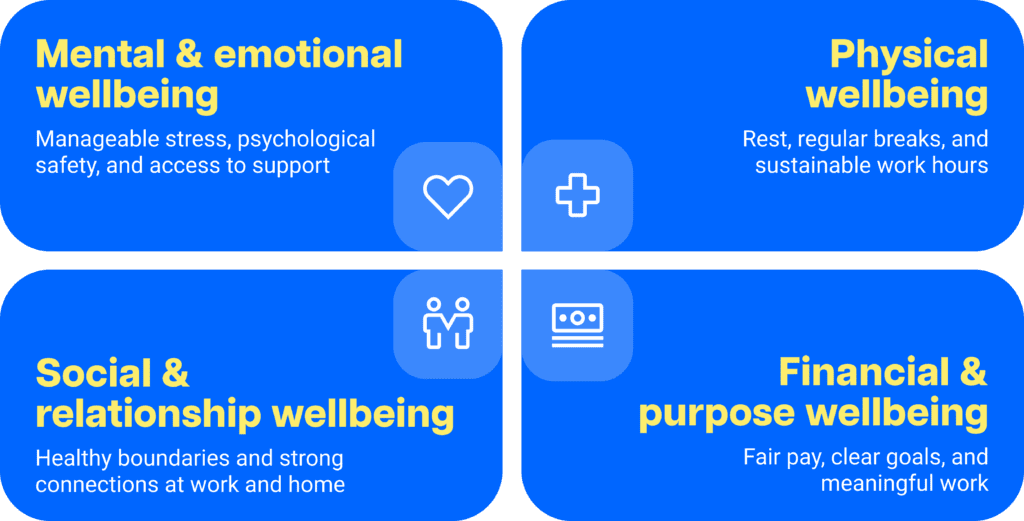
Employee work-life balance is supported by four connected pillars that shape overall wellbeing and sustainable workforce performance. These pillars also guide how effective wellness programs are designed and implemented to strengthen long-term employee health and engagement.
Pillar 1: Mental and emotional wellbeing
Psychological safety, manageable work stress levels, and access to mental health resources support healthy engagement. When pressure becomes constant, long-term performance declines.
Pillar 2: Physical wellbeing
Physical health relies on proper rest, consistent breaks, and sustainable work hours. Extended work hours and missed recovery time often signal deeper workload imbalance.
Pillar 3: Social and relationship wellbeing
Strong connections inside and outside work require clear boundaries and good stress management. When work spills into personal time, stress rises and teamwork loses energy.
Pillar 4: Financial and purpose wellbeing
Fair compensation and meaningful work tied to clear goals help employees feel secure and valued. Employee assistance programs and visible expectations strengthen motivation and retention.
What are the consequences of poor work-life balance?
Poor work-life balance affects both individual wellbeing and organisational performance.
As per WHO (World Health Organization) “Long work hours are linked to a 35% higher risk of stroke and a 17% higher risk of heart disease.”
Without good work-life balance, employees may feel constant fatigue, struggle to think clearly, and find it hard to focus. Over time, relationships weaken and overall life satisfaction begins to decline.
And beyond personal health effects, poor work-life balance directly impacts business performance.
1. Burnout and declining engagement
Chronic stress reduces focus, motivation, and discretionary effort. Employee performance may appear stable, yet engagement drops beneath the surface. Burnout increases absenteeism and weakens accountability in the workplace.
2. Retention risk
When workload remains uneven, high performers carry sustained pressure. Research shows burned-out employees are significantly more likely to actively search for a new job. Poor work-life balance directly affects employee retention factors and increases turnover risk.
3. Reduced productivity and performance sustainability
When people are exhausted, they make more mistakes, think less clearly, and work more slowly. A team might still hit short-term targets, but that pace cannot last. Activity may look high in reports, yet the actual quality and impact of work begin to fall.
4. Cultural strain and trust erosion
When long hours become normal, employees start believing that being constantly visible matters more than delivering real results. Work stretches into evenings and weekends, leaving little time to rest and recover. Over time, this pressure lowers morale and weakens trust across the team.
5. Operational inefficiency
Fatigue causes people to jump between tasks, attend too many meetings, and lose focused work time. Activity may increase, but meaningful progress slows down. Over time, this creates hidden operational inefficiencies that quietly reduce margins.
These consequences do not appear overnight. They build quietly while performance still looks strong.
That is what makes poor employee work-life balance difficult to recognize. Results continue. Deadlines are met. Yet pressure accumulates beneath steady output.
So what causes employee work-life balance to break down even when everything seems fine on the surface?
Why does work-life balance break down despite strong performance?
Work-life balance breaks down because most systems measure results, not strain. As long as targets are met, the hidden cost of delivering those results often goes unseen. Without real-time visibility into workload and time use, pressure builds quietly in the background.
It’s like driving a car while only watching the speedometer. Speed looks steady, so everything feels fine. However, the fuel gauge and engine temperature may already be warning of trouble. In the same way, productivity can remain high while capacity steadily declines.
When visibility focuses only on output instead of workload distribution and recovery time, imbalance becomes inevitable.
The gap between visible results and hidden strain only becomes clear once measurable patterns replace assumptions.
While employee feedback provides important context, it reflects how work feels. Workforce analytics shows how work actually flows. When both perspectives align, leadership decisions become more grounded, proactive, and balanced.
The measurable signals of unhealthy work-life balance
When work life balance begins to weaken, the first warning signs show up in everyday work patterns. The difference between reactive leadership and proactive leadership is simply knowing what to look for.
| Measurable Signal | What it reveals | Business risk | How workforce visibility helps |
| Extended work hours | Workload is growing quietly | Higher burnout and lower energy | Time tracking shows overtime and after-hours patterns clearly |
| Reduced recovery time | Breaks and rest are shrinking | Declining focus and decision quality | Activity data highlights long nonstop work sessions |
| Unused PTO patterns | Employees feel unable to step away | Increased turnover risk | Leave trends combined with workload data show capacity strain |
| Meeting overload | Deep work time is being squeezed | Reactive work and slower execution | Time allocation reports reveal meeting-heavy schedules |
| Fragmented focus time | Constant switching between tasks | Busy activity but lower impact | App and timeline data expose interruption patterns |
| Reactive task switching | Work driven by urgency, not priority | Rising stress and inefficiency | Workflow patterns show unplanned workload spikes |
| Work spilling into personal time | Boundaries are fading | Weakening work-life balance | After-hours activity makes boundary issues visible |
| Uneven workload distribution | Pressure concentrated on a few | High-performer burnout and disengagement | Workload dashboards surface imbalance across teams |
When these patterns become visible, leadership gains clarity rather than relying on guesswork. Workforce analytics shows how work is truly distributed, where pressure is building, and whether recovery time is shrinking.
Instead of waiting for burnout or turnover to appear, the imbalance can be corrected early.
That visibility changes the conversation. Performance is no longer judged only by output, but also by sustainability.
You can protect employee work-life balance while still driving results. Over time, this builds trust, improves accountability, and creates a healthier rhythm between work hours and personal life.
So, if workforce analytics can spot imbalance early, how do you turn that insight into daily action without adding complexity or control?
This is where Time Doctor helps teams move from visibility to sustainable performance.
How can Time Doctor support better work-life balance?
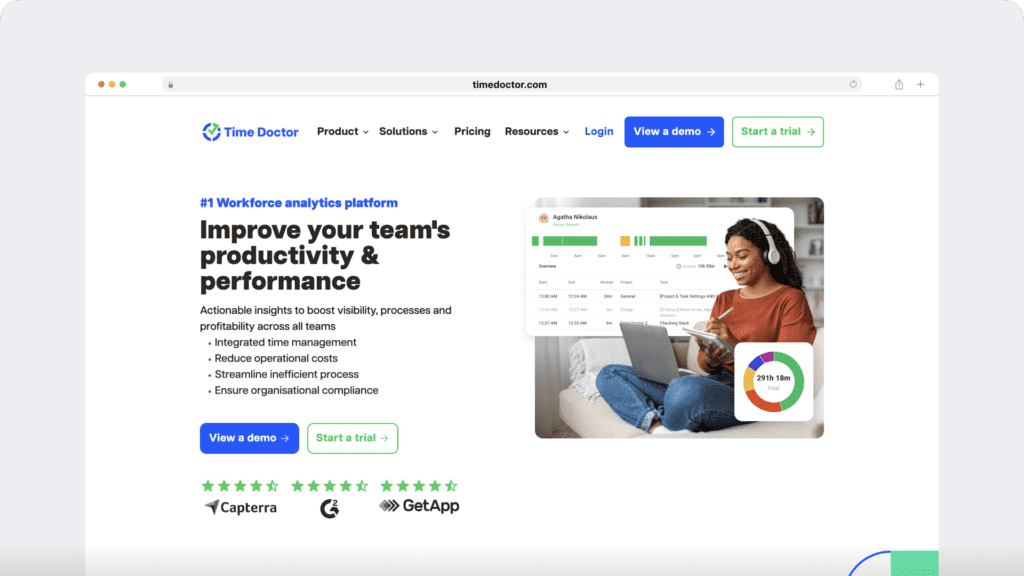
Better work-life balance does not happen through policies alone. It improves when you can see workload pressure early and adjust before strain becomes burnout.
Time Doctor is the workforce analytics platform that help you to lead with trust, not control. By turning daily work patterns into AI-enhanced, actionable insights, it makes productivity data transparent and accessible across remote, hybrid, and in-office teams.
That visibility will allow you to protect sustainable performance while supporting employee wellbeing.
Here’s how that visibility translates into healthier balance:
Make workload distribution visible
Workforce analytics and productivity analytics reveal how time allocation differs across roles and teams. When extended work hours or uneven workload distribution appear, responsibilities can be adjusted before burnout takes hold. Instead of guessing who feels overwhelmed, decisions rely on real operational visibility.
Protect recovery time and defined work hours
Employee time tracking and attendance data clarify how work hours are structured. When personal time begins absorbing overflow, early intervention restores boundaries. Payroll alignment reinforces realistic expectations and discourages silent overwork.
Reduce meeting overload and fragmented focus
Meeting insights expose excessive collaboration, idle meeting time, and disrupted deep work blocks. With that awareness, schedules can shift toward focused execution rather than constant availability.
Detect early strain before disengagement spreads
Unusual activity reports and real-time monitoring signals highlight after-hours patterns and irregular work behavior. Early visibility supports proactive coaching conversations and allows managers to check in at the right time, strengthening accountability without micromanagement.
Align effort with meaningful priorities
Project and task reporting connects time management to business outcomes. When productivity analytics show hours spent on low-impact activities, focus can shift toward higher-value work, reducing unnecessary pressure.
Set sustainable performance standards
Benchmarks AI compares productivity patterns across similar teams. This prevents unrealistic output expectations that often drive chronic overextension.
Reduce operational friction
Integrations and software cost insight eliminate redundant tools and manual reporting. Cleaner workflows reduce cognitive overload and simplify execution, especially across remote and hybrid work.

With this level of transparency, employee work-life balance becomes measurable. You gain the clarity to act early, sustain engagement, and build a workplace culture where productivity and wellbeing reinforce each other.
Across healthcare, BPOs, agencies, technology companies, and contact centers, the pressure points differ. However, the pattern is the same.
When workload distribution, time allocation, and recovery signals become visible, leadership can protect employee work-life balance without sacrificing accountability or performance.
Executive check: Is employee work-life balance truly sustainable?
Pause and evaluate your current system:
- Are extended work hours monitored and reviewed regularly?
- Is workload distribution transparent across teams and roles?
- Are recovery patterns, PTO (Paid Time Off) usage, and time allocation tracked consistently?
- Is meeting density balanced against protected deep work time?
- Are performance expectations tied to sustainable productivity rather than constant visibility?
If any of these areas lack clarity, employee work-life balance may already be weakening beneath stable performance metrics.
Final thoughts
Employee work-life balance is not about working less. It is about protecting your team’s ability to keep performing over time.
When pressure stays invisible, performance may look steady while strain quietly builds. By the time results drop, burnout is already present.
The shift happens when visibility replaces assumption. When workload and recovery patterns are clear, balance becomes manageable instead of reactive.
So consider whether your team’s productivity is truly sustainable or simply holding together.
If you’re ready to replace guesswork with structured visibility, View a Demo and see how Time Doctor helps protect performance while building healthier, more sustainable ways of working.
Frequently asked questions (FAQs)
The 8-8-8 rule divides a 24-hour day into three equal parts:
• 8 hours for work
• 8 hours for personal life
• 8 hours for rest
Originally introduced in the 1800s, the rule aimed to create a structured work schedule that protected recovery time and personal responsibilities.
In modern workspaces with flexible hours and hybrid arrangements, the 8-8-8 model serves as a simple reminder of the importance of work-life balance. This is especially relevant for millennials, who value autonomy and flexibility in how they structure their workweek.
However, maintaining balance today requires clear boundaries, realistic workloads, and visibility into how time is actually spent across the workweek. Time Doctor provide t
The importance of employee work-life balance goes beyond wellness perks. It directly affects job satisfaction, employee satisfaction, retention, and overall company culture.
When work schedules extend beyond healthy limits, burnout increases and engagement declines. Sustainable balance protects performance across the workweek while strengthening trust and long-term workforce stability.
Improving employee work-life balance requires more than flexible hours or surface-level initiatives.
Companies can:
• Monitor workload distribution
• Review extended work hours
• Track PTO and recovery patterns
• Reduce meeting overload
• Encourage setting boundaries within defined work schedules
When balance becomes measurable inside daily workspaces, it shifts from policy to structured execution. Time Doctor support this by providing real-time workforce visibility into workload patterns, ti
Warning signs include:
• Frequent extended work hours
• Unused PTO
• High meeting density
• Fragmented focus across the workweek
• Declining job satisfaction
These patterns often appear before burnout becomes visible. Monitoring operational signals inside the workday allows leadership to act early.
Workforce analytics is the structured analysis of how work is distributed, tracked, and performed across teams.
It examines workload distribution, work schedules, attendance patterns, productivity trends, and time allocation throughout the workweek. In the context of employee work-life balance, workforce analytics helps leaders detect extended work hours, protect setting boundaries, and strengthen company culture through visibility rather than assumption.
Workforce visibility reveals how work actually flows across teams and workspaces.
By reviewing workload distribution, time allocation, and flexible hours in real time, leaders can identify imbalance before it affects employee satisfaction or overall well-being. This allows initiatives to be proactive rather than reactive.
Time Doctor supports employee work-life balance by making workload patterns visible in real time.
It helps organizations:
• Identify extended work hours
• Monitor flexible work schedules
• Reduce meeting overload
• Support proactive check-ins
• Align performance expectations with sustainable output
By turning daily work patterns into actionable insights, Time Doctor helps protect job satisfaction, employee satisfaction, and overall well-being across remote, hybrid, and in-office workspaces.