Move Support remote team productivity with role-based metrics, real work data, and trend insights without micromanaging
Quick overview
Set fair benchmarks for remote teams’ productivity using role-based, context-aware metrics backed by real work data. In this article, you’ll learn how to focus on trends instead of snapshots, define flexible ranges, and use visibility to support remote workers, protect work-life balance, and avoid micromanaging.
It’s hard to define what “good” looks like in remote and hybrid teams. What seems productive doesn’t always lead to real results, and quieter work can still drive real impact.
Without clear metrics, managers rely on work hours, real-time activity, or check-ins. This creates inconsistent standards and makes fair evaluation difficult.
As a result, decisions become reactive, and signs of burnout are often missed until it’s too late.
This happens because traditional office benchmarks are based on in-person interactions, which don’t reflect how remote teams actually track progress.
Table of Contents
- Why do traditional productivity benchmarks fail in remote teams?
- What does “fair” productivity mean in remote teams?
- What are context-aware productivity benchmarks?
- A 4-step framework to set context-aware productivity benchmarks
- How to measure productivity without micromanaging
- What are the most common benchmarking mistakes HR teams should avoid?
- How do better productivity benchmarks improve engagement, not just performance?
- How can you turn benchmark data into actionable HR insights?
- How tools like Time Doctor support context-aware benchmarking
- Final thoughts
- Frequently asked questions (FAQs)
Why do traditional productivity benchmarks fail in remote teams?
Most remote work performance metrics are based on outdated assumptions:
- Hours worked = productivity
- Activity = performance
- Visibility = accountability
These might have worked in office settings, where face-to-face interaction was easier to observe. However, each work model operates differently.
In remote work environments:
- Deep work often looks like inactivity because it requires long, uninterrupted focus
- Meetings and constant notifications can inflate idle time, even when remote employees are actively engaged
- Thinking, planning, and problem-solving don’t always show up as visible activity
As a result, these metrics fail to reflect real output and contribution.
This leads to:
- Unfair evaluations, where high-impact work is undervalued
- Distrust across teams, as employees feel judged by the wrong signals
- Missed burnout signals, especially when long work hours are mistaken for productivity
And most importantly, this creates inconsistent standards across the team members and limited visibility into how work actually happens.
Without context-aware data, it becomes difficult to define performance clearly, support managers consistently, or make confident decisions across a distributed workforce.
Static vs context-aware productivity benchmarks
| Static benchmarks | Context-aware benchmarks |
| Same KPI for all roles | Adjusted based on role and work type |
| Focus on work hours and activity | Focus on output, patterns, and impact |
| Ignore workload and constraints | Account for meetings, tools, and workload |
| Measured in snapshots | Measured over time and trends |
| Encourage micromanagement | Enable coaching and early intervention |
| Lead to inconsistent evaluations | Standardize fairness across teams |
Benchmarks need to reflect role expectations, team norms, mentorship, and real work patterns.
To fix this, you first need to define what “fair” productivity actually means in a remote environment.
What does “fair” productivity mean in remote teams?
Fair productivity means evaluating performance based on context, including work schedules, to create consistent productivity benchmarks across teams.
In remote and flexible work environments, work looks different across roles, teams, and workflows.
A developer may spend hours in deep focus, while a support agent handles constant interactions—both shaped by company culture, yet equally productive in different ways.
To measure productivity fairly, you need to consider:
- Role type
Deep work, collaborative, and operational roles require different expectations - Workload distribution
Time spent in meetings, video calls, tools, or focused work affects output, especially for teams working across different time zones - Tool and process friction
Inefficient systems can reduce visible productivity without reflecting effort
This is where many benchmarks fail. They measure activity rather than impact, and presence rather than outcomes.
What are context-aware productivity benchmarks?
Context-aware productivity benchmarks are performance standards shaped by role expectations, team norms, and real work patterns.
Following the changes brought by the pandemic, this shift is also reflected in employee preferences. According to Gallup, “six in 10 employees with remote-capable jobs prefer hybrid work, while only a small percentage prefer fully on-site roles.”
Instead of measuring everyone against the same targets, they evaluate performance based on how work actually happens across work-from-home setups.
They don’t rely on in-person expectations.
What makes benchmarks “context-aware”?
They take into account three key factors:
1. Role expectations
Deep work roles, such as engineering or content, require long focus time. In contrast, reactive roles like support or sales depend on responsiveness and availability.
2. Team norms
Different teams operate differently. Some are meeting-heavy, while others are focused on independent work
3. Historical performance patterns
Benchmarks are based on actual work data over time, not assumptions or isolated snapshots.
Why static benchmarks create bias
When benchmarks ignore context, they often reward visibility instead of value.
- Employees doing deep, focused work may appear less productive
- Teams with high meeting loads may seem inefficient
- Long work hours can be mistaken for strong performance
Over time, this leads to unfair evaluations, inconsistent standards, and missed signals of burnout or disengagement.
A 4-step framework to set context-aware productivity benchmarks
To create fair and consistent benchmarks for remote team productivity, you need a structured approach. This framework helps you standardize performance across teams while still accounting for how different roles actually work.
Step 1: Segment roles by work type
Start by grouping roles by how work happens, not just by job titles.
Most roles fall into three categories:
- Deep work roles (engineering, writing, design)
Require long, uninterrupted focus time - Collaborative roles (sales, support, HR)
Depend on responsiveness and communication - Operational roles (admin, finance, BPO)
Follow structured, process-driven workflows
An engineer may spend 3–4 hours in uninterrupted focus with minimal visible activity, while a support agent may handle dozens of interactions in the same time.
Using the same productivity benchmark for both roles would misrepresent performance and lead to unfair evaluations.
This ensures you don’t apply the same expectations across fundamentally different types of work.
Step 2: Establish baselines using real work data
Next, define what “normal” looks like using actual work patterns.
Look at:
- Time allocation across tasks
- Work distribution (focus vs collaboration)
- Tool and apps usage patterns
- Time management patterns and key milestones over time
Instead of relying on assumptions, use workforce analytics data and insights from project management tools to understand how your teams actually work.
This is where visibility becomes critical. The right tools, such as Time Doctor, help automate the capture of real work patterns across teams, giving you a reliable baseline to build from.
This gives you a clear basis for deciding whether to hire, redistribute work, or improve processes, rather than relying on assumptions.

Step 3: Layer in context (workload, tools, constraints)
Raw data isn’t enough. You need to interpret it in the context of each team’s workspace.
Adjust benchmarks based on:
- Meeting load, video conferencing, and collaboration time
- Tool inefficiencies or process friction
- Time zone differences
- Workload spikes or seasonal demand
For example, a team spending 40% of their time in meetings should not be expected to produce the same output as a deep work team.
This is what makes benchmarks fair, not rigid.
Step 4: Define ranges, not fixed targets
Finally, avoid setting fixed KPIs.
Instead:
- Define performance ranges (e.g., 60–75% productive time)
- Allow variation across roles and teams
- Focus on trends over time, not daily snapshots
This approach:
- Reduces pressure and metric manipulation
- Encourages sustainable performance
- Gives managers flexibility while maintaining consistency
Once benchmarks are set, the next challenge is applying them without creating a culture of micromanagement.
How to measure productivity without micromanaging
Measuring productivity in remote and distributed teams often gets misunderstood. The goal is not to monitor every action, but to understand patterns and support better decisions.
This aligns with modern remote team management strategies that focus on trust and visibility instead of control.
The difference comes down to this:
Micromanagement focuses on control. Measurement focuses on clarity.
Shift from monitoring activity to understanding trends
Instead of focusing on:
- Hours worked
- Constant real-time activity
- Individual snapshots
Focus on:
- Patterns over time
- Team-level trends
- Changes in workload and output
This helps you create consistent, data-driven standards across teams instead of reacting to isolated behaviors.
Use aggregated insights, not constant individual tracking
You don’t need to watch every employee to understand performance.
Instead, use aggregated insights to support managers and create consistency across teams:
- Look at team-level data
- Identify patterns across roles
- Spot outliers that need support, not scrutiny
This approach helps build trust while still giving you the visibility you need to act early.
Turn visibility into early intervention, not control
The real value of productivity data lies not in measurement but in timing.
It helps you make better workforce decisions by:
- Detecting burnout before it escalates
- Identifying overloaded teams early
- Supporting managers with the right context
Time Doctor supports this by turning daily activity into actionable visibility, so you can guide decisions without relying on guesswork or constant oversight.
Focus on coaching, not enforcement
When benchmarks are used correctly, they:
- Guide conversations
- Support managers
- Improve consistency
They should never be used to:
- Penalize individuals
- Track every action
- Enforce rigid rules
This is how you maintain trust while still improving performance.
So, even with the right approach, benchmarks can still fail if they’re used incorrectly.
What are the most common benchmarking mistakes HR teams should avoid?
Even with the right intent, productivity benchmarks can easily create the opposite of what they’re meant to solve. Instead of improving clarity and fairness, they can lead to confusion, pressure, and distrust.
Here are the most common mistakes to watch out for.
1. Treating benchmarks as enforcement tools
Benchmarks should guide decisions, not control behavior.
When they’re used to enforce rigid rules or monitor individuals too closely, they create pressure, weaken team-building, and reduce trust across teams. Over time, this leads to disengagement rather than better performance.
Benchmarks work best when they support conversations, not compliance.
2. Applying the same metrics across all roles
Not all work looks the same, so benchmarks shouldn’t either.
Using a single standard across deep work, collaborative, and operational roles leads to unfair comparisons and inaccurate evaluations.
Role-based benchmarks are essential for fairness and consistency.
3. Over-prioritizing activity over impact
Focusing too much on work hours or real-time activity can create a false sense of productivity.
Employees may appear busy without delivering meaningful results, while high-impact work that requires focus or thinking time gets overlooked.
Productivity should be measured by patterns and outcomes, not just visible activity.
4. Ignoring context behind the data
Raw numbers don’t tell the full story.
Without accounting for factors such as workload, meeting load, tool limitations, and time zones, benchmarks can misrepresent performance and lead to poor decisions.
Context is what turns data into insight.
5. Failing to communicate how benchmarks are used
When employees don’t understand how benchmarks are applied, they assume the worst.
This can lead to resistance, anxiety, and a lack of trust in leadership.
Transparency helps teams see benchmarks as support, not surveillance.
When benchmarks are set and used correctly, they don’t just improve performance; they also strengthen engagement across teams.
How do better productivity benchmarks improve engagement, not just performance?
When productivity benchmarks reflect how work actually happens, they do more than measure output. They give you the visibility needed to support teams early, create consistency across managers, and strengthen camaraderie across teams while improving long-term outcomes.
Detect burnout before it escalates
Context-aware benchmarks make it easier to spot unhealthy patterns early.
Instead of relying on work hours or last-minute performance drops, you can see shifts in workload, focus time, and work patterns over time. This helps you step in before burnout affects performance or well-being.
Early visibility allows you to act before problems grow.
Enable more consistent manager coaching
When benchmarks are clearly defined and based on real work data, managers no longer rely solely on personal judgment.
They can:
- Set clear expectations
- Give more objective feedback
- Support team members with the right context
This creates consistency, improves one-on-one conversations, and reduces bias in how performance is managed.
Create fairer performance reviews
Without standardized benchmarks, performance reviews often vary from manager to manager.
With context-aware benchmarks:
- Evaluations are based on patterns, not opinions
- Different roles are assessed fairly
- High-impact work is properly recognized
This builds trust in how performance is measured across the organization.
Improve retention and workforce planning
Better benchmarks don’t just improve performance; they also boost productivity and stability.
You can:
- Identify overloaded teams before turnover increases
- Understand where capacity gaps exist
- Make more informed hiring decisions
This connects productivity directly to retention and remote workforce planning.
How can you turn benchmark data into actionable HR insights?
Collecting data is only the first step. The real value comes from how you use it to make better, faster decisions across your teams.
When benchmarks are grounded in real work patterns within your work environment, they give you clear signals on where to act.
Identify overloaded teams early
Benchmark data helps you see when teams are consistently working beyond healthy ranges.
Instead of waiting for burnout or declining performance, you can:
- Rebalance workloads
- Adjust expectations
- Support teams before issues escalate
Spot underutilized capacity
Not all productivity issues come from overload. Some teams may have capacity that isn’t fully used.
With the right visibility, you can:
- Redistribute work across teams
- Improve resource allocation
- Maximize productivity without adding headcount
Uncover workflow inefficiencies
Benchmarks also reveal how work flows across tools, processes, and asynchronous workflows.
You can identify:
- Streamline in workflows
- Time lost to unnecessary meetings
- Tool or process inefficiencies
Use insights to guide key HR decisions
When benchmark data is clear and contextual, it supports better decisions across the organization.
You can use it to:
- Make more informed hiring decisions
- Support managers with consistent data
- Improve processes across teams
This helps you make faster, more confident decisions about hiring, workload distribution, and process improvements.
How tools like Time Doctor support context-aware benchmarking
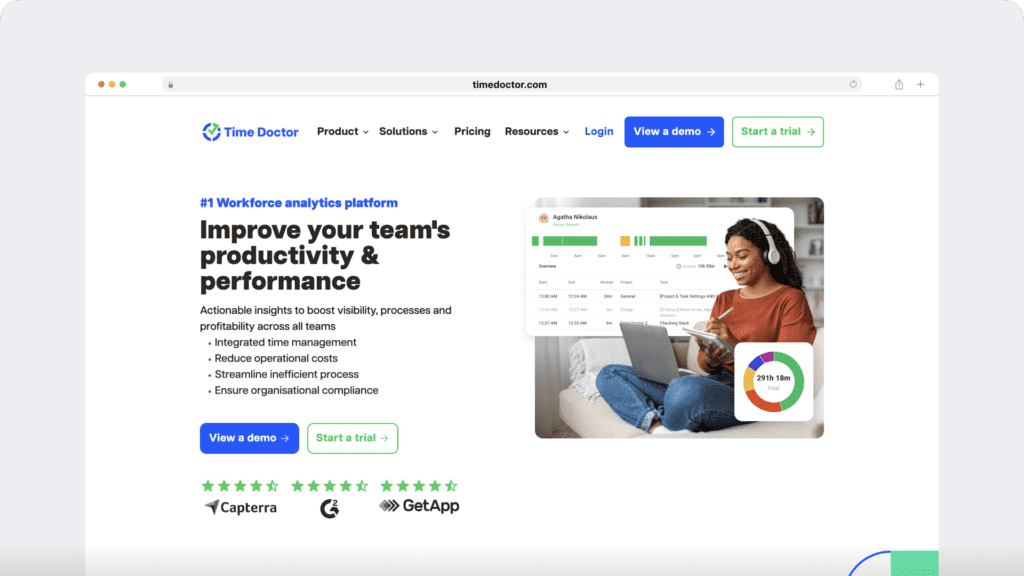
Setting benchmarks is one thing. Applying them consistently across teams is another.
To make this work at scale, you need visibility into how work actually happens across roles, tools, and workflows.
Time Doctor helps by:
- Turning daily activity into clear, actionable insights
- Showing how time is distributed across tasks and tools
- Helping you compare team performance using real benchmark data
This allows you to move from assumptions to data-driven decisions, while still maintaining trust and avoiding micromanagement.
Final thoughts
Fair productivity benchmarks don’t come from guesswork or rigid rules. They come from understanding how work really happens across roles, teams, and remote culture.
That’s why visibility matters.
Not the kind that watches every move, but the kind that helps you see what’s really going on and brings clarity when things feel uncertain.
With that kind of visibility, it’s easier to:
- Set consistent expectations across teams
- Support managers with the right context
- Catch issues early before they grow
This is where your role becomes critical.
Not to control how people work, but to create fairness, guide better decisions, and build a healthier, more sustainable way of working across every virtual team.
And when you have the right data, you’re no longer guessing. You can see how high-performing remote teams actually work, from productivity ranges to workload patterns and early signs of burnout, so you can make decisions with confidence.
Get real data on how top-performing remote teams work, including productivity ranges, workload patterns, and early indicators of burnout.

Frequently asked questions (FAQs)
A remote work system is the structure, tools, and processes that enable teams to work outside a traditional office. It typically includes communication tools like Slack, Zoom, and Microsoft Teams, as well as project management tools like Trello and Asana to manage tasks, collaboration, and workflows.
To measure productivity effectively, focus on output, trends, and context rather than just work hours or real-time activity. Use data from project management tools, collaboration tools, and time tracking platforms to understand how work actually happens across teams.
Improving productivity starts with clear expectations, better visibility, and the right tools. Teams benefit from a mix of asynchronous work, structured check-ins, and the use of communication tools like Slack and Microsoft Teams to stay aligned without disrupting focus.
Remote work can improve flexibility, but it can also blur boundaries between work and personal life. Without proper visibility and workload balance, employees may experience burnout. Context-aware benchmarks help support both performance and well-being.
Building a strong remote culture requires consistent communication, trust, and clear expectations. Teams often rely on collaboration tools, instant messaging, and regular one-on-one check-ins to stay connected, aligned, and engaged.
There’s no single “best” tool, but effective teams use a combination of tools based on their needs. For example:
• Slack and Microsoft Teams for communication
• Zoom for meetings and video calls
• Google Drive for file sharing
• Trello and Asana for task management
The key is choosing tools that support both collaboration and dee
It depends on the role. Deep work roles often prioritize uninterrupted focus, while collaborative roles rely more on communication and one-on-one check-ins. The balance between the two should be reflected in productivity benchmarks.
A remote workforce allows access to global talent, increased flexibility, and often improved productivity. It also enables teams to work across different time zones and adopt more asynchronous workflows.
Tools like Zoom, Microsoft Teams, and instant messaging platforms improve communication, but excessive meetings, messages, and notifications can reduce focus time. Productivity benchmarks should account for how these tools impact both collaboration and deep work.
Collaboration tools are platforms that help teams communicate, share information, and manage work. These include tools like Slack, Microsoft Teams, Zoom, Google Drive, Trello, and Asana. They play a key role in enabling visibility and coordination in remote environments.
Remote work can improve flexibility, but without clear boundaries, it can also blur the line between work and personal life. That’s why context-aware benchmarks are important to maintain balance and prevent burnout.


Carlo Borja is the Content Marketing Manager of Time Doctor, a workforce analytics software for distributed teams. He is a remote work advocate, a father and an avid coffee drinker.