Quick overview
Executives need visibility into team performance, but constant oversight often creates the very problems leaders are trying to prevent. Without the right performance framework, micromanagement becomes a substitute for operational clarity.
In this article, you’ll learn why executives default to micromanagement, how modern workforce visibility has changed in remote and hybrid environments, what strategic oversight should actually look like, and how productivity benchmarks and workforce analytics help leaders improve accountability, efficiency, and performance without hovering over teams.
Executives today face a difficult balancing act.
They need visibility into team performance, operational efficiency, and workforce health without creating a culture of constant oversight.
But in remote and hybrid environments, that visibility gap often pushes leaders toward micromanagement.
When executives lack clear operational signals, they often second-guess teams and rely on excessive check-ins to stay informed.
The problem is not that leaders want too much control.
It is that most organizations still lack a reliable framework for performance visibility.
Research published in Harry Chambers’ book *My Way or the Highway* found that 79% of employees have experienced over-controlling leadership, while 69% considered changing jobs because of it, increasing the risk of high employee turnover.
Many traditional signs of micromanagement are often treated like personality flaws instead of symptoms of poor visibility systems.
In reality, it is usually a visibility problem. Executives do not need to choose between being disconnected from performance and hovering over their teams. The right productivity benchmarks, workforce analytics, and executive dashboards create a third option: strategic visibility without micromanagement.
Table of contents
- What is micromanagement?
- The executive visibility problem: Why leaders default to oversight
- What “right-altitude” leadership actually looks like
- The performance framework that replaces micromanagement
- How to transition from oversight to strategic visibility
- How Time Doctor gives executives visibility without micromanaging
- Signs you’ve built the right system
- Final thoughts
- Frequently asked questions (FAQs)
What is micromanagement?
Micromanagement is a leadership style that happens when managers or executives become overly involved in employees’ work instead of focusing on broader operational visibility and strategic oversight.
In many organizations, micromanagement starts with good intentions. Leaders often want to maintain accountability, reduce mistakes, or stay informed about team performance.
However, excessive oversight can reduce autonomy, slow independent decision-making, weaken employee morale, and limit long-term professional development across teams.
Why do some leaders struggle to let go?
Micromanagement is rarely caused by a simple desire for control. More often, it comes from visibility gaps, leadership pressure, or uncertainty about team performance.
1. Fear of failure and accountability pressure
Many micromanagers believe mistakes reflect poorly on them rather than being part of the learning process. Leaders who fear failure often take an overly hands-on approach, trying to minimize risk by overseeing every detail, convinced that constant involvement is the only way to ensure success. Instead of trusting their team, they believe tight control is necessary to prevent errors.
2. Lack of trust in employees
Some managers struggle to believe that their employees can perform at the same level they would. This lack of trust leads to constant oversight, frequent check-ins, and excessive involvement in day-to-day tasks. Rather than empowering employees, these managers feel more comfortable staying in control, assuming that delegation will result in missed deadlines or poor-quality work.
3. Insecurity in leadership
Not all micromanagers intend to be controlling. Some lack experience or confidence in leading teams, so they compensate by being overly involved. They may feel that stepping back makes them seem disengaged or that their authority will be questioned if they are not actively managing every detail.
According to Harvard Business Review’s article “The Anxious Micromanager,” managers who struggle with insecurity often fall into micromanagement patterns because they lack confidence in their ability to lead through delegation. Instead of coaching and guiding employees, they insert themselves into daily operations to feel more in control.
The executive visibility problem: Why leaders default to oversight
Many executives today are trying to balance visibility with trust.
They want to understand how teams are performing without creating a culture of constant oversight. But as remote work, hybrid teams, and distributed operations continue evolving, that balance becomes harder to maintain.
Think of it like driving through heavy fog. You do not need to see every inch of the road, but you do need the right signals to avoid bigger problems ahead.
Most leaders already have access to more workforce data than ever before, yet many still struggle to identify burnout risks, declining productivity, or falling employee morale early enough. Yet it can still be difficult to spot burnout,workload imbalance, or productivity issues before they begin affecting performance and team morale.
That is where productivity benchmarks help.
Instead of focusing on every task, benchmarks help executives see the bigger picture:
- which teams are performing well
- where work may be slowing down
- and which issues may need attention early
Because strong leadership is not about watching everything.
It is about creating systems that build trust while improving visibility.
What “right-altitude” leadership actually looks like
Executive visibility should not feel like surveillance.
The goal of workforce performance dashboards is not to track every individual action from team members.
Instead, they help executives identify trends, workload shifts, operational risks, and performance patterns across teams.
High-performing organizations use executive dashboards as strategic decision-making tools, not employee scoreboards.
Strong executive dashboards help leaders answer questions like:
- Which teams are drifting below productivity benchmarks?
- Where is collaboration slowing execution?
- Which departments show early burnout risk?
- Are operational changes improving performance?
What signals should executives pay attention to?
| Dashboard signal | What it may reveal | Possible leadership response |
| Declining productive time | Workflow inefficiencies or overload | Review processes or staffing |
| Rising meeting hours | Collaboration bottlenecks | Reduce unnecessary meetings |
| Increasing after-hours activity | Burnout risk | Rebalance workloads |
| Sudden productivity dips | Temporary disruption or operational friction | Investigate team-level changes |
| Uneven workload distribution | Capacity imbalance | Reallocate resources |
Executives should focus on team trends while supporting direct reports and professional development.
For example, a temporary productivity dip after a product launch may be completely normal. But a sustained drop in productive time alongside rising meeting hours may indicate workflow friction or operational overload.
This is the difference between operational visibility and micromanagement.
Executives do not need to monitor individual activity when teams are empowered to make independent decisions. They need enough visibility to guide strategy, allocate resources effectively, and identify risks before they escalate.
The performance framework that replaces micromanagement
Executives do not need more status updates.
They need better performance signals.
The most effective productivity benchmarks help executives identify whether teams are operating efficiently, sustainably, and at the right capacity without relying on constant check-ins or operational micromanagement.
Instead of relying on isolated productivity numbers or gut feel, benchmark-led visibility helps leaders identify the root causes, operational risks, collaboration bottlenecks, and burnout trends earlier.
The goal is not to track every activity.
It is to gain the right level of visibility to make faster, more confident, and high-quality decisions.
| Metric | What it reveals | Possible leadership concern |
| Productive time trends | How focused teams are during work hours | Workflow inefficiencies or imbalance |
| Output-versus-capacity | Whether output depends on sustainable workloads | Burnout or understaffing |
| Collaboration load | How much time do teams spend coordinating work | Meeting overload or bottlenecks |
| AI adoption patterns | How effectively teams use AI tools | Operational lag or inefficiency |
| Work-life balance indicators | Whether workloads are sustainable long-term | Burnout and retention risk |
1. Productive time trends
Productive time measures how much work time is spent in applications and workflows classified as productive for a role or team.
This matters because productivity expectations vary dramatically across departments.
For example, finance teams often operate with highly structured workflows, while marketing and creative teams naturally spend more time collaborating, researching, experimenting, and shifting between tasks.
Without benchmark context, executives may mistakenly assume one team is underperforming simply because its workflows differ from another department.
A lower productivity time percentage does not automatically signal a problem. In many cases, it reflects the natural demands of the role.
2. Output-versus-capacity trends
One of the strongest indicators of organizational health is whether teams are sustaining output efficiently or compensating by working longer hours.
If output remains stable while working hours continue increasing over time, it may signal:
- operational inefficiencies
- understaffing
- workflow bottlenecks
- poor resource allocation
High performance should not depend on unsustainable workloads.
Executives who lead effectively focus on long-term operational efficiency, not simply whether employees appear busy throughout the day.
3. Collaboration load
Collaboration and strong teamwork are essential for remote and hybrid teams, but excessive collaboration can reduce focus time and execution quality.
Rising collaboration time paired with declining execution may signal:
- meeting overload
- slow approval processes
- communication bottlenecks
- workflow inefficiencies
The issue is usually not collaboration itself.
It is how work is being coordinated across teams.
4. AI adoption patterns
AI usage is quickly becoming one of the most important productivity indicators for executives.
Teams that adopt AI effectively often streamline repetitive work faster, reduce operational friction, and improve execution efficiency.
When one department significantly outperforms another while also adopting AI tools faster, it may reveal opportunities to automate repetitive tasks or improve workflows across the organization.
5. Work-life balance indicators
Healthy performance and strong job satisfaction depend on sustainable workloads.
Metrics like:
- after-hours activity
- workload consistency
- meeting load
- break patterns
- idle trends
can reveal burnout risks long before turnover or disengagement becomes visible.
In many cases, top-performing teams maintain high productivity by balancing focused work with structured recovery time rather than operating in constant overload.

Time Doctor Productivity Benchmarks helps leadership teams identify workload imbalance, collaboration bottlenecks, burnout risks, and operational inefficiencies without relying on constant check-ins or manual oversight.You can also explore how Time Doctor Workforce Analytics gives executives a real-time view of productivity trends across remote, hybrid, and distributed teams.
How to transition from oversight to strategic visibility
The shift away from micromanagement helps organizations create a healthier and more accountable work environment without reducing leadership visibility.
It means they rely on better systems for visibility.
Executives who lead effectively create structured review rhythms, clear performance expectations, and benchmark-driven dashboards that allow them to monitor operational health without disrupting day-to-day execution.
The goal is not constant oversight of employees’ work.
It is strategic visibility.
1. Set clear expectations
High-performing organizations operate best when executives trust employees’ abilities while still defining clear performance expectations. They need clarity on goals, priorities, and success metrics. Instead of focusing on how tasks should be done, outline what needs to be achieved. This gives employees room to problem-solve and take ownership without constant intervention.
2. Trust your team and provide autonomy
Micromanagers often find it challenging to step back because they worry that mistakes will reflect poorly on them. However, when employees aren’t given decision-making autonomy, they hesitate to take initiative. Instead of constantly overseeing their work, give your team the space to make decisions while checking in at key milestones to provide guidance when needed.
3. Focus on results rather than process
If you often find yourself fixating on minor details, take a step back and ask: Does this truly impact the outcome, or is it just a short-term concern? Successful teams thrive when leaders focus on results rather than rigid processes. Employees stay more engaged and productive when they can work in ways that align with their strengths rather than being forced into a one-size-fits-all approach.
4. Reduce unnecessary status updates
Frequent check-ins can sometimes feel overwhelming rather than supportive. Instead of constantly requesting updates, establish a structured reporting system, such as weekly check-ins or productivity analytics dashboards. This allows employees to share progress efficiently without unnecessary interruptions to their workflow.
5. Use productivity analytics instead of constant supervision
If you want to watch over your team’s every move, try workforce analytics tools that provide insights without disrupting workflow. Time tracking and performance data can help managers measure output without excessive oversight, allowing them to focus on strategic leadership rather than daily task monitoring.
6. Build a structured benchmark review cadence
High-performing organizations review workforce benchmarks consistently without turning leadership into constant supervision.
Weekly reviews help leaders identify:
- workload imbalance
- unusual productivity shifts
- collaboration overload
- operational friction
Monthly reviews help executives evaluate:
- burnout indicators
- productivity trends
- AI adoption patterns
- operational efficiency
Quarterly reviews support larger strategic decisions around:
- workforce planning
- resource allocation
- process improvements
- long-term operational performance
The goal is not to analyze every short-term fluctuation.
It is to identify meaningful trends before they become larger operational problems.
How Time Doctor gives executives visibility without micromanaging
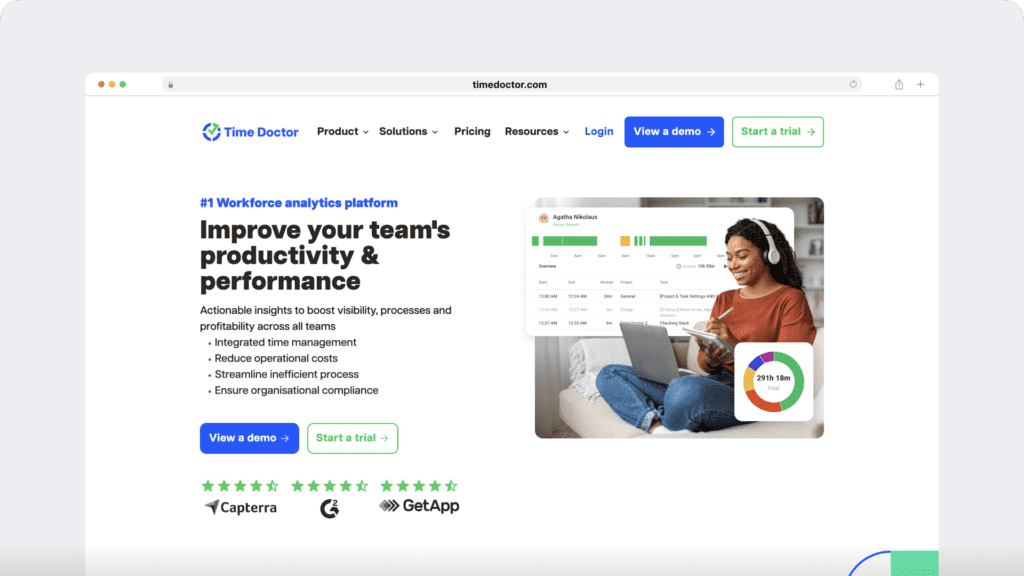
Executives need visibility into workforce performance without creating a culture of constant oversight.
That is where benchmark-driven workforce analytics become valuable for modern people management and performance visibility.
Instead of focusing on isolated employee activity, Time Doctor helps leadership teams identify larger operational patterns across:
- productive time
- collaboration trends
- workload balance
- burnout risks
- AI adoption
- workforce efficiency
Time Doctor’s executive dashboards and Benchmarks AI help leaders compare workforce performance against AI-matched peer groups using actual work behavior and software usage patterns.
This gives executives a clearer operational context without relying on assumptions, endless check-ins, or reactive management.
Rather than encouraging surveillance, the platform is designed to support transparent, data-informed leadership that helps organizations lead with trust, accountability, and operational clarity across remote, hybrid, and distributed teams.
Signs you’ve built the right system
Executives know they have replaced micromanagement with strategic visibility when they can answer critical operational questions without constant check-ins or reactive oversight.
Strong visibility systems allow leaders to identify:
- which teams are approaching capacity limits
- where collaboration is slowing execution
- which departments show early burnout signals
- whether operational changes are improving performance
- where additional support or human resources may be needed
Instead of relying on instinct or manual updates, leaders can use workforce benchmarks and dashboard trends to guide decisions proactively.
The goal is not to monitor every action.
It is to create enough operational clarity to lead confidently without getting pulled into day-to-day execution.
Final thoughts
Executives do not need more check-ins.
They need better visibility into how work is actually happening.
When leaders rely on constant oversight, trust erodes, employee well-being suffers, and operational risks become harder to identify early.
But when organizations build the right performance framework using benchmarks, workforce analytics, and operational visibility, leaders gain the confidence to guide performance without getting pulled into day-to-day execution.
The goal is not less accountability.
It is visible at the right altitude.
Explore how Time Doctor Productivity Benchmarks helps executives lead with clarity, trust, and data-backed decision-making across remote, hybrid, and distributed teams.
Frequently asked questions (FAQs)
Executives can avoid micromanaging by focusing on workforce trends, operational visibility, and productivity benchmarks instead of monitoring individual employee activity. Executive dashboards and workforce analytics help leaders identify workload imbalance, burnout risks, and performance shifts without relying on constant check-ins or excessive oversight.
Executive oversight focuses on team performance trends, operational visibility, and long-term performance management. Micromanagement is a leadership style that focuses too heavily on controlling employees’ work at a highly detailed level. Effective leaders use structured visibility systems to guide performance without disrupting execution.
Productivity benchmarks help executives understand what healthy and sustainable performance looks like across teams. These benchmarks provide context around workload balance, collaboration patterns, operational efficiency, and workforce performance trends.
Many executives micromanage with good intentions because they lack reliable visibility into performance, workload balance, and operational risks across distributed teams. Without clear operational signals, leaders often rely on excessive meetings, manual updates, and reactive oversight to stay informed.
Workforce analytics reduces micromanagement by helping leaders identify meaningful operational patterns without monitoring every individual activity. Executives can use dashboards, productivity trends, and benchmark data to make informed decisions while still giving teams autonomy.
Executives should focus on metrics like:
• productive time trends
• output-versus-capacity ratios
• collaboration load
• workload balance
• burnout indicators
• operational efficiency
These metrics provide better strategic visibility than simply measuring hours worked.
Executive dashboards help leaders identify operational bottlenecks, workload imbalance, collaboration overload, and performance risks earlier. This allows organizations to improve efficiency, allocate resources more effectively, and support teams proactively.
Productivity benchmarks help leaders identify signs of overload, such as increasing after-hours activity, excessive meetings, and workload imbalance. This gives executives earlier visibility into burnout risks before they affect retention, morale, or long-term performance.
Time Doctor combines workforce analytics, executive dashboards, and AI-powered productivity benchmarks to help leaders identify operational trends, workload risks, and performance patterns across remote, hybrid, and distributed teams. The platform is designed to support transparent, data-informed leadership rather than invasive employee surveillance.
A common example of micromanagement is when leaders require constant status updates, repeatedly check employees’ work, or become overly involved in day-to-day decisions that teams can handle independently. In executive environments, these behaviors often happen when leaders lack clear operational visibility into performance, workload balance, or productivity trends.
Micromanagement can reduce employee self-confidence by limiting autonomy, increasing dependency on approvals, and discouraging independent problem-solving. Over time, employees may become less willing to take initiative or make decisions without leadership involvement. Executives who rely on workforce analytics and productivity benchmarks instead of excessive oversight can improve accountability while still supporting autonomy and confidence across teams.


Liam Martin is a serial entrepreneur, co-founder of Time Doctor, Staff.com, and the Running Remote Conference, and author of the Wall Street Journal bestseller, “Running Remote.” He advocates for remote work and helps businesses optimize their remote teams.