
Quick overview
Location-based productivity data shows how productivity differs across office, remote, and hybrid setups. This includes the effect of long commutes on productivity and work-life balance.
This will give you a clearer view of where focus, collaboration, and output perform best in each work environment, without guessing about office vs remote work.
In this article, you’ll see how location-based productivity data works, why it matters, and how leaders use it to make smarter decisions about performance, fairness, and long-term planning.
Which actually performs better, office work or remote work?
It’s a question leaders face every day, yet the answer rarely fits into a simple yes-or-no.
If you’re leading a team today, you’re expected to have a clear answer. Yet productivity often shifts depending on roles, workflows, and the office environment your teams work in.
That makes decisions feel uncertain, especially when the stakes include performance, engagement, and long-term costs.
In the post-pandemic workplace, the hybrid work model has become the default for many organizations. As you plan for the future of work, the pressure to get these decisions right only increases.
Even so, many office vs remote work model decisions still rely on instinct, leadership preference, or incomplete signals. When that happens, decisions about productivity, engagement, payroll, and office space proceed without clear evidence of what works for your teams.
This uncertainty also shows up in broader workforce sentiment. According to Amply, “83% of respondents prefer a hybrid model that allows remote work at least 25% of the time, while only 17% of companies believe hybrid work improves productivity.”
That gap makes it difficult to know how performance truly compares across different work environments.
Table of Contents
- What is location-based productivity data?
- Why does location-based productivity data matter?
- 5 ways to use location-based productivity data
- Who benefits from location-based productivity data?
- Office vs remote work: Workforce analytics insights from Time Doctor
- Final thoughts
- Frequently asked questions (FAQs)
What is location-based productivity data?
Location-based productivity data is a form of workforce analytics that shows how performance changes depending on where people work.
Instead of looking only at tasks or work hours, it highlights patterns across three environments, which are in-office, remote, and hybrid days.
This lens helps leaders see how location shapes work habits like focus, collaboration, and overall output across a distributed workforce.
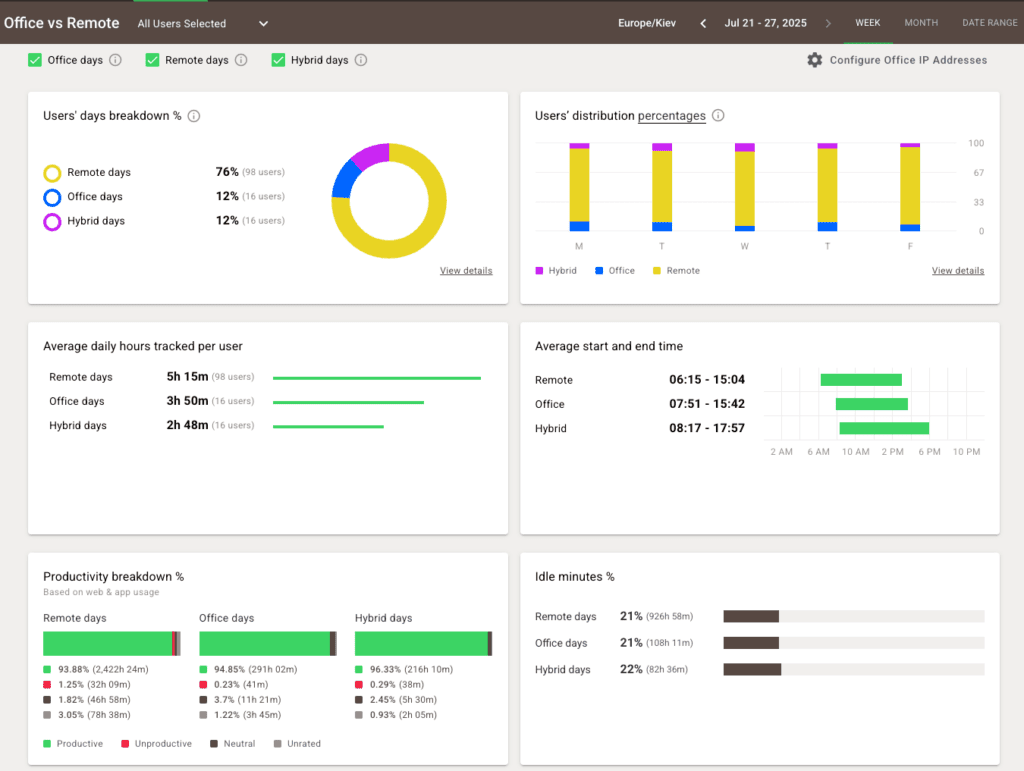
Time Doctor’s Office vs Remote report tracks metrics such as:
- Average daily hours
- Start and end time trends
- Productivity breakdowns (productive, neutral, and unproductive time)
- Idle minutes (when no activity is detected)
- Attendance patterns across office, remote, and hybrid days
- Location breakdowns (office, remote, or hybrid)
- Total hours by location
- User count by location
These insights go beyond simple timesheets. They connect workforce analytics with real behavior, especially when combined with integrations into payroll, project management, or HR systems. With this data, managers can set fairer expectations, design smarter schedules, and build hybrid models that work in practice.
Why does location-based productivity data matter?
Leaders face growing pressure to show whether hybrid and flexible work policies truly work. When decisions rely on trial and error, blind spots appear. Location-based productivity data brings clarity.
Here’s why it matters:
1. It confirms hybrid work productivity
Leaders can see if hybrid schedules actually improve focus and collaboration instead of relying on impressions.
2. It prevents unfair policies
Without data, office-based staff often get more visibility, creating proximity bias. Productivity insights give every team member a fair comparison, no matter where they work.
3. It reduces attrition risk
Employees are more engaged when policies feel fair and transparent. Clear data helps HR design schedules that balance workload and support retention.
4. It reveals missed efficiency opportunities
Data shows where time is lost and highlights chances to redirect effort toward higher-value tasks.
5. It strengthens compliance in key industries:
- Finance: Productivity analytics confirm whether hybrid schedules support compliance checks and client reporting.
- Healthcare: Insights show how admin and care teams perform across locations, helping reduce burnout while maintaining patient care.
- Banking and other regulated sectors: Location-based data shows if reporting standards and risk management goals are being met.
- General business: Leaders gain the confidence to shape policies that balance performance with employee trust.
6. It builds a foundation of trust with data
Accurate employee time tracking creates fair evaluations and consistent policies, strengthening confidence in leadership decisions.
7. It reduces IT and security risks
Privacy-friendly workforce analytics give IT leaders visibility into patterns while maintaining compliance and avoiding invasive monitoring.
8. It gives executives a clear view of performance
Executives can use location-based data to link productivity trends with payroll, workspaces, and long-term strategy, ensuring every decision is backed by clear evidence.
5 ways to use location-based productivity data
Here are five (5) practical ways leaders can turn location-based productivity data to guide hybrid work decisions.
1. Test return-to-office or remote-first models
Many organizations are asking if productivity differs between full-time office and remote work arrangements. Location-based productivity data helps answer that by showing:
- Clear comparisons before and after return-to-office mandates.
- Measured changes in focus hours, idle time, and overall output instead of relying on assumptions.
- Evidence for HR, Finance, and Operations leaders to confirm whether hybrid work productivity improves on-site work or if performance is stronger when teams remain remote.
2. Optimize hybrid schedules
Teams often struggle to agree on which days should be in-office. Location-based productivity data provides clarity by showing:
- Hybrid productivity trends that reveal when collaboration peaks and when focus time is strongest.
- For example, the data may show higher focus on remote days but stronger teamwork during in-person work and video conferencing midweek.
- Actionable insights that help leaders improve time management for remote teams and design hybrid schedules that truly support productivity.
3. Reduce proximity bias in performance reviews
Proximity bias happens when office-based staff receive more recognition than remote employees. Location-based productivity data helps solve this by providing:
- Workforce analytics that create objective comparisons between office and remote performance.
- Productivity insights that ensure evaluations are based on outcomes rather than visibility.
- Greater transparency that builds trust while keeping oversight focused on fairness instead of surveillance.
4. Identify environment-specific friction
Sometimes productivity dips are linked depend on where people are working. Location-based productivity data highlights these patterns through:
- Unusual activity reports indicate that idle time is spiking in the office due to meetings or distractions.
- Compliance visibility for remote teams, where certain apps or workflows may create challenges.
- Screen monitoring for compliance and productivity analytics that pinpoint issues and guide leaders toward targeted solutions.
- Practical support, like giving employees the tools or resources they need to overcome obstacles and stay productive.
5. Guide long-term physical space and resource planning
Deciding whether to downsize office space or invest in remote work tools is a major strategic decision. Location-based productivity data supports leaders by providing:
- Evidence-based insights that show how office vs remote policies impact results over time.
- Workforce analytics tracked across months or years to reveal long-term productivity trends.
- Clear connections between location-based data, employee productivity, and resource allocation.
- Strategic confidence for executives making cost and investment decisions that balance performance with financial efficiency and protect the bottom line

Who benefits from location-based productivity data?
The office vs remote debate often leaves organizations relying on assumptions about performance and access to a wider talent pool.
Location-based productivity data gives leaders a clear view of how work actually changes across environments, including when face-to-face interaction plays a meaningful role, making it easier to move from opinion to evidence.
These insights help people leaders understand how different work settings affect engagement, focus, well-being, and mental health, so hybrid policies support teams without increasing burnout.
Operations teams gain visibility into where time and effort break down across office and remote work, which makes it easier to improve workflows and maintain consistency.
At the same time, technology and compliance teams benefit from clear, privacy-conscious visibility into work patterns, ensuring policies align with security, regulatory needs, and company culture built on trust.
For executives, location-based productivity data connects performance trends with larger business decisions, including payroll, office space, and long-term planning. Instead of guessing which work model works best, leaders across the organization gain a shared, factual view of where teams perform at their best and how hybrid strategies can succeed.
Office vs remote work: Workforce analytics insights from Time Doctor
Time Doctor’s Office vs Remote report gives you precise, location-based productivity data, so you can understand how teams perform while preserving trust and autonomy. Combined with Time Doctor’s dashboards and productivity analytics, it shows where teams work best and why.
a. Automatic location detection
Office vs Remote identifies whether work is happening in-office, remote, or hybrid without relying on GPS or manual tagging. This keeps employee time tracking simple and accurate, while reducing friction for teams.
b. Productivity insights from existing data
The report builds on the workforce analytics Time Doctor already tracks, such as active minutes, idle time, and productivity percentages. Leaders immediately see how performance shifts across environments, with no extra setup.
c. Visibility that builds trust
The data is designed to provide visibility without micromanagement. Leaders can evaluate outcomes like focus hours and collaboration trends, rather than policing activity. This supports transparency and fair evaluations across office and remote staff.
d. Strategic workforce analytics
Executives and operations leaders use productivity trends to guide resource planning. As office and remote performance changes over time, they gain a clear view of payroll needs, office space use, and future investments.
e. Flexible access
Office vs Remote is included in the Time Doctor Premium plan and available as an add-on for Basic and Standard plans. This means organizations can access advanced workforce analytics at a straightforward pricing structure that scales with their needs, without overhauling existing workflows.
Final thoughts
So, which actually performs better for your teams, office work, or remote work?
The truth is, performance depends on the work itself and the environment in which it happens. Yet you are often expected to make office vs remote decisions without clear proof of where productivity, focus, and collaboration are strongest.
Time Doctor gives you that clarity. The Office vs Remote report shows how your teams actually perform across office and remote work using real work data, not assumptions. With this visibility, you can make confident decisions, lead with trust, and design policies that reflect how work really gets done.
The real question is this.
Are your office vs remote policies based on opinion, or on data you can stand behind?
View a demo to see how Time Doctor turns location-based productivity data into smarter, stronger hybrid work decisions.
Frequently asked questions (FAQs)
There is no single answer that works for every team. The best setup depends on the type of work, collaboration needs, and focus requirements. Location-based productivity data helps leaders compare actual performance across office, remote, and hybrid environments, enabling evidence-based decisions rather than assumptions.
Productivity varies based on role, workload, and environment. Some teams focus better remotely, while others benefit from in-person collaboration. Time Doctor’s productivity analytics show how focus time, idle minutes, and output shift across locations, giving leaders a clear view of where teams perform best.
Hybrid work combines office and remote days, but it only works well when work schedules match how teams actually perform. Location-based productivity data reveals which days support focus, collaboration, or deep work, allowing leaders to design hybrid policies that feel fair and effective.
Remote work remains a core part of modern operations, especially within hybrid models. Many organizations now rely on workforce analytics from tools like Time Doctor to evaluate performance across locations. This shift helps leaders focus less on where work happens and more on results and outcomes.
Many leaders associate in-office work with visibility, culture, and collaboration. However, these assumptions are not always backed by performance data. Location-based productivity data allows executives to test whether in-office time truly improves outcomes or whether teams perform just as well, or better, remotely.
Work has shifted from location-based expectations to performance-based decision-making. Teams now operate across offices, homes, and hybrid setups. Time Doctor supports this shift by turning everyday work activity into clear insights, helping organizations adapt policies with confidence.
Higher pay for in-office roles often reflects commuting costs, location-based expenses, or expectations around availability. Location-based productivity data helps leaders evaluate whether these differences align with actual performance, ensuring compensation and policies remain fair and grounded in real work outcomes.
The benefits of remote work often include increased focus, reduced commuting time, improved flexibility, better home life, and higher employee satisfaction. Location-based productivity data helps leaders validate these benefits with real performance insights, ensuring remote work supports both results and long-term engagement


Liam Martin is a serial entrepreneur, co-founder of Time Doctor, Staff.com, and the Running Remote Conference, and author of the Wall Street Journal bestseller, “Running Remote.” He advocates for remote work and helps businesses optimize their remote teams.