
Looking for the top TMetric alternatives?
TMetric is a productivity tool that helps you monitor employee activity at work and boost your team’s efficiency.
However, it isn’t the perfect solution.
For starters, TMetric has no distraction management features and only offers integrations with tools like QuickBooks and Jira in its highest pricing tier.
Why settle for that when you have other tools available on the market?
In this article, we’ll cover everything you should look for in a TMetric alternative. We’ll also highlight the seven best TMetric alternatives available today.
We’ll go through each tool’s key features, pricing plans and customer ratings to help you choose the right one.
Table of Contents
- Five things you should look for in a productivity tool
- The 7 best Tmetric alternatives
- 2. Toggl
- 3. Desktime
- 4. TimeCamp
- 5. Clockify
- 6. RescueTime
- 7. Hubstaff
Let’s get started.
Five things you should look for in a productivity tool
While TMetric is a useful tool to help you monitor your employees’ productivity, it’s far from perfect.
Luckily, there are tons of alternatives you can try out instead.
But how do you pick the right one out of the hundreds of tools available?
Don’t worry.
Just consider these five things before you invest in a productivity tool, and you’re guaranteed to pick the right one:
1. Accuracy and ease of use
What’s the most important factor to consider when choosing a productivity management tool?
Its accuracy.
Your productivity tool should be able to track your employees’ working hours with split-second accuracy. This way, you’ll know exactly what your employees are up to during work hours and how much time they actually dedicate to their work.
Additionally, the app should be simple enough for your employees to understand how to use it. A complicated app will only confuse your employees and they’ll be wasting valuable time figuring out how it works.
2. Distraction management features
From social media to e-commerce, your employees can get distracted easily.
However, while these distractions eat away valuable work time, they also disrupt your employees’ workflow. So whenever they do get back to work, they’re not productive until they fall back into the flow. This can lead them to taking hours to complete even the simplest tasks!
A good productivity management tool should contain features that help distracted users get back on track before they lose focus on their work.
Look for apps that display pop-ups when users access unproductive sites and have idle-timers that stop tracking time when the user has been inactive for some time.
3. Security and privacy
Do you know why many employees hate time tracking tools?
They feel that these software invade their privacy and monitor them even after work hours.
Everyone wants to safeguard their privacy — which is why you have to be careful over which tools you invest in. If a privacy breach occurs on your part, you could end up facing a lawsuit.
Always look for tools that give your employees some kind of control over what’s being tracked. They should also be able to start or stop the program whenever they want to.
Avoid tools like keyloggers, that are often seen as invasions of privacy. Using such tools also gives your employees the notion that you don’t trust them enough, which could demotivate them.
Go for employee-friendly productivity tools and always keep them in the know about what’s being tracked. That’ll help clear up any misunderstandings and minimize the risk of legal trouble.
4. Integrations with other productivity tools
If you want to make the best use of your productivity management tool, ensure that it integrates with the other tools you use at work.
Why?
Integrating a time tracking software with other project management, communication and billing tools can help streamline your workflows.
This saves your employees from manually entering data into your time tracker when they work on other apps. Once it’s integrated, everything will sync in real-time!
5. Reporting capabilities
You may have an accurate and employee-friendly productivity tool.
But if it doesn’t show you how productive your employees are, what’s the point?
Productivity reports show you everything you need to analyze your team’s work performance. Ideally, your productivity app should track things like:
- Employee attendance.
- Time spent on unproductive tasks.
- Which apps and sites employees access during work hours.
Additionally, it’ll be helpful if the software lets you export the reports in CSV or Excel formats so that you can share them with clients for billing purposes.
The 7 best Tmetric alternatives
Here are the best productivity management tools you can use instead of TMetric:
1. Time Doctor

Time Doctor is a workforce analytics platform that empowers managers with the visibility to lead with trust, not control. Mid-market companies and growing SMBs use it to gain real-time visibility into work, support employee well-being, and continuously improve productivity across remote, hybrid, and in-office teams.
With Time Doctor, you can:
- Track how long employees spend on tasks and projects with accurate, down-to-the-second time tracking
- Give managers clear, real-time visibility into work patterns without hovering or micromanaging
- Surface productivity, focus, and work-life balance trends to prevent burnout and capacity issues
- Generate audit-ready timesheets and automate payroll and client billing
- Empower employees with transparency into their own time data so they can self-manage and improve
Time Doctor also has a mobile app that supports on-the-go time tracking and productivity insights for Android devices.
Key features
Here are some features that make Time Doctor the best TMetric alternative:
A. Time tracking
Time Doctor is a workforce analytics platform that gives you flexible time tracking so employees can record their hours in a way that fits how they work. The platform captures work activity in real time and transforms it into clear visibility for teams, helping leaders understand how work happens while keeping the experience simple for employees.
In manual/interactive mode, employees simply open the app, select their current task, and start the timer. Time Doctor runs in the background and tracks the apps and websites used during work. When they’re finished or want to take a break, they can stop the timer with a single click.

In automatic mode, Time Doctor can start tracking time when employees turn on or log into their work devices. This mode helps improve accuracy and reduces the need for manual edits or forgotten time entries.
Both modes are designed to provide clear visibility for managers and employees while minimizing disruption to the workday.
B. Idle time tracking
Time Doctor measures idle time (periods without keyboard or mouse activity) to help teams understand focus patterns and potential productivity blockers.
- Idle time is measured in idle seconds and idle minutes
- You can configure when idle time should start counting and set limits that make sense for different roles
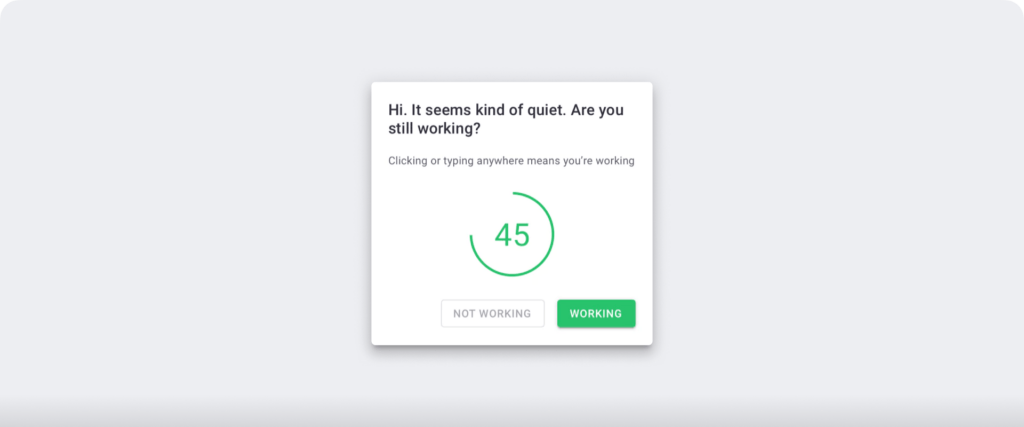
Instead of silently recording behavior, Time Doctor can display a gentle idle time pop-up when someone has been inactive for too long—nudging them to either refocus or take a break. This helps reduce unintentional time drift and supports more accurate timesheets.
This design helps organizations balance accountability with privacy and trust.Moreover, you can set how long the timer can run without any activity. Once it reaches the limit, the tracker automatically stops tracking time and displays an idle time pop-up. This pop-up alerts employees to focus on their tasks.
C. Productivity reports
Time Doctor tracks several data points related to employees activity. You can access a wide range of reports generated in real-time.
Here’s a quick look at these reports :
- Activity summary report: See active seconds, minutes, unproductive, manual, and mobile time for each employee over a selected time period.
- Attendance report: See if an employee is present, absent, partially absent, or late in real-time.
- Hours tracked report: View the total number of hours tracked by employees for any date range.
- Projects & tasks report: See the time spent on projects as well as individual tasks.
- Timeline report: Look at the time spent on tasks and breaks in a day or the whole week.
- Custom export report: Customize the fields you’d like to include in one single report.
- Web and app usage report: View the time spent by an employee on each app and website during work hours.

E. Chrome extension and integrations
Time Doctor’s powerful Chrome Extension integrates with 60+ tools that include project management, helpdesk, accounting software, and more.
For example, Time Doctor integrates easily with tools like Asana and Jira.
You can even add time tracking to tasks you’ve created on tools like ClickUp. As a result, you can help your team avoid wasting time and work more efficiently.

Check out the complete list of integrations here.
F. Benchmark AI
Benchmarks AI helps you understand your team’s performance by comparing their work patterns to similar roles and workflows across Time Doctor’s extensive behavior-based dataset.
- See how your team’s productivity, idle time, and tool usage compare to similar users across thousands of organizations.
- Identify whether shifts in productive time reflect healthy focus, rising workload pressure, or early signs of burnout.
- Spot unusual activity and changes in behavior before they affect performance or well-being.
- Give managers clearer context during coaching by showing where teams fall across percentile rankings and behavior groups.
- Make smarter decisions on resourcing, planning, and workload balancing using AI-matched comparisons instead of generic industry averages.

G. Meeting insight
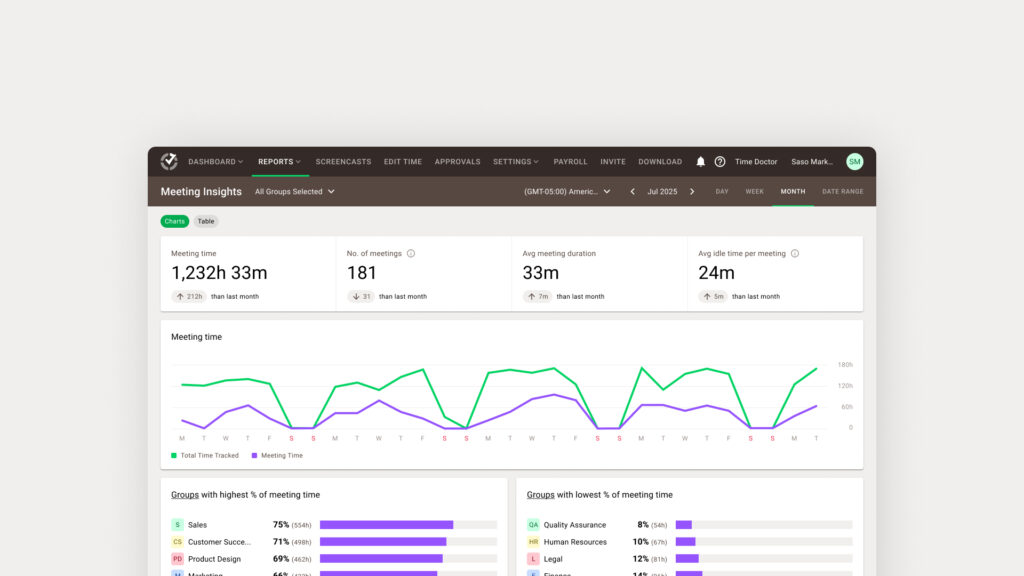
Meeting Insights helps you understand how meetings affect productivity, focus time, and engagement across your team.
- See total meeting hours, number of meetings, and which teams spend the highest or lowest percentage of their time in meetings.
- Measure meeting quality by tracking average duration, idle minutes per meeting, and idle time during meetings versus regular work hours.
- Identify low-value or ineffective meetings by spotting high idle time or unrelated app usage during calls.
- Compare meeting habits across groups to find overload, spot bottlenecks, or highlight teams that collaborate effectively.
- Decide which meetings to shorten, restructure, or move async using data instead of assumptions.
- Protect focus hours by understanding how recurring calls impact productive time and daily workflow.
- Support coaching and policy decisions with clear insights into meeting load, engagement patterns, and collaboration trends.
Pricing
Time Doctor has three affordable pricing plans, and you can quickly sign up for a 14-day free trial without a credit card.
Here’s an overview of the pricing plans:
- Premium: $20/user per month – includes “Standard” features + executive dashboard + client login access.
- Basic: $6.67/user per month – offers time tracking + task management + activity tracking + unlimited screenshots.
- Standard: $10/user per month – includes “Basic” features + integrations + payroll and invoicing.
User ratings
- G2: 4.4/5 (420+ reviews)
- Capterra: 4.5/5 (540+ reviews)
2. Toggl

Toggl is a cloud-based time tracking tool that allows users to track time online or offline. While it’s primarily web-based, it also has apps for iOS and Android devices. However, Toggl offers limited reports in its base pricing plan.
Key features
- Provides a one-click timer with tracking reminders.
- Integrates with project management software like Asana, Basecamp and Jira.
- Supports manual time entry and calendar integration.
- Can convert tracking data into reports.
- Great for small teams.
Pricing
Toggl has three pricing plans:
- Starter – $10/user per month
- Premium – $20/user per month
- Enterprise – Custom pricing
Customer ratings
- G2 – 4.5/5 (1000+ reviews)
- Capterra – 4.6/5 (1000+ reviews)
3. Desktime
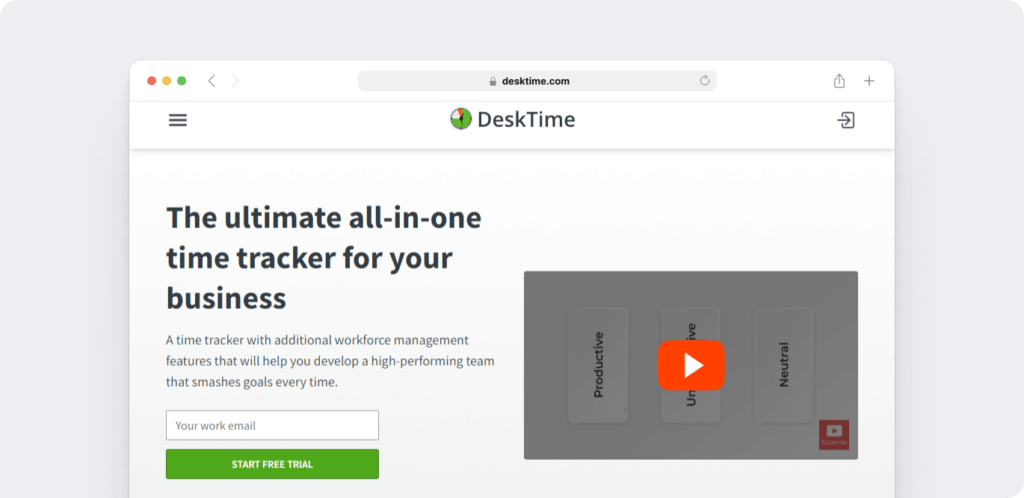
Desktime is a time-tracking tool focused on boosting employee productivity. While it’s great for businesses looking for an automated time tracker, it only has limited features in the free version.
Key features
- Automated time tracking.
- Supports website and app tracking.
- Automatic screenshots available.
- Supports offline and online time tracking.
- Integrates with task management apps like Asana and Zapier.
Pricing
Desktime has four pricing plans:
- Lite – Free
- Pro – $7/user per month
- Premium – $9/user per month
- Enterprise – $14/user per month
Customer ratings
- G2 – 4.6/5 (15 reviews)
- Capterra – 4.3/5 (100+ reviews)
4. TimeCamp
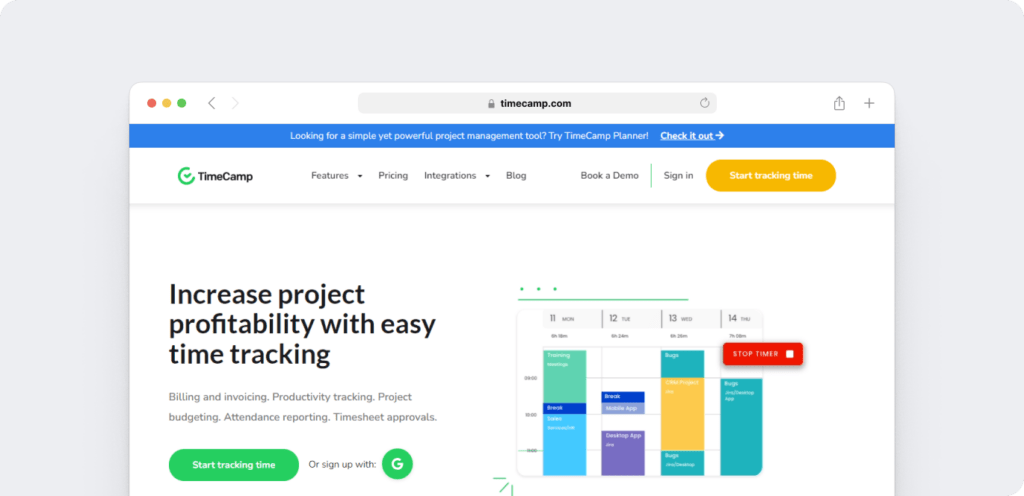
TimeCamp is a time tracking app that helps remote teams improve work efficiency and handle client invoicing.
Key features
- Can easily track billable hours.
- Offers a GPS location tracker for employees out in the field.
- Helps streamline billing with quick online invoicing.
- Provides attendance and time-off reports.
- Integrates with apps like Zoho, Wrike and Zendesk.
Pricing
TimeCamp has four pricing plans:
- Solo – Free
- Basic – $5.25/user per month
- Pro – $7.5/user per month
- Enterprise – Custom pricing
Customer ratings
- G2 – 4.7/5 (100+ reviews)
- Capterra – 4.7/5 (400+ reviews)
5. Clockify

Clockify is a time tracking solution that supports unlimited tracking and unlimited users in its free version. However, it doesn’t offer screenshot or other monitoring features as it goes against their policies.
Key features
- Simple, easy to use interface.
- Supports automatic time tracking and manual time entry
- Integrates with tools like Trello and Todoist.
- Provides detailed productivity reports.
- Can customize billing rates and control access based on job role.
Pricing
Clockify has four pricing plans:
- Free
- Plus – $9.99 per month flat fee
- Premium – $29.99 per month flat fee
- Enterprise – $9.99/user per month
Customer ratings
- G2 – 4.4/5 (64 reviews)
- Capterra – 4.7/5 (1000+ reviews)
6. RescueTime

RescueTime is a web and app monitoring tool that also offers time tracking and reporting features. However, RescueTime doesn’t provide any support for billing and invoicing activities.
Key features
- Supports automatic time tracking.
- Provides detailed reports and trends on employee productivity.
- Can block distracting websites during work and set daily limits on apps and sites.
- Integrates with hundreds of apps like Slack and Google Calendar.
- Helps set productivity goals to improve your time management.
Pricing
RescueTime has two pricing plans:
- Free
- Premium – $9/user per month
Customer ratings
- G2 – 4.1/5 (65 reviews)
- Capterra – 4.6/5 (100+ reviews)
7. Hubstaff

Hubstaff provides time tracking for distributed, hybrid, and field teams, with productivity metrics, GPS-based location features, and payroll capabilities.
Key features
- Offers simple time tracking.
- Online timesheets are available to record employee work hours.
- Supports URL, screenshot and app tracking.
- Helps locate employees with GPS tracking.
- Offers detailed reports with great stats and visualizations.
Pricing
Hubstaff offers four plans:
- Free: time tracking with limited screenshots.
- Starter: $4.99/month per user – limited screenshots + limited reports
- Grow: $7.50/month per user – includes Starter with 1 integrations + Project budgets
- Team: $10.00/month per user-includes Grow with unlimited screenshots+unlimited app & URL tracking
- Enterprise: $25.00/month per user – includes Premium with unlimited team members and priority support.
- Hubstaff also offers a 14-day free trial with no credit card required and a 30-day money-back guarantee.
Customer ratings
- G2 4.5/ 5 (1496+ reviews)
- Capterra – 4.6/ 5 (1580+ reviews)
Wrapping up
While TMetric is a good employee productivity monitoring solution, it’s not perfect.
So why not consider the TMetric alternatives we covered here to get the job done?
While each tool listed in this guide is good, Time Doctor is easily the best all-in-one time tracking tool for any large or small business.

