The first wave of remote work had a low bar. Companies went remote because a pandemic gave them no choice. Being remote at all was the differentiator.
The second wave is different. It is voluntary, which means it is competitive.
Companies now choose whether to offer remote flexibility. Which means the employees choosing to work for them have genuine alternatives. According to Buffer, 98% of workers want remote work at least some of the time. 46% would consider leaving if forced back to office full-time. The talent pool for distributed companies is exponentially larger than it was five years ago.
In that environment, remote-friendly is the floor. It is not the ceiling.
Nick Francis, Chairman of Help Scout, made this case at Running Remote 2026 with a framework that is immediately useful for any leader thinking about where their organizations actually stands.
Remote-friendly versus remote-excellent
The distinction Francis drew is precise, and it is worth sitting with.
Remote-friendly organizations treat remote as a policy, a document that says people can work from home. Remote-excellent organizations treat it as an operating model, every decision, every system, every process evaluated through the lens of distributed work.
Practically, this shows up in specific ways. Remote-friendly organizations default to synchronous meetings for decisions and communication. Remote-excellent organizations default to asynchronous work, with strong writing cultures and documentation practices that make meetings optional rather than obligatory. Remote-friendly organizations value presence, consciously or not. Remote-excellent organizations value outcomes, and have built the systems to understand what those outcomes actually look like.
Most organizations that consider themselves “remote-first” are, on examination, remote-friendly. The gap between the two is real, measurable, and directly linked to talent retention, team performance, and organizational resilience.
The Remote Excellence Audit
Francis introduced five dimensions his team has used to assess where organizations actually stand.
1. The company playbook.
GitLab’s public handbook, built over more than a decade, is the gold standard: a document so complete that anyone can understand how the company operates without ever working there. The test: can a new hire understand how decisions get made before their first meeting? Do cultural norms get reviewed and updated, or filed away and forgotten? Does work move forward without real-time communication?
2. Transparency.
Buffer exemplifies this through their Open hub, sharing analytics, metrics, goals, and salary information publicly. At Help Scout, every significant decision generates a decision record: who made it, who was involved, what context was considered, and the outcome. These records post automatically to a public Slack channel daily. Transparency is not a value. It is an infrastructure decision.
3. Healthy accountability.
Francis introduced the ARPA framework: Accountable (one person, owns the outcome), Responsible (one or two people for execution), Participants (everyone involved), Advisor (particularly important for CEOs, staying in an advisory role rather than unconsciously taking over decisions). Every spec, initiative, and strategy document at Help Scout begins with an ARPA. Feedback must be frequent, written, and normalized. Remote organizations make it structurally easier to avoid hard conversations, which is a risk that requires deliberate design.
4. Team connection.
Connection, Francis described, is rocket fuel, it makes everything move faster when trust is established. Help Scout has run more than fifteen all-hands retreats, with detailed public playbooks for each one. They institutionalized ‘fika’, a Swedish concept of coffee with a friend, using a Slack bot that randomly pairs employees monthly for non-work conversations. The principle for retreats: 60% connection and fun, 40% work. In-person onboarding radically accelerates new hire integration. These are not nice-to-haves. They are the infrastructure that makes distributed teams function at high performance over time.
5. Hiring for remote skills.
Remote excellence in hiring means testing for the actual capabilities remote work requires: strong writing, the ability to work without real-time supervision, comfort with ambiguity and async communication. Help Scout pays for project work during interviews. They require in-person onboarding for new employees. Their requirement for global hiring is four hours of time zone overlap between teammates, a concrete standard, not a preference.
For HR and people leaders, this changes what you develop managers to do. The valuable skills aren’t the traditional supervisory ones. They’re judgment calls: reading a situation accurately, deciding under uncertainty, giving a team clarity without controlling every step.
The use of AI effectively
Francis closed with something that connects the entire framework to a practical competitive advantage.
If decisions live in people’s heads or buried in Slack threads, AI will amplify the mess. Searching across unstructured chaos and returning incoherent results is not useful. But with three years of documented decisions, properly structured, in playbooks, decision records, and transparent communication channels, AI creates tangible impact on speed, onboarding, and organizational coherence.
What does AI actually save your team? Now you can measure it.
Time Doctor’s AI Impact Report gives managers visibility into AI adoption across groups, estimated time saved, and business value generated by role. You can see which tools your team uses most, how usage breaks down by task type (writing, research, code generation, and more), and whether prompt quality is improving over time.*
Explore the AI Impact Report →
*Available to Advanced Data Capture customers
The organizations that have been building remote excellence infrastructure are now the ones best positioned to use AI effectively. The investment in writing things down was never just about remote work. It was about building an organizations that can think and learn at scale.
This is the compounding return on remote excellence. The teams that did the work of building a genuine operating model, not just a remote policy, are now the ones for whom AI becomes a force multiplier rather than a noise amplifier.
Where to start
The Remote Excellence Audit gives leaders a practical diagnostic. The five dimensions (playbook, transparency, accountability, connection, hiring) can be assessed honestly without needing a consultant or a budget.
For most organizations, the playbook dimension is the most telling. If new hires cannot understand how work gets done before their first meeting, the organizations is leaking institutional knowledge every time someone leaves, every time a decision gets made without context, and every time AI searches the chaos and returns noise.
The second wave of remote work rewards organizations that have built for it deliberately. Remote-friendly got companies through the first wave. Remote-excellent is what wins the second.
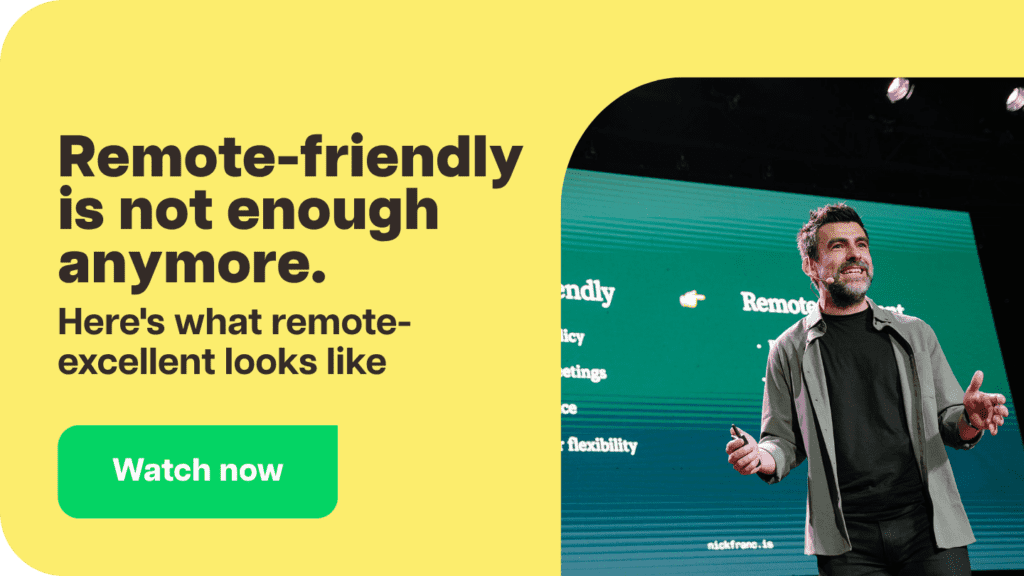
This blog post draws on the session “The Second Wave of Remote Work, and Who Wins It” at Running Remote 2026 in Austin, Texas. Speaker: Nick Francis, Chairman, Help Scout.