AI is absorbing the parts of your team’s work that used to prove someone was doing their job. If you manage a distributed team, that leaves a real question: what do you actually measure now, and how do you know it’s true?
The location debate is already settled. US remote work has held steady at around 27% of the workforce for three years running, according to figures Liam Martin, co-founder of Time Doctor, cited in his opening keynote at Running Remote 2026. That number isn’t declining or surging. It’s just where things landed. The harder question now is who’s doing the work, whether you can trust what they produce, and how you judge performance when raw output is nearly free to generate.
Remote work is stable. 27% of the US workforce has worked remotely for three consecutive years. Before COVID, it was 7%. It surged to 62% in 2020, then settled where it is now. It is not declining. It is not surging. It is a permanent feature of how knowledge work operates.
Who does the work?
Martin’s framing for the next decade is a shift from distributed people to distributed intelligence. Humans, AI, and AI agents are already working side by side on the same projects, in the same workflows. This is happening now, and it’s moving fast enough that three challenges remote leaders have circled for years can’t be put off any longer.
The manager’s job is changing
For decades, managing meant the same basic loop: gather people, assign tasks, track completion, check quality. Remote work already strained that model. AI is breaking it further.
Asana research puts the average knowledge worker’s day at 60% “work about work,” coordinating information, chasing status updates, communicating across tools instead of doing the work itself. AI is now doing a lot of that coordinating.
work.
That leaves managers who built their value on supervising this kind of activity with an urgent, practical problem. Martin’s answer is to stop supervising output and start designing the conditions for good decisions, building alignment, culture, and judgment instead of watching task completion.
For HR and people leaders, this changes what you develop managers to do. The valuable skills aren’t the traditional supervisory ones. They’re judgment calls: reading a situation accurately, deciding under uncertainty, giving a team clarity without controlling every step.
The trust gap: from visibility to verifiability
Remote work has always carried one trust question, whether someone is actually working. A second question is now just as urgent, whether they’re actually who they say they are.
In 2025, the FBI and DOJ raided more than a thousand companies after finding that remote workers at those organizations were North Korean operatives extracting information. That’s a documented, large scale risk.
Liam’s eframe moves the standard from visibility to verifiability: verify who someone is, what they produced, and whether you can trust it. That takes real infrastructure and process built around verification, not more monitoring tools.
For IT and ops leaders running distributed teams, this is a concrete shift in what to build. The tools that show someone is active are not the same tools that confirm the right person did verified work. Building the second is now a practical requirement.
The performance paradox
Martin’s own conference talk, slides and structure included, took 78 seconds to build with AI. He spent three weeks choosing the jacket he wore on stage.
When a full day’s output can be generated in under a minute, measuring performance by effort stops making sense. Long hours and visible busyness were never great proxies for value. Now they’re close to meaningless.
Martin’s proposed formula:
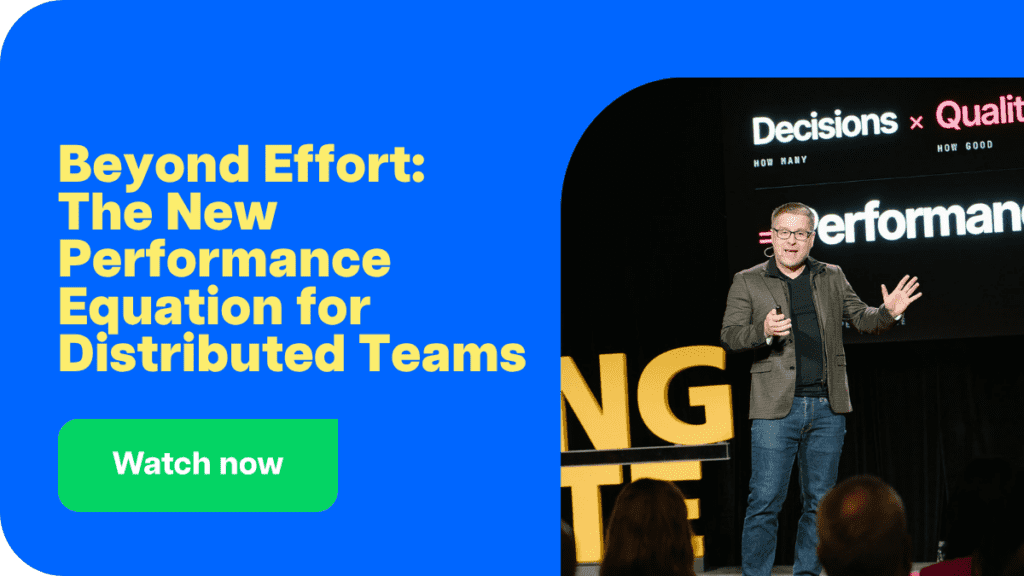
Decisions x quality ➗ time.
Decisions multiplied by quality, divided by time.
The number of decisions someone makes, how good those decisions are, and how quickly they make them. When production is nearly free, a person’s value comes down to judgment, how fast and how accurately they can read a situation, make a call, and own the outcome.
That has direct consequences for how distributed teams set expectations and review performance. If your reviews still lean on hours logged or volume produced, you’re measuring the wrong thing.
What this means for how you lead
The question underneath all three shifts is the one you started with, whether you actually know what’s happening on your team and can trust what you’re seeing.
Answering that well means understanding patterns, how work moves, where time actually goes, what output looks like across a distributed team. That kind of clarity is what lets you run performance conversations based on judgment instead of guesswork about effort.
It also surfaces problems earlier. When you can see real working patterns, you catch burnout before it turns into someone quitting, you catch bottlenecks before they become missed deadlines, and you make capacity decisions with actual information instead of a hunch.
Wave one settled location. Wave two is about performance, verification, and judgment, and it’s already underway. The teams that start building for it now will be the ones setting the pace for everyone else.
Liam Martin is co-founder of Time Doctor and Running Remote. This post draws on his opening keynote at Running Remote 2026 in Austin, Texas.