To save time and improve efficiency across your team, you might have tried implementing to-do list apps or project management tools.
As helpful as these platforms can be, many actually create problems like:
- Requiring staff to track tasks and projects manually
- Providing data but no actionable insights that you can use to improve
- Failing to integrate with your payroll and scheduling tech stack
With the right employee productivity tracker, you can understand how work happens, spot inefficiencies early, and help your team improve focus and performance.
Which platform is the best fit for your team? In this article, we’ll compare seven employee productivity tools to help you choose the right option for your workflow, reporting needs, and management style.
Table of Contents
- What to look for in a good employee productivity tracker
- Top 7 employee productivity tracking software
- 2. Hubstaff
- 3. ActivTrak
- 4. ClickTime
- 5. Toggl Track
- 6. Teramind
- 7. DeskTime
Let’s get rolling.
What to look for in a good employee productivity tracker
Productivity tools often include a lot of bells and whistles. Yet any platform you choose should have these essential elements:
1. Activity monitoring: Don’t rely on employees to input their tasks or hours manually. With automated activity tracking, you can gather productivity data and generate insights much more efficiently.
2. Project forecasting: Productivity platforms that integrate with project management tools can make scheduling and budgeting much easier. Look for an app that works with Asana, Trello, and other tools you already use—so you can complete projects on time and on budget.
3. Insightful reports: You need much more than a summary of how many hours your team worked or a list of who put in overtime. Make sure the tool you adopt includes insights that help you improve efficiency and identify top-performing employees and teams.
4. Employee-friendly tracking: In order for a productivity tool to work for your organization, you have to get your team on board. Look for an employee-friendly tool that gives staff some control over how and when they’re tracked—so they can maintain privacy when necessary.
5. Productivity alerts: Most productivity trackers are designed to help teams improve and level up. But any tool you choose should also be able to alert you to serious problems. Look for a platform that can warn you about employee burnout and overworked team members.
Top 7 employee productivity tracking software
With so many employee productivity tools available, which one should you choose?
Let’s answer that by looking at the seven best productivity tracking software that you can use today. We’ll start with our own, Time Doctor.
1. Time Doctor
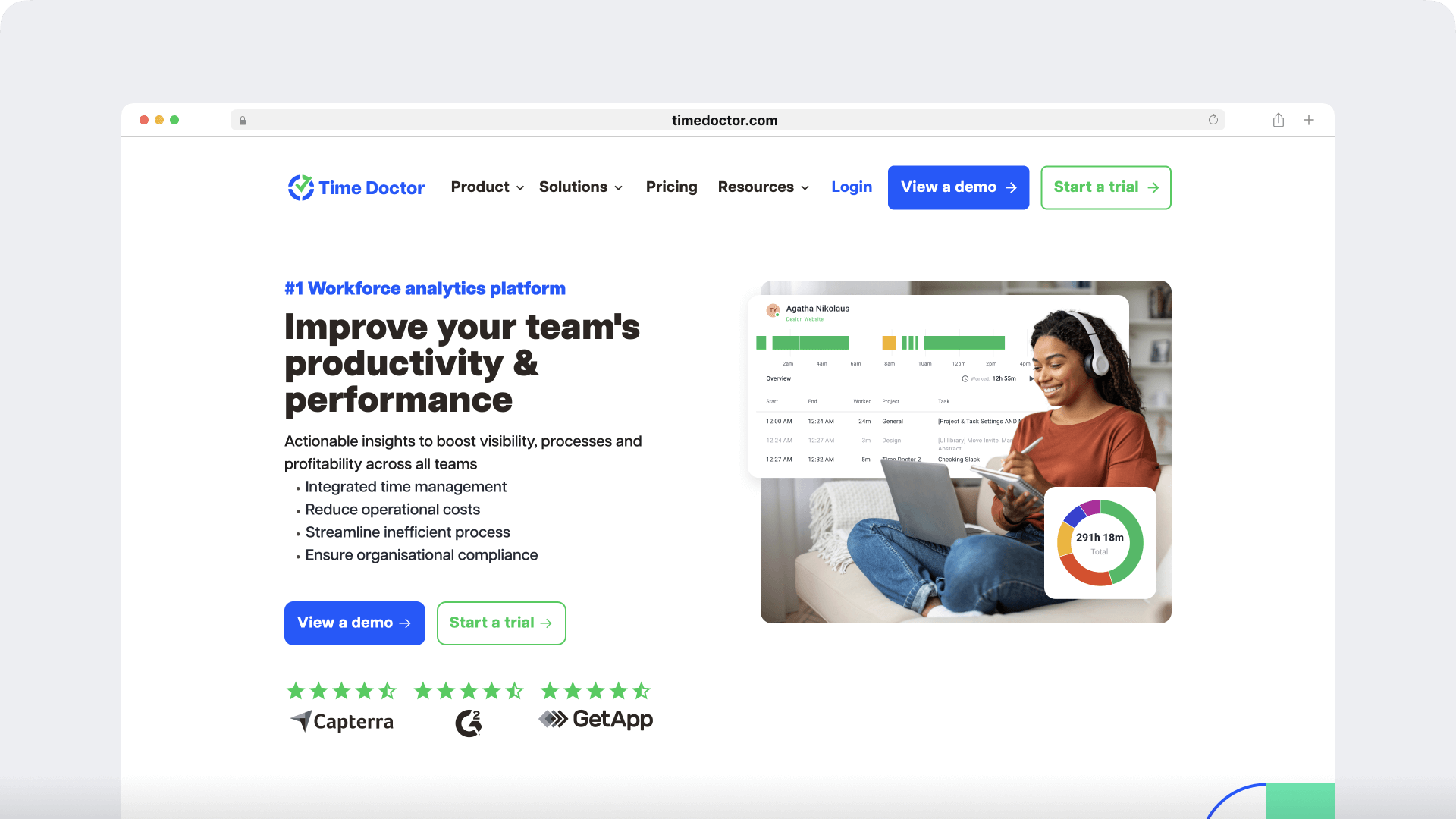
Time Doctor is a workforce analytics and productivity management platform used by freelancers, small businesses, and larger organizations that want clear visibility into how work gets done.
Time Doctor combines flexible time tracking, productivity insights, privacy controls, and a user-friendly interface to support both performance and employee trust.
Key features
Let’s have a closer look at some of the platform’s best features:
1. Interactive time tracking
Time Doctor gives teams a flexible way to manage time accurately.
Employees can track time manually by pressing the app’s start and stop buttons and selecting relevant tasks and projects. With this option, your team gets total control over when their time is tracked.

In addition, Time Doctor offers an option to automate time tracking. With this feature, employees don’t have to worry about starting the time tracker every time they start work or begin a new task.
In automated mode, Time Doctor tracks time and activity from the moment team members power up their devices for the day until they sign off.
2. Detailed reports
Time Doctor offers detailed productivity reports in a clear and intuitive interface.
The different productivity metrics that Time Doctor can auto-generate for you include:
- Timeline report: See the time employees spend on tasks and breaks.
- Projects and tasks report: Determine how much time employees take to complete tasks and projects.
- Hours tracked: See how many hours your employees have tracked time per day, week, or month.
- Activity summary report: Get real-time reports of any employee’s active time.
- Web and app report: Track the time team members spend on different applications and websites.

3. Productivity ratings
The sites and apps your employees need to use for work depend on their roles and projects. For some team members, an app may be essential for a task—but for others, it may be considered unproductive.
Most productivity software classifies social media sites and specific communication tools as unproductive for all employees.
However, that’s not the case with Time Doctor.
Time Doctor doesn’t automatically classify sites as productive or unproductive. Instead, it allows managers to choose whether they want to classify sites as:
- Productive
- Unproductive
- Neutral
- Unrated
Productivity reports of employees are generated based on these four unique productivity ratings.
This gives managers more relevant productivity insights because app and website ratings can reflect each team’s actual work.

4. Idle time tracking
With Time Doctor, you can track the idle time of your employees.
What’s idle time?
Idle time is a minute or second where there are no keyboard strokes or mouse movements detected on the employee’s computer.
Idle time tracking helps ensure inactive time is not counted as work and supports more accurate client billing.
Note: Time Doctor does not support keystroke logging. It only monitors whether some keys are pressed or not to protect user privacy.
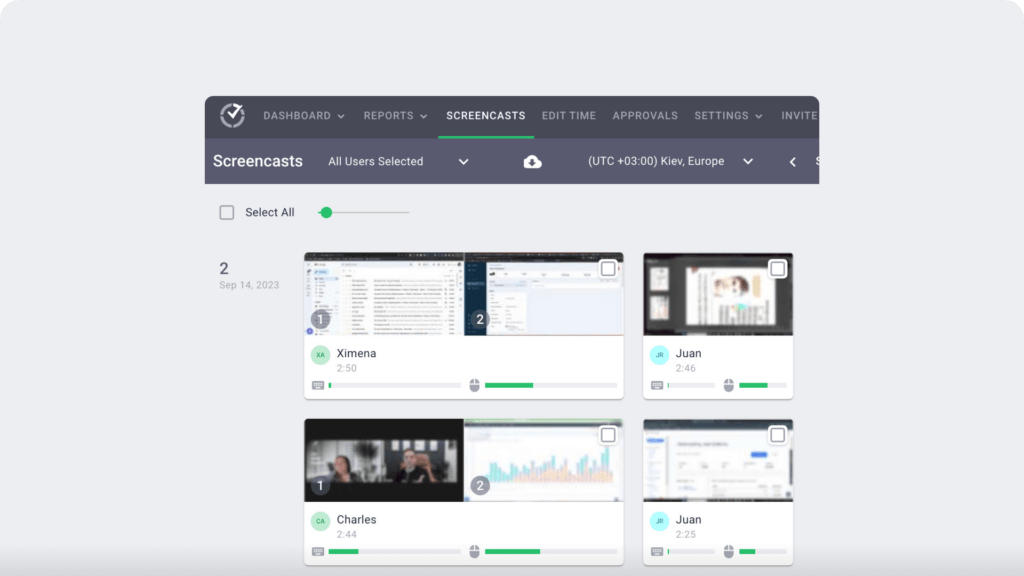
5. Screencasts
Time Doctor allows you to capture screenshots of your employees’ computer screens at random intervals.
This optional feature gives managers additional visibility while helping teams stay accountable during work hours.
Screencasts allow managers to:
- See and download the (selected) screencasts.
- Change the timezone.
- View screencasts with no/low user activity.
Productivity tracking technology
Time Doctor tracks the websites and mobile apps employees use during work hours and turns that activity into reports managers can act on.
A big part of the value comes from helping employees manage their time more effectively while giving leaders higher-level visibility into how work happens across the organization.
Additional features
- User-friendly interface for easy productivity tracking.
- Offers both manual and automatic employee time tracking modes.
- Track time without an internet connection.
- Create and assign projects across your team.
- Manage payroll and client billing from tracked time.
- Offers dozens of integrations across project management, payroll, and operational workflows.
- View website and app usage during work hours.
- Includes privacy and data security controls.
- Access responsive customer support.
- Use the mobile app on Android devices.
Pricing
Time Doctor gives you a 14-day free trial that doesn’t require any credit card info. Paid plans start as low as $6.67/user per month.
Customer ratings
- G2: 4.4/5 (320+ reviews)
- Capterra: 4.5/5 (490+ reviews)
2. Hubstaff

Hubstaff is another good option for tracking the productivity of your employees.
It offers employee productivity monitoring features like screenshots, reporting, and URL tracking.
Hubstaff includes features such as task management and geofencing, though its reporting is geared more toward activity visibility than deeper productivity analysis.
Key features
- Powerful geofence functionality for live location tracking.
- Easy generation of timesheets to bill clients or pay your team.
- Offers both online and offline activity monitoring.
- Optional screenshot feature as well as app and URL tracking to monitor remote work.
Productivity tracking technology
Hubstaff monitors the websites and apps your team uses while on the clock and provides productivity statistics to help the organization improve.
Pricing
Hubstaff’s free plan offers basic features like time tracking for a single user. Paid plans start from $5.83/user per month.
Customer ratings
- G2: 4.3/5 (415+ reviews)
- Capterra: 4.6/5 (1375+reviews)
3. ActivTrak

ActivTrak is a workforce analytics and employee monitoring platform designed to help teams understand productivity patterns.
It offers a workforce intelligence dashboard that gives powerful insights into your team’s performance.
Its focus is on dashboard-based visibility and productivity insights rather than visual dashboard customization.
Key features
- Compare productivity levels between individuals and groups.
- Know your top performer’s habits so that you can coach those patterns to other team members.
- Set automated caps on unproductive breaks.
- Business intelligence style dashboard to track performance.
- Experiment with goals, test strategies, review results to minimize time wastage.
Productivity tracking technology
ActivTrak automatically logs the websites and apps that remote employees use. The platform offers insights into productivity patterns and goal-setting, and it also supports integrations for broader reporting and visibility workflows.
This includes HRIS-connected visibility features that can bring approved time-off data into dashboards for a fuller view of availability and productivity.
Pricing
ActivTrak’s free plan offers limited visibility into activity and productivity for up to 3 users. Paid plans start at $10/user per month for a minimum of 5 users.
Customer ratings
- G2: 4.4/5 (200+ reviews)
- Capterra: 4.6/5 (540+ reviews)
4. ClickTime
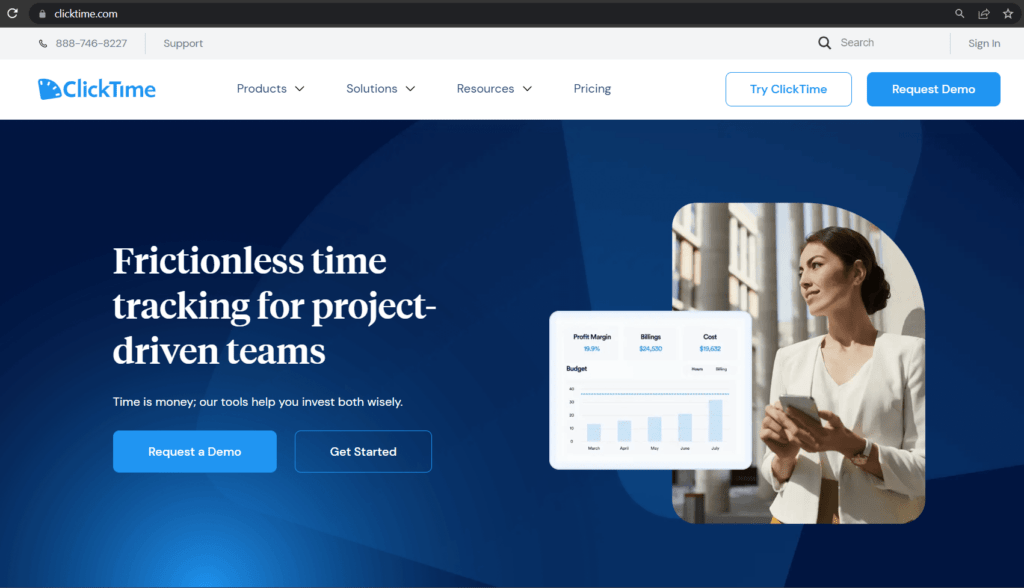
ClickTime is an employee productivity monitoring software that can help your team perform better while working on projects and tasks.
You can get insights on project progress, get project reports, the number of employees required on the project, billable hours, etc.
However, ClickTime does not give you options to copy, paste, edit, or add repetitive tasks.
Key features
- Intuitive and easy-to-use software.
- Offers insights into project budgets to reduce project costs.
- Gives 80+ reports on timesheet management, resource utilization, billable hours, etc.
- Detailed project reports to help analyze ROI (Return on Investment).
- Available on web, desktop, and mobile.
Productivity tracking technology
ClickTime lets you attribute hours worked to specific projects so you can ensure tasks are completed on time and on budget.
Pricing
All plans have a free 14-day-trial period. Paid plans start at $10/user per month.
Customer ratings
- G2: 4.6/5 (675+ reviews)
- Capterra: 4.6/5 (205+ reviews)
5. Toggl Track
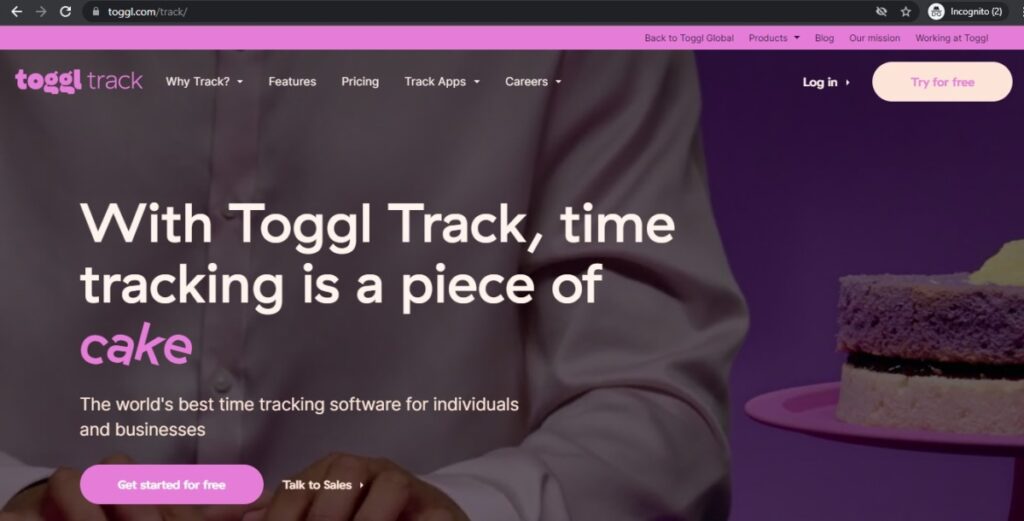
Toggl Track is another great productivity tracker for businesses of all sizes.
Available both as a web and mobile app, this time tracking tool offers real-time employee productivity tracking in an easy to use interface.
Unfortunately, Toggl doesn’t allow you to capture screenshots for advanced productivity tracking of remote teams. Additionally, the starter paid plan comes with minimal reporting functionality.
Key features
- Supports manual and automatic time tracking for effective time management.
- Detects and tracks idle time.
- Allows users to set a Pomodoro timer.
- Schedule alerts to notify you when projects go over their estimated time.
- Integrates with tools like Freshbooks, Asana, and Basecamp.
Productivity tracking technology
Toggl Track integrates with 100+ apps via browser extensions and a built-in calendar.
Pricing
Toggl Track offers a free plan with the basic features for teams of up to five members. Paid plans start at $9/user per month.
Customer ratings
- G2: 4.6/5 (1525+ reviews)
- Capterra: 4.7/5 (2150+ reviews)
6. Teramind

Teramind gives managers a strong employee monitoring space with advanced monitoring features and productivity reports.
However, the in-depth computer monitoring software features can be complex, and it can take a lot of time before you understand how they work.
Key features
- Intuitive UI and user-friendly dashboard.
- Video recording of all remote workforce actions.
- Built-in remote desktop control (RDP) and real-time alerts.
- Excellent privacy compliance and data security features.
- Data loss prevention features like fingerprinting, OCR (Optical Character Recognition), etc.
Productivity tracking technology
Teramind records work sessions on desktop, laptop, or mobile devices, providing behavior analytics to improve productivity.
Pricing
Teramind offers a 7-day free trial. Paid plans start at $10/user per month, for a minimum of five users.
Customer ratings
- G2: 4.5/5 (90+ reviews)
- Capterra: 4.7/5 (85+ reviews)
7. DeskTime

DeskTime is a popular employee tracking software that can help increase your team’s productivity.
It also offers a private time option for employees. When the option is enabled, employee behavior isn’t tracked – giving them the freedom to browse non work related websites during breaks.
However, Desktime only connects with a handful of third-party apps – so you might not be able to integrate it with your favorite work tools.
Key features
- Track time spent on different projects, desktop apps, and websites.
- Identify top performers and employees who are constantly underperforming.
- Manage employee scheduling and attendance tracking processes.
- Create accurate invoices based on the tracked time.
Productivity tracking technology
DeskTime offers automated URL and app tracking as well as periodic screenshots to monitor employee productivity.
Pricing
DeskTime is free for a single user. Paid plans start at $7/user per month.
Customer ratings
- G2: 4.6/5 (180+ reviews)
- Capterra: 4.5/5 (510+ reviews)
Benefits of an employee productivity tracking software
Employee productivity tracking offers several practical benefits. Let’s quickly go through a few of them:
1. Evaluates and improves the productivity of employees
With real-time reporting of employee performance, managers can:
- Track employee performance and know when they’re productive or unproductive.
- Build a better relationship with employees by understanding and interacting with them about improving their work skills.
- Give underperforming employees more training and assistance.
- Reward, recognize, and assign more responsibilities to highly productive employees.
With useful productivity management software in place, managers don’t have to be involved in every task. They can monitor employees without having to micro-manage tasks.
2. Improves employee engagement
When team members have visibility into their work patterns, they often become more aware of their performance.
Consequently, employees can also take proactive steps to improve their performance, such as:
- Blocking distractions.
- Reducing idle time.
- Taking frequent breaks to prevent burnout, etc.
When teams and managers share visibility into work hours and activity, accountability becomes clearer across the organization.
Improved focus on work means employees are more productive and engaged in the workplace.
3. Effective project management
The time tracking feature of productivity tracking apps will help you estimate the time taken on various tasks so you can finish the project before the deadline.
You can use this estimated timeline to proactively plan, schedule, organize, and prioritize tasks for efficient project management.
With productivity monitoring software, you can also track hidden tasks that are not directly related to the project, like client meetings, administrative tasks like scanning, uploading files, etc., and factor these to better estimate project timelines.
Activity data can also be reviewed later so managers can improve workflows, support performance, and focus more time on high-value work.
Time Doctor helps you turn productivity data into better decisions
Productivity tracking software helps you understand how work happens across your team.
The tools in this list can help improve visibility, support productivity, and strengthen day-to-day decision-making.
If you want a platform that combines time tracking, productivity insights, privacy controls, and connected workflows, Time Doctor is worth a closer look.
It gives you visibility into how employees use their time, helps you spot idle and active patterns, and provides reports you can use to improve productivity without micromanaging.
Get a demo to see how Time Doctor helps you improve productivity with clearer visibility, better reporting, and trust-first workforce analytics.

